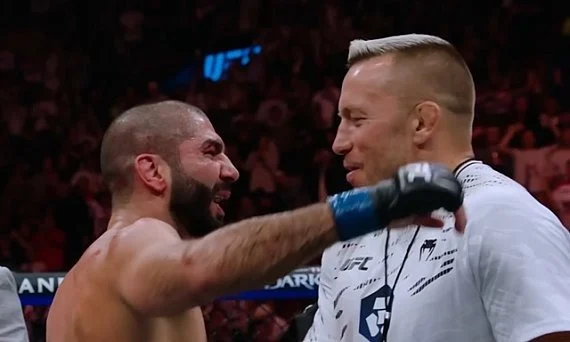
The rigorous pursuit of martial arts excellence often leaves little room for complacency, even immediately following the elation of victory or the bitter pill of defeat. For elite mixed martial artists operating out of the world-class gyms of Canada, the standard for greatness was set long ago by legendary former two-division Ultimate Fighting Championship titleholder Georges St-Pierre. Under the meticulous guidance of renowned head coach Firas Zahabi, St-Pierre carved out one of the most illustrious and dominant careers in the history of the sport, characterized not only by physical dominance and tactical brilliance, but by an unwavering commitment to continuous self-assessment and analytical film study.
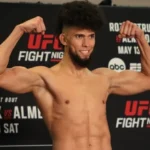
That exact cultural ethos—one that prioritizes harsh self-critique over celebratory revelry—lives on today through Firas’s brother, UFC bantamweight contender Aiemann Zahabi. Following in the foundational footsteps of "Rush," Aiemann has faithfully maintained a sacred post-fight tradition that bridges generations of elite Canadian mixed martial arts excellence. The practice, which involves retreating behind the curtain immediately after a grueling combat sports engagement to dissect every tactical error, misstep, and technical flaw alongside his coach and brother, remains a cornerstone of the Zahabi camp’s methodology, transcending the final verdict rendered by the judges or the referee inside the Octagon.
GSP’s Post-Fight Film Study is a Tradition for the Zahabi Brothers
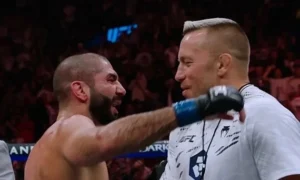
The enduring nature of this ritual was brought back into the public eye recently when a compelling historical clip resurfaced across social media platforms. The archival footage captured Georges St-Pierre walking backstage immediately following his successful defense of the coveted UFC welterweight championship against formidable rival Josh Koscheck back in 2010. Even after retaining his belt at the apex of the sport through a masterclass performance, St-Pierre did not bask in immediate adulation; instead, he sought out Firas Zahabi to immediately watch back the footage, seeking microscopic details to improve upon for his next defense.
Reflecting on the timelessness of this ritual, Aiemann Zahabi stepped forward to confirm that this exact post-fight film study remains an immutable part of his own career trajectory. Aiemann emphasized that the tradition holds firm regardless of whether his hand is raised in triumph or whether he suffers a setback under the bright lights of the Ultimate Fighting Championship.
"Firas and I have kept this alive, we go over my mistakes after each fight whether I won or lost!" Aiemann wrote in a public reaction to the resurfaced video, offering fans a rare glimpse into the psychological framework that separates standard professional athletes from championship-caliber martial artists.
The weight and history behind this tradition are deeply intertwined with the unprecedented legacy of Georges St-Pierre. Widely regarded as one of the greatest mixed martial artists to ever grace the sport, St-Pierre compiled a remarkable professional record of 26 wins against just 2 losses. During his dominant first stint in the Ultimate Fighting Championship, "Rush" successfully defended the welterweight championship an astonishing nine consecutive times against the absolute elite of his generation, establishing a benchmark of sustained excellence before voluntarily vacating the throne in 2013 to step away from the sport for a much-needed hiatus.
St-Pierre’s eventual return to the Octagon four years later in 2017 added an extraordinary final chapter to his storied career. Moving up a weight class, he challenged reigning middleweight champion Michael Bisping at UFC 217. In a dramatic and unforgettable performance, St-Pierre secured a submission victory to capture the middleweight title, joining an exclusive pantheon of fighters who have held championship gold in two different weight divisions simultaneously, before officially hanging up his gloves for good and cementing his status as an immortal of the sport. The meticulous preparation and relentless post-fight film study overseen by Firas Zahabi played an instrumental role in every single one of those historic victories, shaping a mindset of perpetual evolution.
For Aiemann Zahabi, the continuation of this exact post-fight tradition serves as both an anchor and a compass as he navigates the treacherous waters of the modern UFC bantamweight division. Carrying a professional record of 14 wins and 3 losses, Aiemann has proven himself to be a dangerous and formidable presence inside the Octagon. However, the path of an elite athlete is rarely a linear progression of unblemished victories, and the realities of mixed martial arts at the highest level demand absolute accountability when setbacks occur.
Aiemann enters the next chapter of his career looking to bounce back from a challenging performance, having recently suffered a knockout loss to elite bantamweight contender Sean O’Malley. That high-profile encounter, which took place at UFC Freedom 250 with the event headlined by Ilia Topuria versus Justin Gaethje, unfortunately snapped an impressive seven-fight winning streak for the Canadian competitor. The loss served as a stark reminder of the razor-thin margins at the elite level of the Ultimate Fighting Championship, where even the smallest defensive lapse against a lethal striker can alter the course of a contest in a matter of seconds.
Yet, it is precisely in the wake of such difficult setbacks that the time-tested tradition established by Firas Zahabi and Georges St-Pierre proves its true value. By refusing to shy away from the raw data of defeat—sitting side-by-side in the backstage shadows to watch the mistakes unfold on a screen—Aiemann and Firas continue a legacy of accountability. As Aiemann Zahabi looks toward the future and works to rebuild his momentum within the fiercely competitive 135-pound weight class, this unwavering dedication to honest technical appraisal ensures that the lessons of the past will directly inform the triumphs of tomorrow.