At 41 years old, LeBron James continues to rewrite the record books, recently etching his name even deeper into basketball lore by becoming the first player in NBA history to reach 16,000 field goals. Playing a crucial role for the Philadelphia 76ers, the four-time NBA champion is demonstrating week in and week out that biological age is little more than a number when paired with elite preparation, relentless drive, and a meticulous approach to physical maintenance. While his on-court achievements are well documented, a rare look behind the scenes into his training regimen reveals the sophisticated mobility, core, and reaction work that keeps the basketball icon performing at an elite level.
The blueprint for his enduring success was recently highlighted in a video shared by the NBA’s official Instagram account, capturing James deep into his preparation. The footage, posted just ahead of his regular-season debut for the Sixers, offered aspiring athletes and fans a glimpse into the unseen labor required to sustain a career at the absolute summit of professional sports. It is this rigorous behind-the-scenes dedication that has allowed James to embark on a record-extending 24th season in the league, maintaining a level of competitive hunger that rivals players half his age.
How Does LeBron James Train for Longevity, Core Strength, and Mobility?
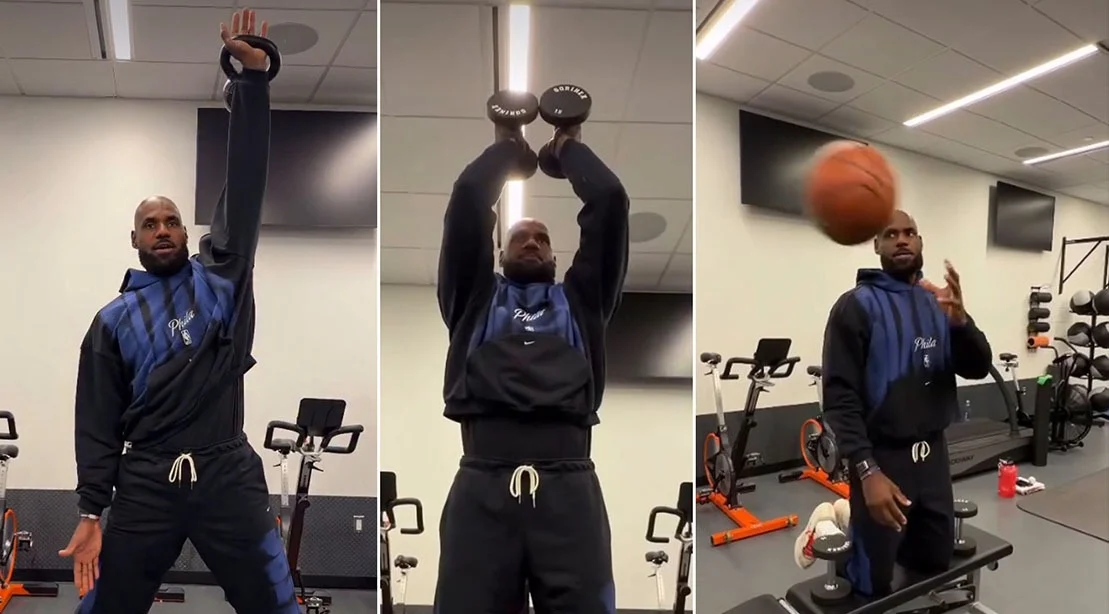
A closer examination of James’s training methods highlights a strong emphasis on joint health, stability, and functional strength rather than sheer power lifting alone. In the gym footage, James can be seen utilizing kettlebells to stretch his obliques and systematically strengthen his core, integrating movements that prioritize overall mobility alongside muscular endurance. This approach ensures that his joints remain supple and resilient despite the immense physical toll exacted by more than two decades of professional basketball.
Further demonstrating his focus on upper-body resilience, James incorporates complex dumbbell movements designed to maximize time under tension. Starting with a standard shoulder press, he modifies the movement by bringing the dumbbells together at the top of the press, followed by a slow, controlled descent into a downward elbow squeeze. This rotational arm movement serves as an exceptional tool for enhancing shoulder mobility while simultaneously targeting muscle groups that stabilize the upper torso. To compound the challenge, he finishes the sequence with a rear-delt fly, placing additional stress on his shoulders and chest to build structural integrity against injury.
Of course, training for basketball inevitably involves working directly with the basketball itself, and James’s gym sessions reflect a deep integration of cognitive and physical reaction drills. In one notable exercise captured in the training footage, James kneels on a bench while a partner rapidly throws the ball toward his side. This specific drill removes his lower body from the equation, requiring him to maintain strict balance on the bench while executing a fluid, single-handed catch and an immediate return pass in one swift motion.
Sports science research underscores the value of such methods, showing that when professional athletes train their reaction times away from the direct context of their chosen sport, their overall game benefits significantly from enhanced cognitive performance. For James, this translates directly to split-second decision-making and heightened spatial awareness on the court, contributing directly to his scoring efficiency and playmaking vision. For his lower body, his routine incorporates dumbbell-weighted squats alongside specialized drills engineered to build explosive power and improve his deceleration and stopping abilities—critical components for protecting his knees and ankles over the grind of an arduous NBA schedule.
With the Philadelphia 76ers currently holding a strong position at the top of the Western Conference, James appears just as determined as he was during his earliest championship runs. Addressing reporters prior to the start of the campaign, the veteran superstar firmly dismissed any lingering retirement chatter while making his intentions crystal clear.
"I didn’t leave my family in Los Angeles to lose in the second round. I know that for sure," James remarked ahead of the season. "Work needs to be done and I’m ready to get to work."