

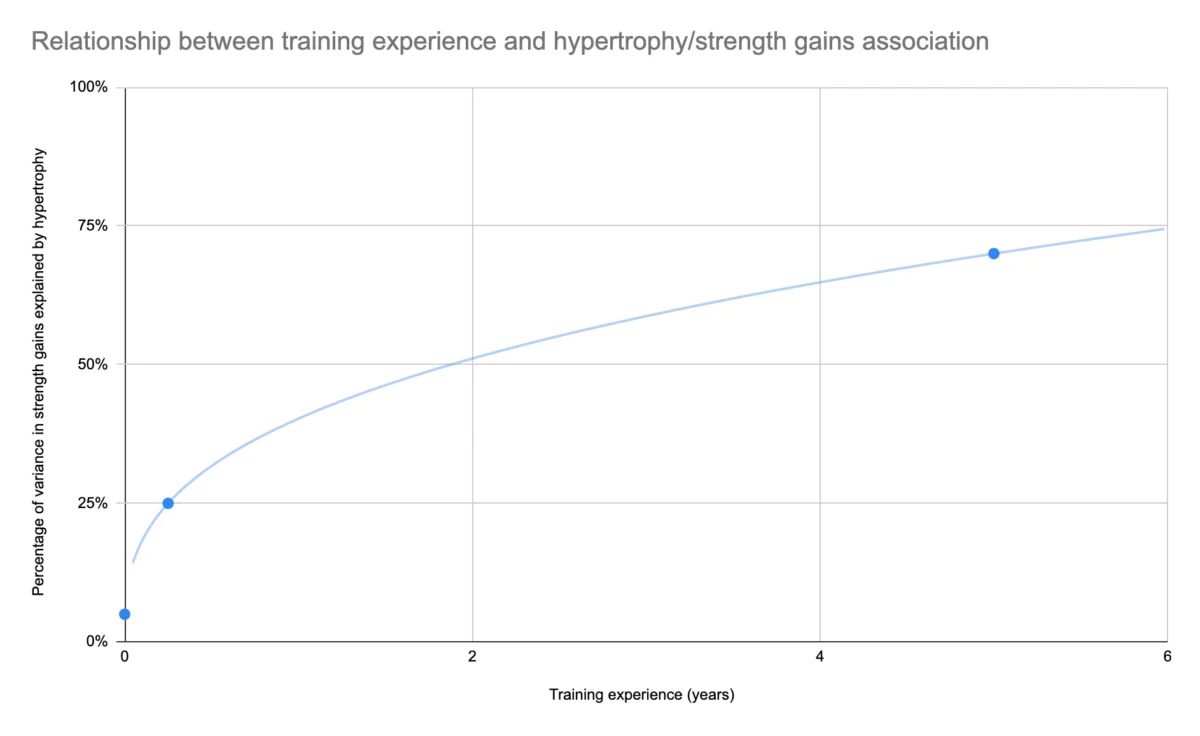
For years, exercise science researchers have investigated the complex relationship between muscle hypertrophy and strength gains, painting a picture that has remained relatively consistent. In studies involving untrained subjects, the relationship between growing larger muscles and getting stronger has traditionally appeared quite weak. However, as individuals accumulate training experience and move along the spectrum toward becoming well-trained, this relationship grows progressively stronger, with previous research indicating that well-trained subjects can see R-squared values near 0.7, meaning hypertrophy explains roughly 70 percent of the variance in strength gains.

This intuitive relationship makes logical sense from a physiological standpoint. Early strength gains are heavily driven by improvements in technique, motor learning, and neurological efficiency. In studies on untrained lifters, researchers frequently observe modest increases in muscle size alongside substantial increases in strength. Consequently, hypertrophy can only account for a fraction of early strength gains. But as training status increases and motor learning plateaus, further gains rely more heavily on structural changes, allowing hypertrophy to explain a much larger share of the variance in strength.

A recent study by Marques and colleagues challenged this established framework. Titled Muscle Growth Is Very Strongly Correlated with Strength Gains after Lower Body Resistance Training: New Insight from Within-Participant Associations, the study proposed that previous research may have systematically underestimated the strength of the relationship between hypertrophy and strength gains due to suboptimal statistical methods.

Evaluating Statistical Approaches in Hypertrophy Research
The researchers argued that prior studies heavily relied on between-participant analyses, such as simple linear regression or Pearson’s correlation, which evaluate interindividual associations but can lack sensitivity when capturing changes within participants over time. By looking at single aggregated data points representing percentage changes from pre-training to post-training for each subject, these methods can obscure true intraindividual associations. Fixed individual factors, such as moment arms or specific tension, mean that pre- and post-training values within the same individual are inherently dependent and better evaluated using repeated-measures correlation.

Repeated-measures correlation accounts for the non-independence of paired data within the same person, yielding greater statistical power. To visualize this, consider two lifters with identical biceps size at baseline. If one lifter possesses favorable internal moment arms and high specific tension while the other has unfavorable insertions and low specific tension, a matching increase in muscle size will yield disparate strength outcomes. Plotting relative increases across a cohort might suggest a weak group-level relationship, even if hypertrophy exerts a powerful direct effect within each individual.

Prior research using hierarchical linear modeling (HLM)—a statistical method allowing both intercepts and slopes to vary between subjects—similarly found that accounting for within-subject associations explained a larger proportion of variance than simple between-subject models, though still capping well below the near-perfect correlations suggested by some newer analyses.

Analyzing the New Findings and Potential Artifacts
In the study by Marques et al., 39 untrained men completed a 15-week lower body resistance training program focused on the quadriceps. Researchers assessed strength via isometric knee extension torque and one-repetition maximum (1RM), while tracking quadriceps volume through magnetic resonance imaging. On average, isometric strength increased by 21.6 percent, 1RM increased by 28.6 percent, and quadriceps volume increased by 12.7 percent.

When evaluated using repeated-measures correlation, the resulting r-values reached 0.92 for isometric strength and 0.89 for 1RM, implying that hypertrophy explained roughly 80 to 85 percent of the variance in strength gains. In contrast, traditional between-subject correlations yielded r-values ranging from 0.35 to 0.60, suggesting hypertrophy explained only 12 to 35 percent of the variance.

At first glance, these findings suggest that prior studies missed an almost perfect relationship due to methodological flaws. However, closer examination reveals that repeated-measures correlation can produce high correlation coefficients even when variables are entirely unrelated.

When researchers simulated data matching the study’s summary statistics—where changes in quadriceps volume were designed to be completely independent of strength gains—the repeated-measures correlation formula still yielded r-values in the 0.81 to 0.83 range. This indicates that repeated-measures correlation can make it appear as though hypertrophy explains 65 to 70 percent of strength variance purely by chance, driven largely by change-score coefficients of variation when variables move in the same general direction.

Accounting for this null case significantly alters the interpretation. The actual additive increase in variance explained beyond what random noise would predict sits closer to 37 percent for 1RM strength and 53 percent for isometric torque. While standard between-subject correlations do appear to underestimate the true strength of the relationship, uncritical interpretation of repeated-measures correlations risks overshooting the true physiological association. Furthermore, the confidence interval for the 1RM correlation in the study extended from 0.81 to 0.94, meaning the value did not differ significantly from the null simulation case.

Methodological Strengths and Future Considerations
The study by Marques and colleagues features several genuine methodological advantages over typical short-term training trials. Running for 15 weeks allowed for greater accumulation of muscle mass and strength gains than standard short interventions, while the inclusion of an isometric strength test minimized the confounding variable of motor skill acquisition. These factors likely contributed to the stronger Pearson correlations observed compared to typical literature on untrained subjects.

Nevertheless, exercise science researchers and consumers of scientific literature must exercise caution when interpreting repeated-measures correlations. Because these statistical outputs are highly sensitive to change-score variability, high correlation coefficients do not automatically indicate a robust causal relationship without proper baseline simulation and context. Future research utilizing repeated-measures correlations would benefit from incorporating multiple measurement timepoints—such as pre-, mid-, and post-training—alongside detraining periods to better distinguish true physiological coupling from statistical artifacts.