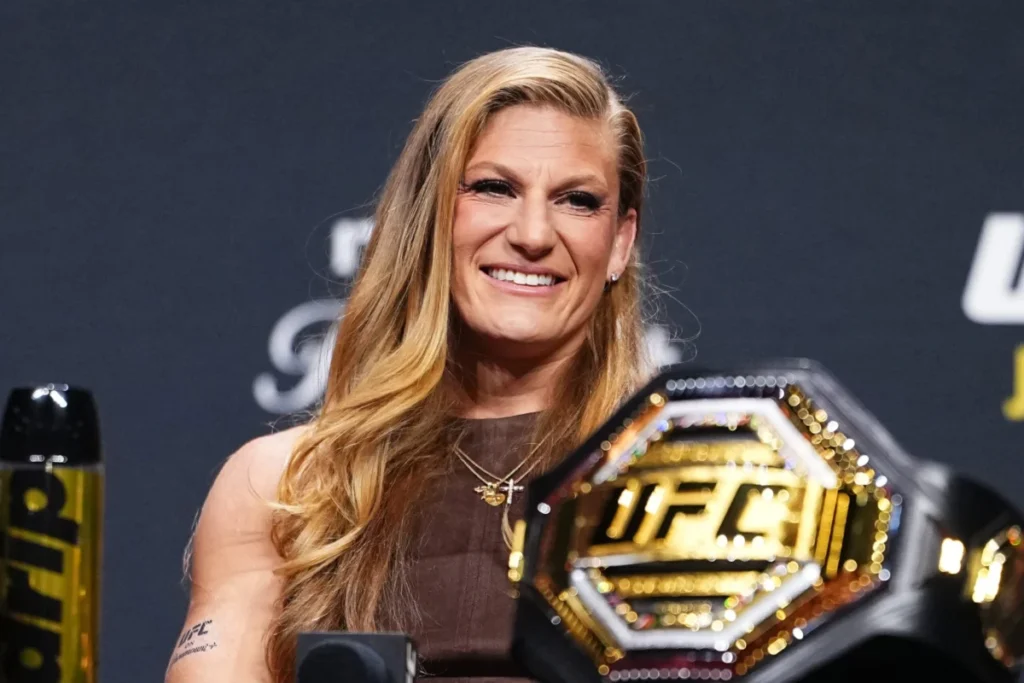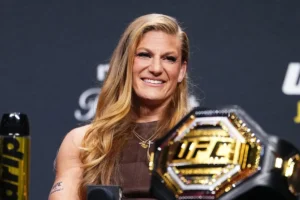
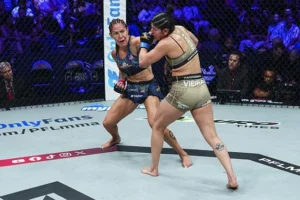
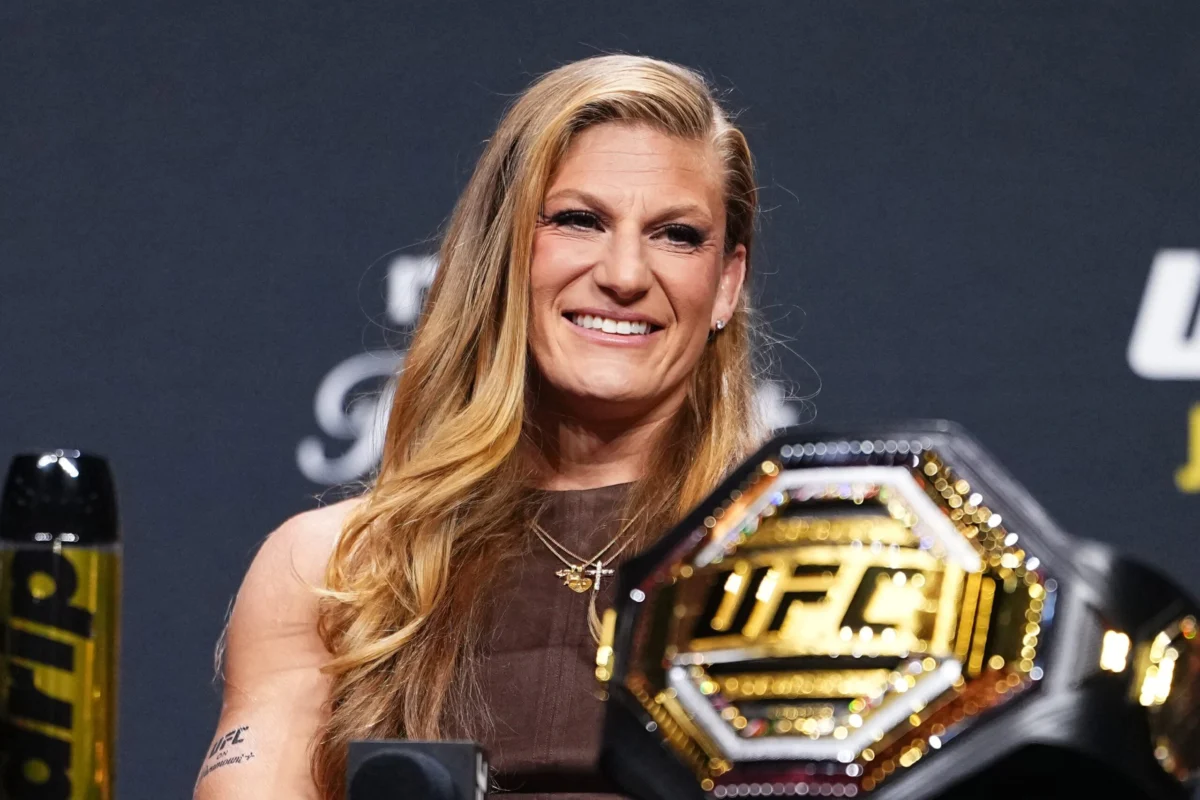
Kayla Harrison cannot wait to finally share the octagon with Amanda Nunes at UFC 334, a high-stakes scenario that felt like an absolute impossibility just a few short months ago.
The two bantamweight greats have been on a direct collision course for years, their paths frequently intersecting through shared history and parallel dominance. They previously trained together while Nunes was establishing her legendary reign of terror, simultaneously dominating both the UFC bantamweight and featherweight divisions. During that same era, Harrison was carving out her own path of destruction, making a remarkably successful transition from a decorated two-time Olympic judo champion to a dominant two-time PFL tournament champion. Harrison eventually made the much-anticipated jump to the UFC in 2024, but by the time she arrived under the promotional banner, Nunes had already stepped away from the sport, announcing her retirement from mixed martial arts.
That retirement proved to be temporary. Nunes shocked the MMA world by announcing a comeback scheduled for 2025, and the combat sports community immediately began salivating over a potential booking between the two titans. The matchup was initially slated for UFC 324, but severe physical health issues intervened when a serious neck injury forced Harrison out of the event entirely. Following a lengthy and grueling recovery period, the fight has since been rescheduled. Harrison and Nunes are now officially set to collide with Harrison’s coveted bantamweight championship on the line at UFC 334, scheduled for November 14 in New York.
As of this moment, Harrison is completely confident that she will finally step into the cage and settle the score with the woman universally considered to be one of the greatest mixed martial artists of all time. However, getting to this point of physical and mental readiness was an arduous journey fraught with deep-seated doubts and terrifying physical agony.
Opening up about her harrowing ordeal during a recent appearance on the Deep Waters podcast, Harrison pulled back the curtain on the darkest moments of her recovery.
"I feel awesome," Harrison said on the podcast. "To be honest, it was rough at the beginning. I think more just obviously physically, but mentally, it was such a big surgery and I went 10 years without having surgery. I had reconstructive knee surgery in between my two Olympics and then I went 10 years with no surgery, but in the last four years, I’ve had four surgeries back to back to back to back, and this one was the most serious."
The psychological toll of enduring repeated major medical procedures caught up to the ferocious competitor, leaving her stranded in unfamiliar territory of self-doubt.
"I kind of was just like, ‘Dude, am I ever going to be OK again?’" Harrison admitted. "It got to the point where I was questioning if I was ever going to feel like myself again. But I’m back. I’m back."
The road to the operating table was neither straightforward nor painless. Initially, Harrison had hoped to undergo a disc replacement procedure as opposed to a full spinal fusion. Based on the medical opinions and research she had gathered, a disc replacement offered superior long-term benefits regarding overall mobility, athletic longevity, and spinal flexibility. It was her explicit intention to fix the problem as conservatively as possible so she could return to training and fight Nunes at the earliest possible opportunity.
However, once Harrison was thoroughly examined by specialized medical professionals, it didn’t take long for a doctor to realize that her preferred treatment option was completely off the table, forcing a drastic pivot in the medical strategy for the reigning UFC bantamweight champion.
"I had a two-level fusion," Harrison revealed. "So I have five herniated discs. I wanted to do the disc replacement because I hear that’s much better, and then when the doc went in, he was like, ‘No, you can’t.’"
The urgency of the situation became clear when considering the timeline and the excruciating physical torment Harrison was hiding while attempting to push through her training camp.
"You have to remember, I was trying to make it to my fight," Harrison explained. "So this was two weeks before I’m supposed to fight Amanda. I can’t lift my arm, I’m getting lightning bolts. The last five days I think I slept maybe three hours because I would fall asleep and then the lightning bolts. It’s the worst pain ever. So finally, the UFC is like, ‘Go to New York.’ I flew to New York, the doctor looked at all the stuff, he was like, ‘Yeah, you need surgery now. When do you want to have it?’"
Displaying the unrelenting work ethic and stubborn competitive drive that made her an Olympic champion, Harrison underwent surgery the very next morning, still clinging to the belief that there was an outside chance she could somehow make her targeted date with Nunes. In addition to the eventual surgery, Harrison detailed the exhaustive, exhaustive measures she took, leaving absolutely no stone unturned in a desperate attempt to fix her neck ahead of schedule and salvage the booking.
"I did everything to try to get to the fight," Harrison said. "I was doing monthly stem cell injections, I was doing PT rigorously, then I started doing muscle relaxors, didn’t touch it. Then I was doing nerve pain pills, then they gave me heavy-duty pain pills, but nothing touched it."
When Harrison finally steps into the cage to lock horns with Nunes, it will mark a monumental clash featuring two of the most statistically accomplished and decorated women in the entire history of combat sports going toe-to-toe with their storied legacies directly on the line. That is, at least, how the promotional marketing machine is framing the matchup for the fans.
For Harrison, however, as genuinely excited as she is about the massive career opportunity of adding Nunes’ legendary name to her already elite résumé, there is nothing that can happen inside the cage on November 14 that will fundamentally diminish her or discourage her spirit. The process of surviving her injury forced her to achieve a profound level of personal peace.
"I’m already satisfied," Harrison said. "It’s not about getting the fight. Of course, I want this fight, but I’m satisfied with my career. I had to come to terms with that when I had neck surgery, it sort of went back to pre-kids where it’s like, are you able to love yourself if you don’t reach all of your goals? Are you still worthy of your own love, Kayla? And I am. I’m good with everything I’ve done. If I never fight again, I’m still a child of God with inherent worth and value, and I’m a mom, and I’m a daughter, and I’m a friend. I’m good, but this is for me. This is about me."
For the champion, fighting has evolved past the pursuit of external validation, financial gain, or championship belts. It has become a deeply personal test of character and self-discovery.
"I love fighting. I thought I loved judo and then I met MMA and I love it so much, and I know our time is very short," Harrison said. "You don’t get to do this forever, and so I want to make the most of it, and I had to fight like hell to get through this neck surgery and just mentally to get back to a place of, ‘Oh yeah, I am that b*tch.’ This is for me. I don’t need money. We could do it at ATT, this is just for me. I want to go out there and see what I’m made of. Am I who I say I am?"