Mike Tyson remains etched in the collective memory of sports fans as one of the most iconic, destructive, and fiercely feared heavyweights to ever lace up a pair of gloves. Known for his explosive punching power, blistering hand speed, and an intimidating, psychological aura that frequently left opponents beaten before they even stepped into the ring, "Iron" Mike captured the imagination of the global sports world in the mid-1980s. He became the youngest heavyweight champion in boxing history at just 20 years old, tearing through the division and eventually unifying the belts during his terrifying athletic prime.
However, the trajectory of a combat sports career can be unforgiving, and by the mid-2000s, years of tumultuous personal struggles, high-profile legal troubles, prison time, and well-documented battles with substance addiction had taken an undeniable and visible toll on his once-imperious career. The youthful ferocity had dimmed, replaced by the reality of an aging athlete attempting to recapture lightning in a bottle.
In June 2005, Tyson stepped into the ring at the MCI Center in Washington, D.C., for what would officially mark the final professional bout of his storied career—setting aside, of course, his heavily promoted exhibition and comeback fight against Jake Paul years later. His opponent that night was Kevin McBride, an Irish-American journeyman heavyweight. At that stage of his career, Tyson still commanded global attention and remained a massive pay-per-view attraction simply on the weight of his legendary name, while McBride was a largely unknown fighter whom oddsmakers and analysts expected to be little more than a routine stepping stone or a manageable opponent for a fading icon.
McBride brought few accolades into the ring that evening. He possessed no major victories over elite contenders on his professional resume and had already accumulated several losses against lower-tier competition. Yet, what the journeyman lacked in technical pedigree and explosive skill, he made up for in sheer physical dimensions and stamina. Standing significantly taller than Tyson and carrying a naturally heavier frame, McBride represented a stylistic nuisance for a shorter, aging pressure fighter whose primary weapon had always been rapid, devastating inside combinations fueled by relentless energy.
The contest began in a manner that felt comfortingly familiar to longtime followers of the former champion. Tyson started the fight strong, aggressively closing the distance and bullying McBride around the canvas in the early rounds. Exhibiting flashes of his trademark head movement and throwing heavy, thudding punches, Tyson appeared to be in control during the opening frames, landing clean shots and keeping the larger opponent on the defensive.
As the bout wore on, however, the stark reality of the former undisputed champion’s physical decline became increasingly apparent. The stamina that had once allowed Tyson to maintain a furious, suffocating pace over twelve championship rounds had vanished. Visibly fading under the bright lights, Tyson grew sloppy and desperate as the middle rounds progressed. Lacking the sustained energy to break down his opponent through traditional offensive output, he began leaning heavily on McBride—a fighter who would ultimately retire in 2011 with a modest, unglamorous career record of 35 wins, 10 losses, and 1 draw, having never once fought for a major world title.
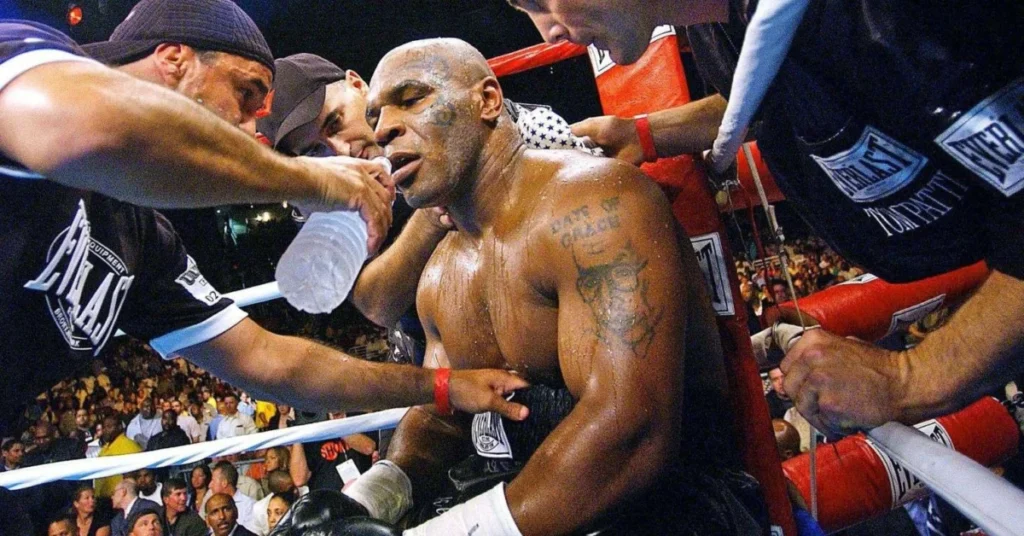
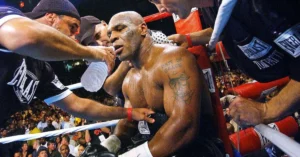
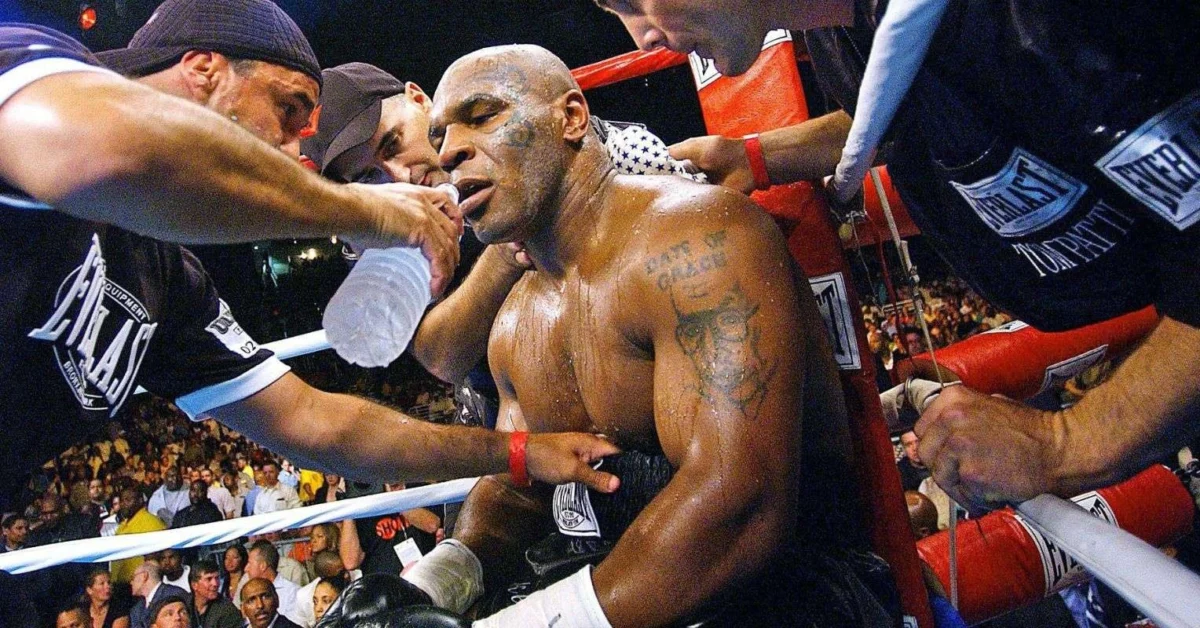
As frustration mounted and exhaustion set in during the later rounds, Tyson’s desperation manifested in unorthodox and illegal tactics. During a tangle in the clinch, he even attempted to bend and break McBride’s arm, a desperate maneuver that underscored his complete loss of composure and control inside the squared circle. The accumulation of fatigue, frustration, and the realization that his body could no longer deliver what his mind demanded culminated at the end of the sixth round. When the bell sounded to signal the end of the frame, Tyson walked back to his corner, sat down heavily on his stool, and flatly refused to answer the bell for the seventh round, signaling an abrupt and shocking end to the contest.
In the immediate aftermath of the fight, standing in the center of the ring under the glare of the television cameras, Tyson dispensed with the usual bravado of elite athletes and offered a brutally honest, heartbreaking assessment of his career, his mental state, and his motivations. He openly admitted to the stunned crowd and a global television audience that he no longer possessed any internal desire to continue fighting, revealing that he had accepted the bout strictly out of financial necessity to pay off mounting bills rather than any lingering competitive ambition.
Reflecting on the mental shift that had occurred within him over the years, Tyson bared his soul to reporters and fans alike, capturing the tragic twilight of a once-feared champion.
"I got the ability to stay in shape, but I don’t got the fighting guts I don’t think anymore… I’m just sorry I let everyone down, I don’t have this in my heart anymore," Tyson said, addressing the crowd and the boxing world with rare, unvarnished vulnerability.
"I’m just fighting to take care of my bills basically, I don’t have the stomach for this anymore, I’m more conscious of my children and those guys, I’m looking at my opponents, I just don’t have that ferocity, I’m not an animal anymore."
With those words, the professional chapter of one of boxing’s most complex and compelling figures closed not with a blaze of glory, but with a quiet, exhausted surrender on a stool, leaving behind a profound legacy defined equally by historic dominance and the heavy human cost of the sport.