


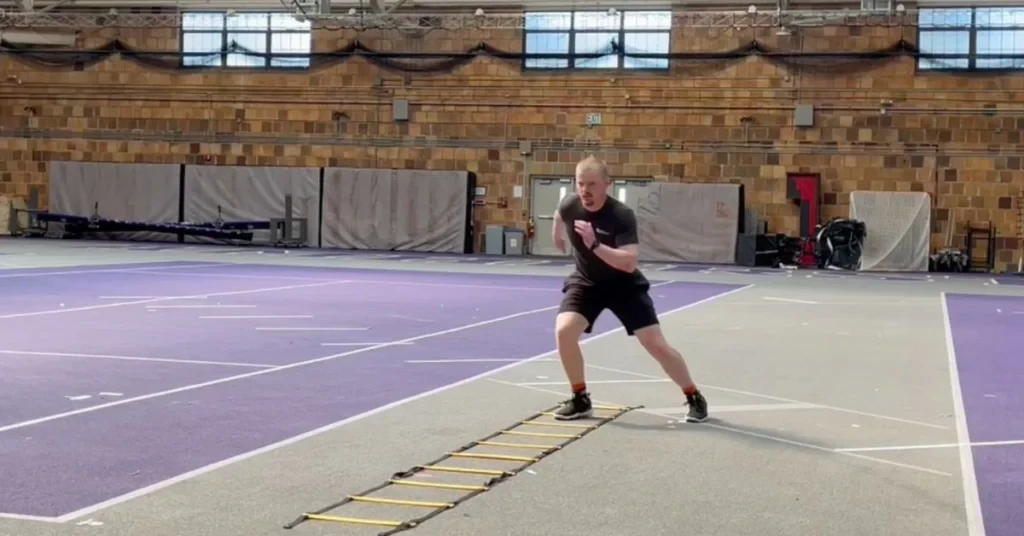
For years, the debate surrounding speed and agility ladders has divided the athletic development community. Often viewed with skepticism by seasoned strength and conditioning coaches, these brightly colored nylon strips laid out on turf or hardwood have earned a reputation as a flashy training gimmick rather than a serious performance tool. Critics are quick to point out that traditional ladder drills do not replicate the high-velocity mechanics of true sprinting, nor do they capture the unpredictable, stimulus-driven nature of reactive agility on the field.
Despite this well-documented skepticism, respected coach TJ Cahill argues that dismissing the ladder entirely means missing out on several practical benefits. Rather than abandoning the equipment or using it under false pretenses, Cahill suggests that coaches can strategically leverage ladders to enhance warm-up protocols, build foundational coordination, introduce extensive plyometric contacts, and boost overall athlete engagement. By reframing how we look at the equipment, practitioners can turn a controversial training aid into a functional asset within a broader athletic development program.
To understand where the ladder fits, Cahill emphasizes the necessity of first establishing what the tool cannot do. In the realm of speed training, conditioning specialists generally categorize exercises into primary, secondary, and tertiary tiers. Primary speed training directly enhances maximum velocity by matching the speeds and technical demands of sprinting, with examples including specialized push-up starts. Secondary drills support speed development with minor alterations to resistance or technique, such as heavy sled pulls that alter mechanics while still driving high force output. Tertiary drills offer generalized support, such as standing broad jumps that train horizontal force production without mimicking running mechanics.
While ladder drills often require athletes to move their feet at high frequencies, the actual motor patterns performed within the squares bear little resemblance to true sprinting mechanics. Consequently, ladder drills cannot serve as a substitute for legitimate sprint training.
A similar disconnect exists regarding agility. According to established definitions by organizations like the National Strength and Conditioning Association, agility is fundamentally defined as the skills and abilities needed to change direction, velocity, or mode of locomotion in response to an external stimulus. Because standard ladder routines involve pre-planned movement patterns executed in a sterile, predictable environment, they fail to replicate the cognitive processing and reactive neuromuscular adaptations required for true athletic agility.

Where Do Ladders Fit in Athletic Development?
Acknowledging these physiological and mechanical limitations does not render the training ladder entirely useless. Instead, it invites coaches to evaluate its utility through a more realistic lens. Cahill outlines four specific areas where incorporating ladder work can genuinely benefit athletes when properly contextualized within a comprehensive program.
The first and perhaps most viable application is within the warm-up routine. Following the established RAMP protocol—which stands for Raise, Activate, Mobilize, and Potentiate—warm-ups should systematically elevate body temperature, heart rate, respiration, and blood flow before transitioning into movement-specific neural activation. When used correctly, ladder drills can successfully fulfill these early-stage requirements.
High-profile athletes frequently endorse this approach. Notably, NFL standout Christian McCaffrey has highlighted his use of ladder drills at the start of training sessions, describing the practice as a way to warm up his feet, mobilize his hips, and synchronize his brain with his physical body. Integrating these drills can provide a neurological activation stimulus comparable to traditional track and field movements like A-marches and A-skips, giving coaches an alternative tool to prepare athletes for the demands of the session ahead.
Beyond simply raising core temperature, ladder work can contribute to improvements in basic coordination and timing, particularly for younger or less experienced athletes. While performing patterns like lateral steps, hip switches, and in-and-out series, participants must navigate tight spatial constraints that demand rhythmic precision. Although scientific concepts like rate coding—referring to the discharge frequency of motor units—explain muscle force control, researchers emphasize that ladder drills do not inherently rewrite these neuromuscular pathways to directly produce faster sprinting speeds. Nevertheless, they remain effective vehicles for teaching body awareness, rhythm, and intermuscular coordination.
A third advantage lies in the accumulation of extensive plyometric contacts. Although extensive plyometrics are less effective at developing rapid rate of force development compared to high-intensity shock methods, they play a vital role in building tissue tolerance and preparing the body for more demanding impacts. This is especially valuable during general physical preparation phases. By gradually increasing submaximal plyometric volume through short ladder series, practitioners can help athletes build a durable structural foundation, a quality particularly beneficial in intermittent, high-endurance team sports like soccer.

Managing Motivation and Athlete Engagement
Perhaps the most underestimated aspect of the training ladder is its undeniable psychological pull. Athletes frequently arrive at off-season training sessions specifically requesting ladder work, often captivated by viral videos of elite performers moving through complex patterns with apparent effortless grace.
This strong desire to use the equipment presents a unique coaching opportunity. Because athletes are inherently motivated to master ladder drills, incorporating them into a session can immediately drive engagement and intent. When leveraged correctly, this enthusiasm can spill over into better focus for subsequent, more demanding aspects of the workout. Of course, as with any training modality, coaches must maintain clear communication about the underlying rationale, ensuring that athletes understand the why behind every exercise rather than chasing aesthetic perfection on the turf alone.
Ultimately, Cahill places ladder work firmly in the category of tertiary training methods. They should never replace dedicated sprint sessions, change-of-direction drills, or reactive agility training. However, when utilized with clear expectations and realistic objectives, the training ladder remains a versatile instrument for enriching warm-ups, refining basic rhythm, accumulating low-level plyometric contacts, and keeping athletes mentally engaged throughout the training cycle.