

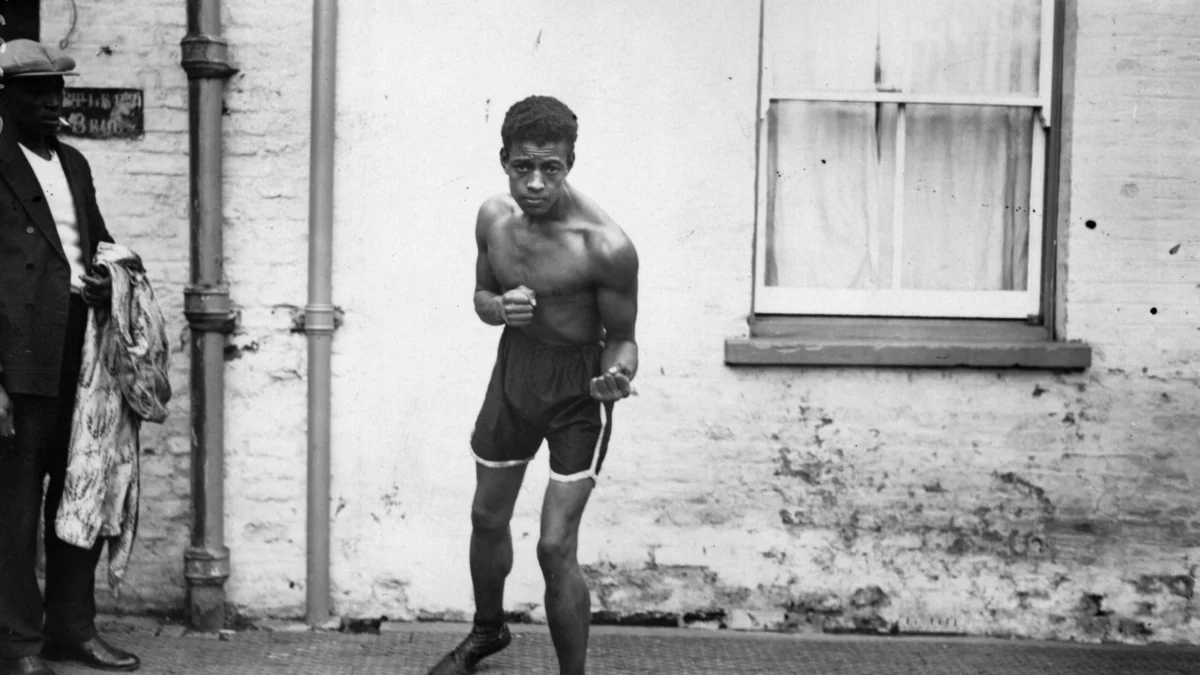
More than half a century after his death, one of Britain’s most extraordinary sporting figures is finally receiving the civic recognition that eluded him during his lifetime. Len Johnson, a master of the boxing ring who won more than 90 professional fights but was denied the right to compete for the British championship because of the colour of his skin, is set to become the first Black individual to be honoured with a dedicated statue in Manchester.
Following a long-running grass-roots campaign, Manchester City Council has formally confirmed that a permanent monument to Johnson will be erected in a prominent location opposite Manchester Victoria Station, subject to final planning permission. The decision marks a major landmark in restoring the memory of a working-class Mancunian who, after being systematically excluded from his country’s highest sporting honors, redirected his formidable discipline into becoming a pioneering civil rights activist, trade union leader, and political organizer.
The story of Len Johnson is both a testament to individual endurance and a revealing lens through which to examine Britain’s complex history of institutional racism, post-war social activism, and the battle for equal rights.
A Prodigious Talent Forged on Manchester’s Streets
Born Leonard Benker Johnson on October 22, 1902, in the industrial district of Clayton, Manchester, Johnson grew up as the eldest of four siblings in a mixed-race household. His father, Bill Johnson, was an immigrant from Sierra Leone and a former boxer who worked as a merchant seaman and laborer, while his mother, Margaret, was from Ireland. Growing up in working-class Manchester at the turn of the century, Johnson’s early life was defined by hard physical labor and the background friction of a society grappling with subtle and overt racial prejudices.
Johnson’s entry into the world of boxing was entirely unplanned. He possessed little initial knowledge of the sport and had received no formal athletic training when an altercation at his workplace prompted his father to take him to a local boxing contest. Recognizing his son’s raw physical capabilities and natural agility, the elder Johnson stepped in to manage and train him.
Without access to modern facilities or expensive equipment, Johnson prepared for his athletic debut through sheer resourcefulness, famously conditioning himself by skipping with an old discarded washing line.

In short order, the teenager stepped into a professional ring for the first time at the Alhambra Theatre in Openshaw. Facing fellow teenager Jerry Hogan, Johnson delivered an astonishingly composed performance, securing a third-round knockout victory. It was an auspicious beginning to what would become one of the most prolific boxing careers in interwar Britain, spanning more than a decade and encompassing over 90 victories across dozens of bouts.
Rule 24 and the Institutional Exclusion of Non-White Boxers
By the mid-1920s, Len Johnson had established himself as one of the premier middleweight boxers in Europe. His boxing style—characterized by exceptional defensive skill, precise footwork, and tactical intelligence—allowed him to dominate formidably tough opponents.
His breakthrough year arrived in 1925 when he achieved back-to-back victories over the reigning British middleweight champion, Roland Todd, defeating him twice within a seven-month span. That same year, Johnson shared the ring with Ted "Kid" Lewis, a legendary multi-division champion whom modern boxing icon Mike Tyson would later describe as "probably the greatest fighter to come out of Britain." Johnson defeated Lewis as well, cementing his reputation as an elite competitor capable of besting the finest fighters in the nation.
Yet, despite repeatedly outpointing and knocking out the top-ranked boxers in the country, Johnson was repeatedly denied the opportunity to contend officially for the Lonsdale Belt—the ultimate symbol of domestic boxing supremacy.
Standing in his path was not a superior athlete, but a discriminatory regulation enforced by the sport’s governing body. Under Rule 24 of the British Boxing Board of Control (BBBofC), contestants competing for British title belts were explicitly required to have been born of two white parents. Because his father hailed from Sierra Leone, Johnson was categorically barred from contending for or holding the British title.
Seeking championship validation elsewhere, Johnson traveled to Australia in 1926. There, he captured the Empire middleweight title in convincing fashion. However, upon returning to Great Britain, he was bluntly informed by authorities that his achievement would not be officially recognized at home. He was routinely excluded from premier venues such as the Royal Albert Hall and the National Sporting Club in London—locations where the most lucrative purses and highest-profile fights were held.

The relentless weight of systemic discrimination eventually took its toll. Speaking candidly about the barrier in 1930, Johnson reflected on the professional wall he had hit:
"I’m barred from the Albert Hall and the National Sporting Club. In fact, whenever there is big money, I’m kept out of it. The prejudice against colour has prevented me from getting a championship fight. I feel now that there is no use whatever going on with the business."
Recognizing that the athletic establishment would never permit a mixed-race fighter to hold its official crown, Johnson hung up his gloves in 1933, bringing an end to a boxing career that had brought him widespread admiration among fans but systemic denial from sport administrators.
A Shift from the Ring to Radical Political Activism
Deprived of a world championship inside the ring, Johnson turned his energies toward the broader struggle for racial and social justice. Following the conclusion of the Second World War, he joined the Communist Party of Great Britain and established himself as a tireless trade unionist and community leader in the Moss Side neighborhood of Manchester.
Johnson’s activist work extended far beyond local labor grievances; he recognized that the struggle of Black Britons was fundamentally linked to global anti-colonial movements. In October 1945, Johnson served as a key local representative and delegate at the historic Fifth Pan-African Congress, held at the Chorlton-upon-Medlock Town Hall in Manchester.
The 1945 Congress proved to be a seminal turning point in modern history, bringing together future African leaders, intellectuals, and activists to demand an end to colonial rule across the African continent and to address racial subjugation worldwide. Working alongside international figures, Johnson helped anchor the event in the local reality of working-class Manchester, demonstrating how local struggles coincided with global liberation movements.

The Old Abbey Taphouse and the Campaign Against the Colour Bar
While Johnson fought for international anti-colonial causes, he remained deeply attentive to the everyday racial discrimination faced by non-white residents in his home city. In mid-20th-century Britain, social discrimination was frequently enforced through informal but pervasive practices known as the "colour bar." Under this unwritten rule, business owners—particularly pub landlords—retained the legal discretion to deny service, entry, or employment to individuals based purely on their race.
In 1953, Johnson personally encountered this practice when he walked into the Old Abbey Taphouse, a pub located just south of Manchester city centre, and was refused service because of his skin color.
Rather than walking away, Johnson transformed the personal insult into a campaign for civil rights. Alongside his long-time friend and fellow activist Wilf Charles, Johnson launched an organized campaign targeting racially discriminatory service practices across Manchester. The duo immediately reported the incident to local authorities, secured an audience with the Lord Mayor of Manchester, and mobilized public opinion.
Days later, Johnson and Charles coordinated a direct-action demonstration. They returned to the Old Abbey Taphouse accompanied by a crowd of roughly 200 supporters, community members, trade unionists, and journalists. Faced with mass public scrutiny, media coverage, and an organized presence outside her doors, the landlady capitulated.
Although Johnson himself was a non-drinker, he stood at the counter and was formally served a drink, marking a resounding symbolic and practical victory. The high-profile campaign at the Old Abbey Taphouse effectively broke the back of the institutional colour bar across Manchester pubs, forcing establishments across the city to abandon discriminatory entry policies.
It would take another twelve years before the British Parliament formally outlawed racial discrimination in public venues nationwide through the passage of the landmark Race Relations Act of 1965. Johnson continued his community advocacy, political writing, and labor organizing until his death in 1974 at the age of 71.

A Permanent Tribute at Manchester Victoria Station
For decades following his death, Johnson’s contributions remained largely overlooked by mainstream history. However, grassroots organizers, historians, and boxing enthusiasts worked persistently to ensure that his legacy was not forgotten.
The drive to erect a permanent monument has been spearheaded by the Len Johnson Campaign CIC, led by activist Deej Malik-Johnson. To fund the initiative, campaign organizers launched creative community-led fundraising efforts, including an annual celebrity football match featuring prominent local internet personality Angry Ginge, backed by world-class darts player Luke Littler, and supported by former world championship boxer Tony Bellew.
The campaign reached a major breakthrough when Manchester City Council officially designated a site for the monument directly opposite Manchester Victoria Station—one of the city’s busiest transit hubs.
Reacting to the council’s decision, Deej Malik-Johnson highlighted the significance of placing a working-class Black activist at the center of Manchester’s civic landscape:
"Today’s news is another milestone towards properly acknowledging the historic contributions of a working-class, mixed-race Mancunian whose brave actions in the past developed the foundations of a better future. In a sport and a society rigged against him because of his skin colour, Len made himself a champion for people outside the boxing ring. At home and abroad, as an athlete, a worker, an organiser, a politician and a family man, he exemplifies the best of us."
Civic leaders have similarly praised the initiative for shining a light on a crucial chapter of local history. Councillor Tracey Rawlins, Deputy Leader of Manchester City Council, emphasized the educational and symbolic value of the upcoming statue:

"Len Johnson was not only one of the best boxers of his era, he was also a model of a Mancunian—a community champion who contributed much to the city during his lifetime. His life and his remarkable achievements are part of Manchester’s history and deserve to be told. The planned statue will provide both a springboard for people to learn more about Len and a focal point for the city to remember and honour him."
While the final installation remains subject to formal planning permission, the council’s site approval ensures that Len Johnson’s image will soon stand permanently in the heart of Manchester. Decades after being denied his rightful place on the official podium of British boxing, the fighter who fought just as fiercely for human rights outside the ring will finally be memorialized in bronze for generations to come.