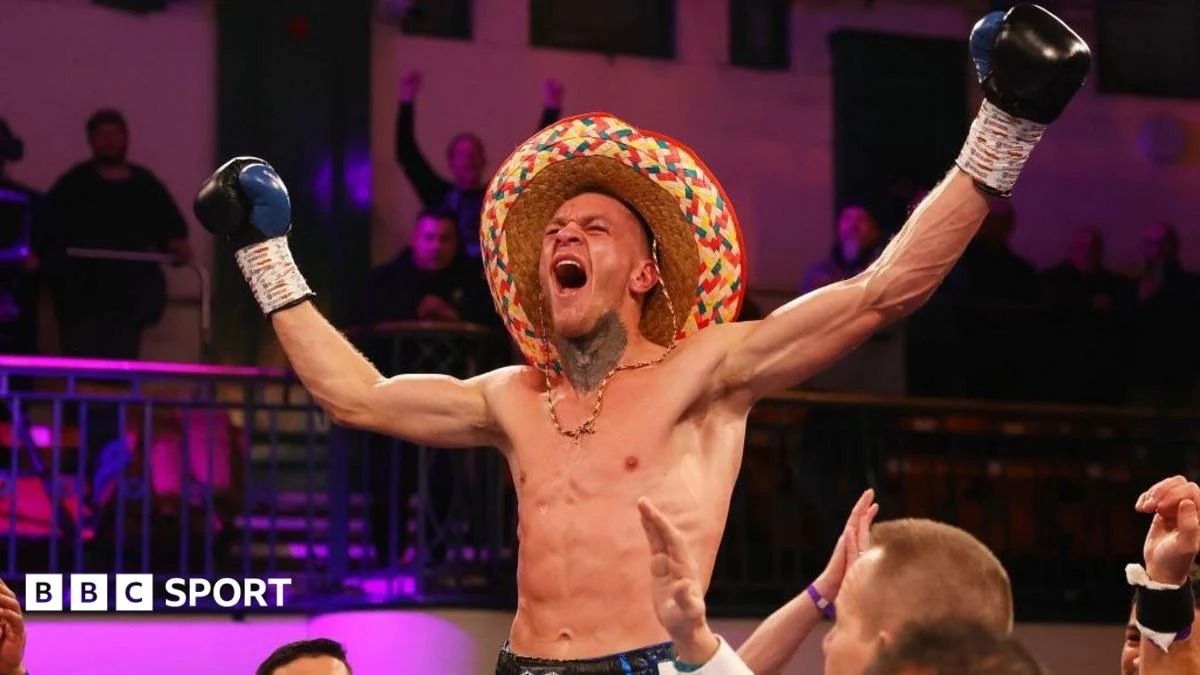
In the high-stakes, uncompromising world of professional boxing, Gavin Gwynne has never been a fighter who blends into the background. Long before the opening bell rings, the Welsh lightweight demands attention. Whether it is the giant sombrero he proudly dons during his ring walks—a colorful nod to his moniker, "The Merthyr Mexican"—or the striking image of a roaring lion tattooed across his throat, Gwynne is an unmissable figure. Yet, while his flamboyant entrance attire and bold body art initially draw the glances of onlookers, the proud native of the South Wales Valleys is increasingly giving fight fans far more compelling reasons to pay attention to his work inside the squared circle.
Having already etched his name into domestic and continental boxing lore by capturing the British, Commonwealth, and European lightweight titles, Gwynne has spent recent months proving that his finest hour inside the ring may still lie ahead. In May, Gwynne produced one of the most eye-catching results of his career by stepping up a weight class to face the previously unbeaten Khaleel Majid, who entered the bout boasting a pristine 16-0 record. Gwynne tore up the script, defeating Majid to claim the WBA International belt at super-lightweight and catapulting his name into the upper echelons of the sanctioning body’s world rankings.
Now, as the 36-year-old prepares for another pivotal chapter in his professional journey, the stakes could not be higher. On Saturday, 14 November, Gwynne will step under the bright lights of London’s Wembley Arena to face Manchester’s skilled contender Zelfa Barrett with the WBA Intercontinental lightweight title on the line. For Gwynne, the upcoming bout represents far more than just another title defense or regional showdown; it is a cross-roads encounter that could grant him the world title shot he has spent a lifetime chasing, proving once and for all that he is defined by elite championship credentials rather than just a catchy nickname and throat ink.
Despite reaching an age where many fighters begin to contemplate life after boxing, Gwynne insists that he is currently operating at the absolute peak of his physical and technical powers. Speaking to BBC Sport Wales ahead of his clash with Barrett, the Welshman expressed supreme confidence in his late-career trajectory, pointing to other veteran champions who have scaled the mountain late in their professional journeys as proof of what remains possible.
"I’m 36 but just feel like I’m getting better," Gwynne said. "Just look at Anthony Cacace, he was 35 when he won his world title. That’s what I want. I want these big fights, even if I can get a title shot. All I have to do is win this fight and it pushes me in contention. It’s must-win."
The reference to Belfast’s Anthony Cacace is telling. Cacace’s dramatic rise to world title glory at the age of 35 served as a powerful reminder across the British boxing landscape that veteran fighters with deep experience, exceptional engine power, and unyielding belief can still achieve ultimate glory. Gwynne sees a clear parallel between Cacace’s path and his own, viewing his current run not as the final twilight of his career, but as the culmination of years of hard-earned experience coming together at precisely the right moment.
To reach this point, Gwynne has had to overcome significant adversity and grueling ring encounters that have forged his reputation as one of the most resilient, workhorse fighters in the division. Gwynne does not specialize in easy nights, and virtually every time he steps between the ropes, the contest turns into a brutal war of attrition. Even in set-backs, his combativeness has won him the admiration of fight crowds. In November 2024, Gwynne suffered a defeat against the undefeated prospect Cameron Vuong, a outcome that sparked considerable debate. When the decision was announced in Vuong’s favor, large sections of the arena voiced their strong disagreement, booing the judges’ scorecards after watching Gwynne push his opponent to the absolute limit in another relentlessly physical affair.
That willingness to engage in toe-to-toe combat is fundamental to who Gwynne is as a fighter. It is an instinct that predates his professional title victories and, in fact, gave birth to the famous sobriquet that has followed him throughout his career. Recalling how he became known as "The Merthyr Mexican," Gwynne smiled as he remembered a transformative trip to the United States, where he walked into a traditional Mexican boxing gym in Los Angeles to test his mettle against local fighters.
"That’s where the nickname came from," Gwynne explained. "The coach came out just as me and this local guy were sparring lumps out of each other. He asked me where I was from and I told him ‘Merthyr’ as if he was going to know where that was, and he said: ‘Oh, the Merthyr Mexican!’ It suits as I’m non-stop and I just love fighting. It’s just in me."
The moniker stuck immediately, perfectly encapsulating Gwynne’s relentless, high-volume pressing style, body attack, and iron-willed stubbornness—traits traditionally associated with the revered Mexican school of boxing. It was an identity forged not in a marketing office, but in the heat of an intense sparring session thousands of miles from home.
If his nickname was earned through blood and sweat in a foreign gym, the striking tattoo etched across his throat speaks to the psychological fire that drives him forward. The ink depiction of a roaring lion covering his neck is impossible to ignore, serving as a visual reflection of his inner temperament. However, bringing that striking piece of art to life required a display of physical tolerance that mirrored the grit he displays in the ring.
"That lion is inside me, always trying to get out, so that’s what’s behind it," Gwynne said, opening up about the personal meaning behind the arresting tattoo. "The pain was unbearable to be honest. I had to stick it because I wouldn’t have gone back to finish it if I’d left."
The ordeal of sitting through four continuous hours of painful tattooing on one of the body’s most sensitive areas offers a glimpse into Gwynne’s mindset. Once he commits to a path, there is no turning back, no willingness to leave a job half-done, and no retreat from discomfort—whether he is in a tattoo chair or enduring the championship rounds of a high-tempo bout.
Yet despite the bold throat ink, the sombrero, and his action-packed fighting style, Gwynne remains fundamentally grounded. Away from the bright lights, he is far from a flash, attention-seeking personality. He is a blue-collar fighter who builds his success on honest sweat, grueling slog, and intense gym dedication. If anything, his fierce work ethic has sometimes been a double-edged sword, threatening to work against him when taken to extremes.
Gwynne credits his recent career surge and renewed energy in part to his trainer, Gary Lockett. Recognizing that his fighter’s incredible work ethic was leading to overtraining, Lockett took the crucial step of holding Gwynne back in the gym, forcing him to embrace rest and recovery as an essential component of his training regimen.
"I was draining myself and I was leaving it all in the gym," Gwynne admitted candidly. "Come fight night, I didn’t have anything left."
The tactical shift under Lockett’s guidance has allowed Gwynne to enter his recent bouts fresher, sharper, and far better equipped to maintain his relentless pace over twelve rounds without burning out his engine prematurely. That improved energy management was evident in his victory over Khaleel Majid, where Gwynne looked full of vitality as he controlled the action against a younger, undefeated opponent.
That renewed vigor will be tested to the absolute limit against Manchester’s Zelfa Barrett at Wembley Arena. Barrett represents a formidable hurdle on Gwynne’s quest for world honors, bringing elite skill, sharp counter-punching, and high-level experience to the ring. Gwynne is under no illusions regarding the scale of the task awaiting him in London, nor is he blind to the stark reality of his position at age 36.
"It’s a massive step—and, as I say, it’s must-win because I haven’t got time to build myself back up now," Gwynne emphasized.
Looking around Lockett’s gym in South Wales, where a new generation of bright young Welsh prospects train alongside him, Gwynne is acutely aware of the passage of time. The youngsters in the gym have years ahead of them to rebuild after setbacks, navigate detours, and climb back up the rankings. Gwynne, by contrast, knows that his window of opportunity is right now. A defeat against Barrett would represent a devastating blow to his dream of securing a world title fight, effectively closing the door on the top-tier opportunities he has worked a lifetime to reach. Conversely, a victory over a marquee name like Barrett for the WBA Intercontinental title would seal his position in the global upper tier and make his claim for a world title shot virtually impossible to ignore.
When Gwynne makes his entrance at Wembley Arena on Saturday, 14 November, complete with his giant sombrero and his lion tattoo on display, the theatricality will quickly give way to the harsh, uncompromising business of elite-level boxing. For the Merthyr Tydfil warrior, the clash with Barrett is the ultimate fork in the road—a night where victory can transform a decorated domestic career into a bid for world glory.