
Boxing’s ongoing and deeply entrenched world title confusion has reached an entirely new level of absurdity. The International Boxing Association (IBA) has once again aggressively promoted its IBA.PRO championship as a legitimate world title, a move that potentially brings the total number of active belts carrying that prestigious description across the sport to a staggering eight.
The controversial organization announced that two-time Olympic gold medalist Hasanboy Dusmatov will square off against Roderick Bautista of the Philippines for the designated IBA.PRO world title. The high-stakes showdown is scheduled to take place on December 4 in Istanbul, Turkey. The ten-round contest, set at a 52.2 kg limit, will serve as a prominent feature during the final day of the inaugural IBA President’s Cup, hosted at the iconic Sinan Erdem Sports Arena.
Throughout its promotional rollout, the IBA has made no attempt to disguise or downplay the championship’s status. In clear messaging distributed across its official social media channels, the organization explicitly stated that Dusmatov is targeting an IBA.PRO world title. For an organization with deep historical roots in amateur boxing to be openly describing a separate professional championship as a world title creates immense ambiguity for fans navigating an already uncertain and fragmented landscape.
This latest development arrives hot on the heels of previous warnings from industry watchdogs. World Boxing News recently highlighted how major promotional entities like Matchroom Boxing and Zuffa were collectively pushing the sport toward an unsustainable total of seven different world-title designations, even as the traditional, established championship structure technically remained unchanged. Now, by inserting its own claim into the mix, the IBA is inflating an already overcrowded picture, exacerbating a problem that has plagued the sweet science for years.
Eight World Title Claims and Growing Confusion
To understand the scale of the current crisis, one must examine the baseline of the sport. Historically and traditionally, the World Boxing Association (WBA), World Boxing Council (WBC), International Boxing Federation (IBF), and World Boxing Organization (WBO) remain boxing’s four established world championship organizations. The principal titles governed by these four bodies have long formed the foundational basis of undisputed championship status, acting as the gold standard by which fighters measure their careers.
However, the ecosystem has fractured significantly over time due to subsidiary titles and splinter organizations. The WBA, for instance, has long faced criticism for operating its secondary Regular championship alongside its primary belt. Meanwhile, Eddie Hearn’s Matchroom Boxing has routinely promoted the International Boxing Organization (IBO) belt as a world-level prize. Adding further to the administrative clutter, Zuffa Boxing has introduced its own newly minted championship into the mix.
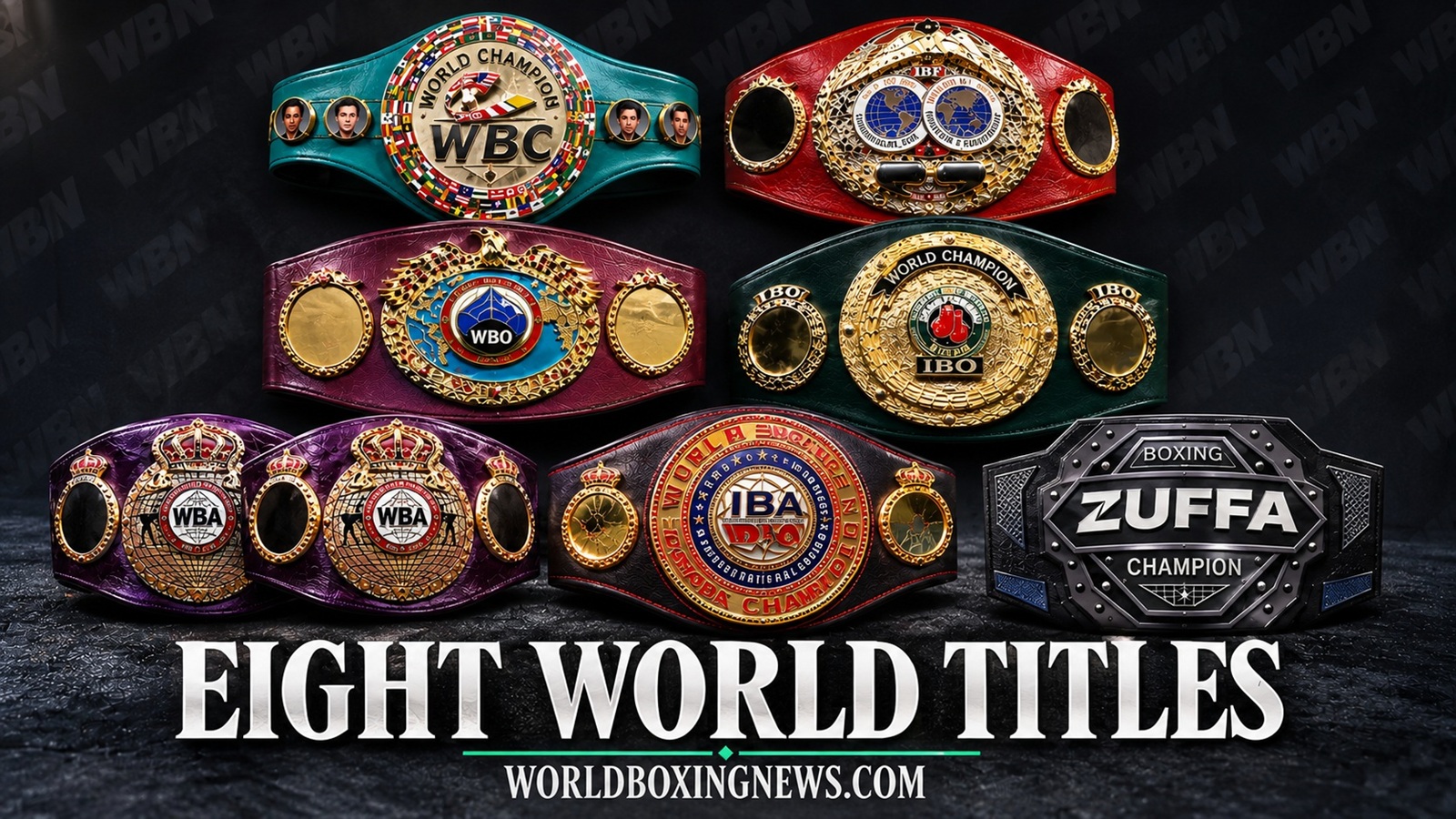
When counting the WBA’s principal and Regular titles separately alongside the WBC, IBF, WBO, IBO, and Zuffa belts, the sport was already burdened by seven different championship designations being aggressively marketed and presented to the public as world titles. The introduction and persistent promotion of the IBA.PRO championship potentially pushes that alarming figure to a remarkable eight.
For casual observers and new fans trying to understand who the real, undisputed world champions are in any given weight class, the situation has become increasingly difficult to follow. Modern boxing features a reality where a fighter can be introduced on television broadcasts as a world champion without ever holding one of the four principal, universally recognized titles sanctioned by the traditional governing bodies. The IBA’s latest announcement serves as yet another stark example of how easily and loosely the description can be applied in the modern era.
The Battle Over World Title Recognition and Integrity
In response to this administrative bloat, industry gatekeepers maintain strict standards regarding what constitutes true championship gold. World Boxing News firmly maintains its editorial stance of not recognizing the IBA.PRO championship as a legitimate world title. This policy mirrors the outlet’s treatment of other disputed accolades, excluding belts such as the WBA Regular, the IBO, and the Zuffa championships from its widely referenced recognized world champions list.
From a legal and operational standpoint, the IBA is fully entitled to stage professional boxing contests and award its own internal championships to successful competitors. The core issue of contention, however, lies in the marketing and terminology used. Concerns naturally arise when those promotional entities begin utilizing the exact same heavyweight terminology as boxing’s established, historical world titles, thereby blurring the lines for an unsuspecting public.
At some critical juncture, collective action or a concerted industry effort needs to be taken to ensure that splinter organizations and promotional outfits cannot simply declare any newly minted championship belt a world title and expect fans, media, and historians to blindly accept it. There is no suggestion that the IBA has only just created its championship overnight; rather, the underlying problem is its continued, stubborn insistence on promoting the belt as a world title during an era when boxing is already struggling beneath the weight of an excess of championship claims.
While the foundational four-title structure has not officially changed on paper, the language, marketing, and media surrounding it have shifted dramatically. With an eighth championship now being actively pushed into the global spotlight as a world title, professional boxing risks making an already convoluted and inaccessible sport even harder for newcomers to comprehend, threatening the long-term clarity and prestige of true championship boxing.