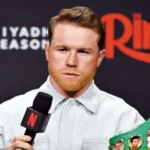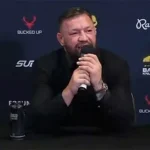

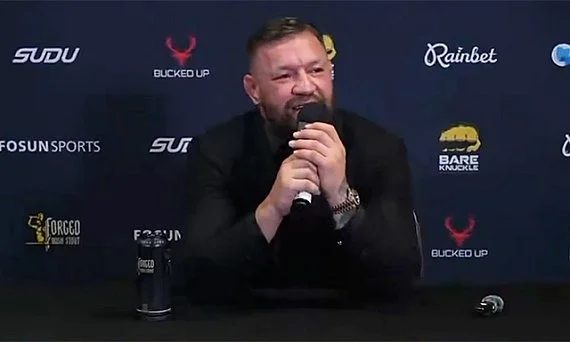
Conor McGregor has set his sights firmly on a trilogy fight with Max Holloway, expressing deep-seated frustration over the abrupt, injury-shortened conclusion to their second encounter earlier this year. Speaking candidly at the post-fight press conference for BKFC Glasgow, the former two-division UFC champion did not hold back his lingering resentment regarding how their main event matchup at UFC 329 came to an end.
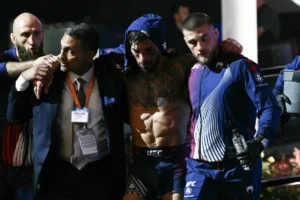
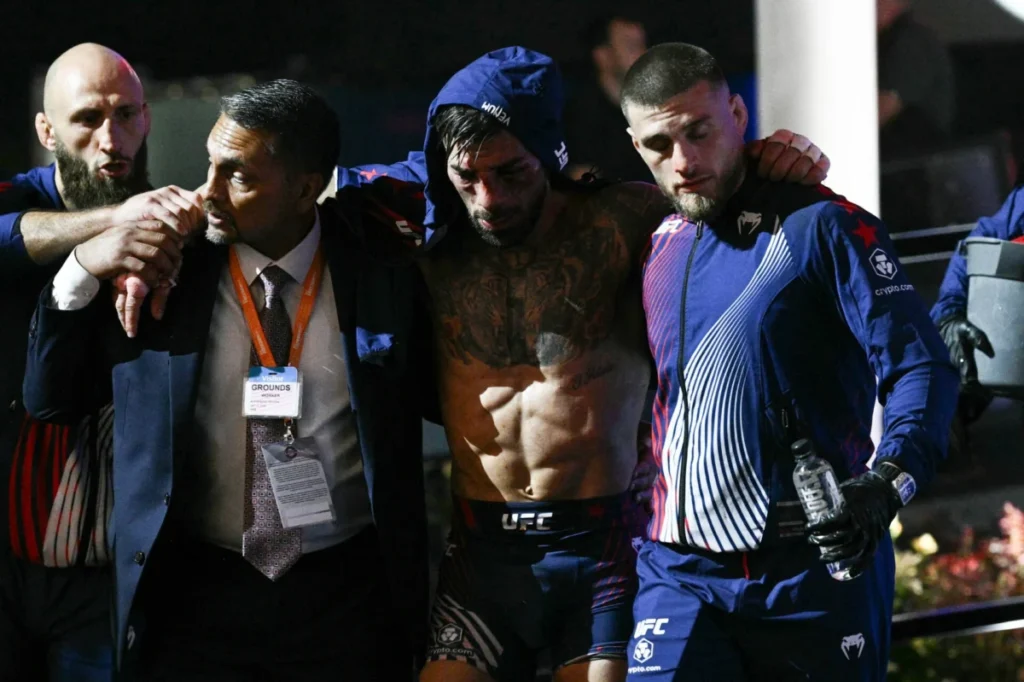
The bout, which took place in July, ended in the first round when Holloway was awarded a technical knockout victory after McGregor suffered a severe knee injury that compromised his mobility inside the Octagon. However, months removed from the event, McGregor is offering a radically different narrative of those fateful moments. According to the Irishman, the stoppage was premature and heavily influenced by his opponent’s appeals to the officiating referee rather than an overwhelming display of dominance.
Addressing reporters in Glasgow, McGregor made it clear that unfinished business remains between the two former champions and that a third meeting is the only acceptable resolution to the rivalry. The sheer intensity of his emotions revealed a fighter still grappling with the psychological weight of a defeat that he believes was artificially manufactured by circumstances rather than a definitive martial arts masterclass.
“It has to be Holloway,” McGregor stated emphatically during the press conference. “Just do the fu**ing thing again. Just do the thing again. The guy didn’t engage once. He’s the one that called for the stoppage of the fight. He said, ‘Ref, ref!’ He’s the one stopping the fight.”
The crux of McGregor’s grievance lies in his belief that fighters should be given every opportunity to continue competing, regardless of physical setbacks, unless they are rendered entirely defenseless. In his estimation, the fight was halted prematurely at a time when he was still capable of defending himself and mounting an offense, even with a severely compromised limb.
McGregor went a step further, offering a bold assessment of how the remainder of the first round would have played out had the referee allowed the contest to proceed. Despite dealing with a knee injury that ultimately required medical evaluation and rehabilitation, the charismatic star insisted that his opponent’s reluctance to engage would have worked in his favor.
“Imagine I’d have just said, ‘Yes, yay,’ and jumped the fence. I won. He doesn’t want to fu**ing fight,” McGregor remarked, painting a picture of a tactical stalemate where Holloway was supposedly hesitant to close the distance despite the Irishman’s physical disadvantage. “I’d have done him on the one leg. He wasn’t coming near me.”
For a competitor of McGregor’s stature, whose career has been defined by high-stakes battles, legendary comebacks, and an unyielding competitive spirit, accepting a loss under such controversial circumstances has proven to be an ongoing challenge. He acknowledged that the ending of the UFC 329 main event continues to weigh heavily on his mind, casting a shadow over his current professional outlook and fueling an intense desire for redemption.
“The Notorious” described the aftermath of the fight as a deeply emotional and distressing experience, emphasizing that the memory of the premature stoppage has not faded with time. To hear him tell it, the unresolved nature of the contest represents a stain on his competitive record that only a return to the cage against Holloway can wash away.
“So shocking and so heartbreaking to me, and I’m still Fing dealing with it,” McGregor shared with the press. “Pero it has to be Holloway. Come on, just Fing dust it off. Redo it.”
The comments quickly reverberated across the mixed martial arts community, drawing widespread attention from fans, analysts, and fellow fighters alike. Prominent combat sports media outlets, including Full Send MMA, captured and shared the viral remarks on social media platforms, amplifying McGregor’s passionate call for a trilogy fight to a global audience. The circulating video clips reignited debates among the MMA faithful regarding the nature of injury stoppages, referee discretion, and the criteria for halting high-profile championship bouts.
As the sports world processes McGregor’s latest demands, the ball now sits firmly in the court of matchmakers and promoters. Whether the UFC will entertain the idea of booking a third chapter between McGregor and Holloway remains to be seen, especially given the complex landscape of the featherweight and lightweight divisions and McGregor’s own unique contractual and competitive standing. Nevertheless, by publicly laying down the gauntlet and demanding a redo of their controversial encounter, McGregor has ensured that the rivalry between two of the sport’s most defining figures will remain a dominant talking point for the foreseeable future.