


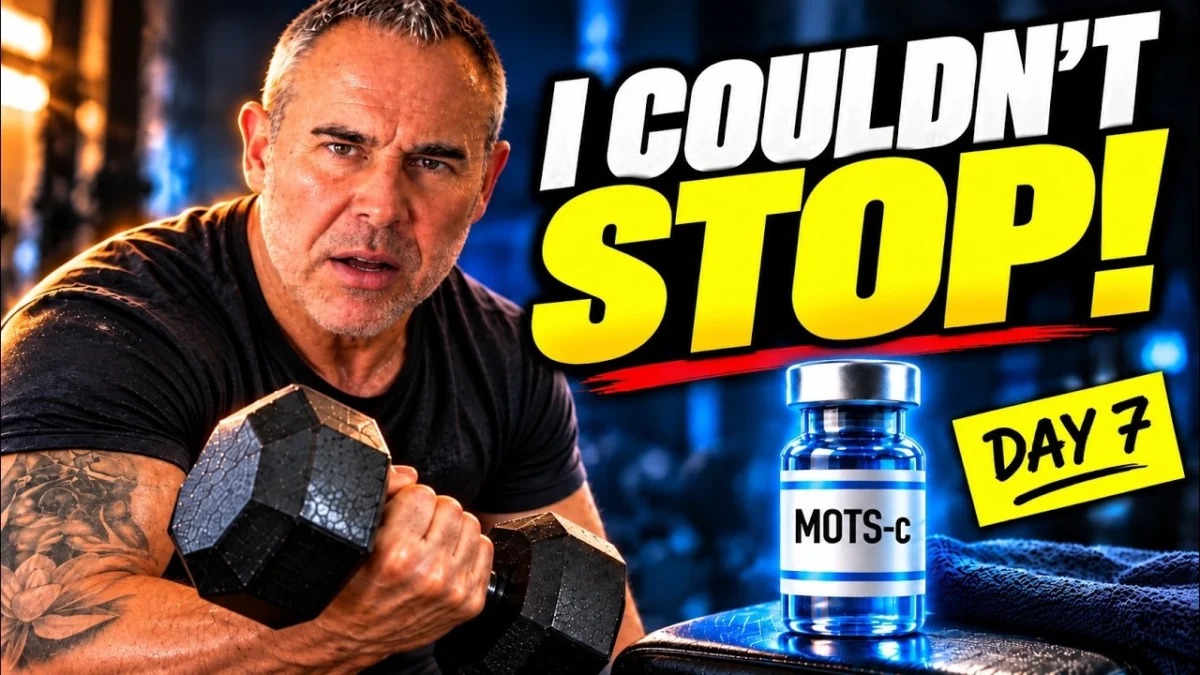
For many adults balancing chronic health conditions with demanding daily routines, maintaining steady energy levels and physical performance can feel like an uphill battle. For David, a 57-year-old living with Type 1 diabetes, the pursuit of sustainable energy recently led him down an unconventional path. He recently wrapped up his first week experimenting with MOTS-c, a mitochondrial-derived peptide that has captured the attention of the biohacking and fitness communities under the provocative moniker "exercise in a bottle."
In a recent video journal shared online, David documented his daily experiences, physical sensations, and blood sugar fluctuations over a five-day protocol. His findings offer a personal glimpse into the real-world use of an experimental peptide that is currently generating significant buzz in scientific and wellness circles. While his observations included noticeable boosts in vitality and training endurance, his journey also highlighted the challenges of separating subjective feelings from objective physiological data, particularly for someone managing a complex metabolic condition like Type 1 diabetes.
Does modern science support the hype surrounding MOTS-c, or are these early personal accounts merely a reflection of expectation and routine? To understand the significance of David’s experiment, it helps to examine both his daily logs and the broader research context that surrounds this fascinating molecule.
The Headline Result: Workouts He Didn’t Want to End
David’s primary takeaway from his first week on MOTS-c was deceptively simple: his training sessions felt better, and stopping them proved remarkably difficult. Rather than experiencing a sudden, overwhelming surge of adrenaline or jitter
y nervousness, he found himself simply enjoying the physical exertion to a degree that disrupted his usual timeline.
Reflecting on his routine, David noted that he had a hard time cutting his workouts short, which occasionally caused him to run behind in his morning tasks. He was careful to clarify that these delays were minor—he was never late for any critical appointments, only lagging slightly behind his normal schedule—and the sensation persisted across multiple days.
His chosen dosing protocol involved administering one milligram daily for five days, bringing his total weekly intake to five milligram. To maintain some scientific rigor in his personal trial, David intentionally skipped recording his impressions on the very first day, hoping to bypass any initial excitement or placebo effect that might skew his baseline observations.
Day-by-Day: What He Reported
As the week progressed, David’s daily video logs captured a gradual accumulation of subtle physical and mental shifts. By the second day, following a routine dumbbell workout, he felt a growing confidence that the effects he was noticing might be genuine rather than purely psychological. He remarked that he simply did not want to stop working out once he got started.
Age played a central role in how he contextualized these changes. David pointed out that low-grade fatigue and a general reduction in baseline stamina often creep in over the years, meaning that any restorative boost might feel more pronounced for someone in their late fifties than it would for a younger athlete in their forties.
By the third day, following a 30-minute session on a stationary bicycle, David reported a distinct mental shift alongside his physical endurance. He described experiencing a notable clarity in his head, which he attributed directly to a reduction in systemic fatigue. Given that his daily occupation is physically demanding, David would normally expect to feel the cumulative toll of harder gym efforts in his knees and back. Yet, to his surprise, those familiar aches were noticeably absent.
Days four and five brought further confirmation of what he characterized as cellular energy rather than caffeinated stimulation. Although the fifth day began with genuine fatigue due to an exceptionally busy work schedule, the familiar pull to exercise returned the moment he began moving. He was careful to remain grounded in his assessments, explicitly telling his audience that he was not waking up feeling like Superman, but rather experiencing a restoration of energy levels that felt reminiscent of his younger years. He repeatedly emphasized that the results were nothing crazy, taking care not to lead observers in a misleading direction.
The Blood Sugar Question
For any individual managing Type 1 diabetes, glucose control remains the central axis around which daily life revolves. Because preliminary animal studies have suggested that MOTS-c may play a role in influencing insulin sensitivity and metabolic regulation, David monitored his blood sugar numbers with heightened attention throughout the week.
In the early stages of the experiment, his readings remained remarkably stable. Post-workout measurements consistently hovered in the 120 to 140 milligrams per deciliter range, and he did not require any emergency glucose tablets during the first few days of training. However, a minor wrinkle emerged late on the fourth day, when his glucose levels dipped to approximately 85 milligrams per deciliter, prompting him to consume a quick source of carbohydrates because he preferred not to run low while out and about.
The following morning, he woke up with a blood sugar reading of 108 milligrams per deciliter. While it was tempting to attribute the fluctuation directly to the peptide, David acknowledged that variables such as insulin timing, dietary choices, and a routine bedtime correction could explain the shift just as easily. This candid admission underscores a fundamental limitation of self-experimentation: one person’s isolated glucose log cannot easily disentangle the effects of a peptide from the myriad other factors that govern daily metabolic control.
What Is MOTS-c, Exactly?
To understand why David and many others are experimenting with this compound, it is necessary to examine what MOTS-c is at a molecular level. MOTS-c—short for mitochondrial open reading frame of the twelve S rRNA-c—is a small peptide that is naturally encoded within the mitochondrial DNA and produced by the human body.
In recent years, researchers have begun investigating its potential links to cellular metabolism, insulin sensitivity, and physical performance. Scientific theories suggest that the body’s natural production of MOTS-c may increase in response to physical exercise, where it acts as a signaling molecule to help regulate energy homeostasis. Furthermore, laboratory studies have indicated that the peptide may activate AMPK, a crucial cellular enzyme often referred to as the body’s master energy sensor, which plays a pivotal role in how cells handle nutrients and produce energy.
While animal research has yielded intriguing hypotheses regarding metabolic health and endurance, these findings remain strictly confined to preclinical models. David was explicitly transparent about this distinction, reminding observers that preliminary data from mouse studies do not equate to proven clinical outcomes in humans.
The Fuller Picture on “Exercise in a Bottle”
Catchy media monikers like "exercise in a bottle" invariably promise more than empirical evidence can currently deliver. Preclinical findings observed in laboratory rodents frequently fail to translate successfully to human physiology, and robust, large-scale clinical evidence supporting the use of MOTS-c in people remains conspicuously absent.
Expectation and psychological framing can also exert a powerful influence over how physical exertion feels, even when individuals take precautions like skipping their initial day of logging. Furthermore, David’s established lifestyle must be taken into account; as someone who already maintained a consistent daily training routine, his baseline fitness, sleep habits, and occupational activity all interacted dynamically with his perceived energy levels during the trial.
Week Two: Dose Decisions and Real Numbers
As David looks ahead to the second week of his personal exploration, he faces decisions regarding his dosing strategy. He is currently weighing whether to increase his daily intake or maintain the steady one-milligram protocol. While he has encountered anecdotal accounts from other users suggesting weekly totals as high as 20 milligrams, he remains aware of the medical principle that higher doses do not automatically translate to superior results.
His overarching goal moving forward centers on prioritizing empirical data over subjective feelings. By continuing to track his metrics carefully, he hopes to provide a more comprehensive view of his ongoing experiment. Whether MOTS-c will ultimately prove to be a meaningful therapeutic tool or merely another fleeting wellness trend remains an open question, one that continued scientific research and cautious observation will eventually have to answer.