

In the sweet science of boxing, few terms are bandied about as frequently—or misunderstood as profoundly—as "fighting on the outside." For generations of fighters, trainers, and spectators, the phrase has conjured images of long-range engagement, safe distance, and evasive retreat. However, a closer examination of ring mechanics reveals that conventional wisdom regarding the outside game is fundamentally flawed. The common instinct to rely on straight-back movement as a primary defensive tactic often leads fighters straight into disaster, trapping them against the canvas ropes where they become easy targets for aggressive opponents.
The core misconception stems from how fighters interpret distance. When overwhelmed, pressured, or unable to track incoming punches, many athletes view the backstep as an immediate solution. It functions as an instinctive, emergency exit strategy. Statistically and practically, stepping completely out of range avoids incoming blows more reliably than complex defensive maneuvers such as blocking, slipping, rolling, or ducking. When an opponent’s fist is cutting through the air toward your face, creating absolute physical separation guarantees safety from that specific strike.
Yet, this reliance on the linear backstep carries a fatal flaw: it fails to change the broader tactical scenario. At best, an instinctive retreat buys a fraction of a second by neutralizing one or two punches. Once that momentary gap is created, the pressing opponent simply steps forward, instantly re-establishing the original engagement range while permanently reducing the retreating fighter’s remaining territory. Faced with mounting pressure again, the panicked fighter is forced to decide whether to attempt a genuine defensive technique or simply smash the emergency backstep button once more.
The geometric reality of a boxing ring quickly exposes the limitations of linear retreat. A fighter positioned at the center of the ring possesses very little margin for continuous backward movement. Typically, two consecutive backsteps are enough to completely erase the buffer zone, depositing the athlete directly onto the ropes or into the corner. Even inside a remarkably large ring, a smaller competitor may not physically touch the ropes after a second step, but the psychological proximity of the boundary inevitably alters their focus and disrupts their composure. Furthermore, distinguishing between micro-adjustments meant to set up a counter-attack and desperate panic jumps reveals a stark reality: most retreating fighters are simply running away, depleting their stamina while emboldening their pursuers.
Relying purely on superior footwork and athletic speed to continuously fade away from a charging opponent is rarely a sustainable strategy. Such an approach requires flawless execution across multiple variables. It depends entirely on facing a sluggish opponent who moves with the rigidity of an unyielding object, and it demands extraordinary, world-class cardiovascular endurance. Most critically, it fails the moment an aggressive adversary gains confidence upon realizing that their opponent is actively fleeing. When a fighter’s primary objective becomes escaping rather than engaging, they invite a relentless pursuit that drains their energy reserves and surrenders all control of the bout’s tempo.
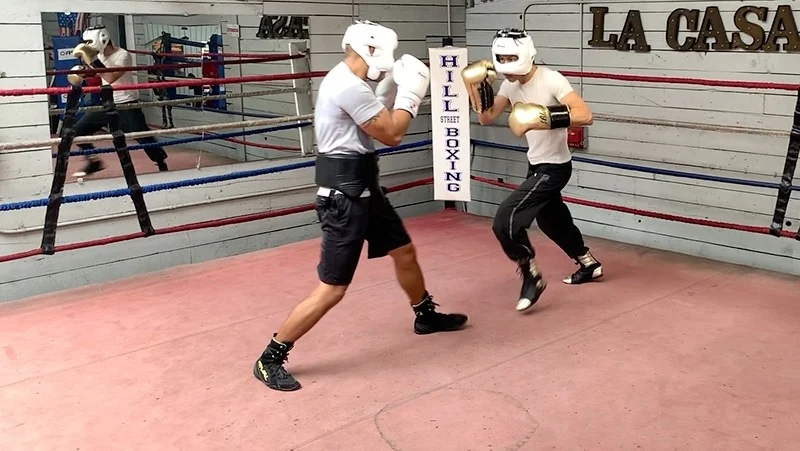
To truly maintain control and keep space open, elite fighters utilize lateral movement instead of linear retreat. Circling around an opponent—whether moving clockwise toward their right side or counter-clockwise toward their left—represents the only reliable method for preserving operational space within the squared circle. This lateral approach offers distinct mechanical advantages that transform the dynamics of the ring.
First and foremost, lateral movement never runs out of space. While linear backpedaling inevitably ends at the ropes, circling allows a fighter to continually generate new pathways of movement, retaining the option to step backward only as a genuine last resort. By moving sideways, the athlete keeps the opponent constantly off-balance and thinking, preventing them from marching forward unchecked. Fighters cannot effectively launch counter-punches if they are constantly jumping themselves entirely out of range, a common sight in poorly executed retreats where one boxer lands a blow, sends their opponent stumbling, misses a flailing counter in the empty air, and gets caught again as the aggressor closes the gap.
Observing legendary masters of the sweet science such as Muhammad Ali or Sugar Ray Leonard reveals the true nature of elite outside fighting. To the casual observer, these champions appeared to be running backward away from danger. A closer analysis, however, shows that they were rarely traveling in a straight line. Instead, they combined lateral shifting with a steady, disruptive jab, maintaining optimal punching range while keeping their adversaries perpetually disoriented.
Furthermore, targets moving laterally are notoriously difficult to strike cleanly. Striking at diagonal angles feels profoundly unnatural to a human body conditioned to punch straight ahead. While traditional boxing lore warns fighters to always circle away from an opponent’s power hand, the geometric reality of lateral movement offers a broader protective blanket. A moving target forces an attacker to constantly recalculate trajectory, timing, and distance, breaking their rhythm and blunting the effectiveness of their combinations.
Mastering this movement requires deliberate adjustment of both the circling angle and body posture. The way an opponent perceives your lateral movement changes dramatically depending on whether you circle at a wide, purely sideways angle or press slightly forward into the pocket. Similarly, while traditional defensive lateral movement often involves turning completely sideways and shuffling like a basketball defender, advanced practitioners employ a more fluid approach. By turning the torso sideways and utilizing a rhythmic, skipping motion backward while circling, athletes achieve a slick, dynamic bounce reminiscent of the sport’s greatest technicians.
This rhythmic footwork is complemented by maintaining proper posture. Many inexperienced fighters compromise their defense during lateral movement by popping straight up, elevating their chin, and inadvertently creating a larger target for swinging hooks and crosses. Retaining a slight torso hunch, with the head tucked securely and leaning fractionally toward the opponent rather than upward, preserves elusiveness. Combined with proper conditioning from skipping rope, this posture allows a fighter to bounce laterally while remaining fully prepared to duck beneath incoming punches.
Advanced tacticians also incorporate the two-direction switch to completely unravel an opponent’s timing. By feinting or taking a half-step in one direction—such as moving right to draw an opponent’s commitment before sharply cutting left—a fighter creates immediate openings. Alternatively, committing fully to an initial lateral step can catch a hesitant opponent off guard, requiring only one additional movement to complete a clean escape.
Ultimately, true outside fighting is not defined by running backward or retreating in fear. At its core, the concept simply means maintaining continuous, purposeful movement that keeps an athlete in a perpetual state of readiness. As long as a fighter avoids the trap of linear backpedaling and instead relies on lateral angles, head movement, and active positioning, they remain on the outside—even in close quarters. By eliminating the habit of stepping straight back during shadowboxing and heavy bag sessions, fighters can break the cycle of panic and reclaim mastery over the entire canvas of the ring.