After years of remaining at the margins of the traditional sports rights market, Netflix is making its definitive, high-stakes push into live sports broadcasting. A long run of strategic experiments and tentpole programming tests has officially borne fruit, yielding a rapidly growing portfolio of major global sporting events that signal a fundamental shift for a platform that was once entirely ambivalent about the immense costs associated with live sports.
The global streaming giant has steadily increased its footprint. It now broadcasts five National Football League (NFL) games per season, a notable bump from just two games the previous year. Looking ahead to December, the platform is set to carry what is widely regarded as the most-hyped heavyweight boxing contest in a generation, featuring British former champions Tyson Fury and Anthony Joshua as they finally collide at Cardiff’s Principality Stadium.
These high-profile acquisitions confirm a profound directional shift for a platform that long questioned the financial viability of expensive sports rights. However, the streaming titan is moving well beyond one-off set-pieces into longer, more complex, and multi-year broadcast projects. This evolution was underscored by a landmark, comprehensive rights deal for the 2030 FIFA World Cup in Spain, securing a prominent role for the platform in soccer’s signature men’s tournament four years from now.
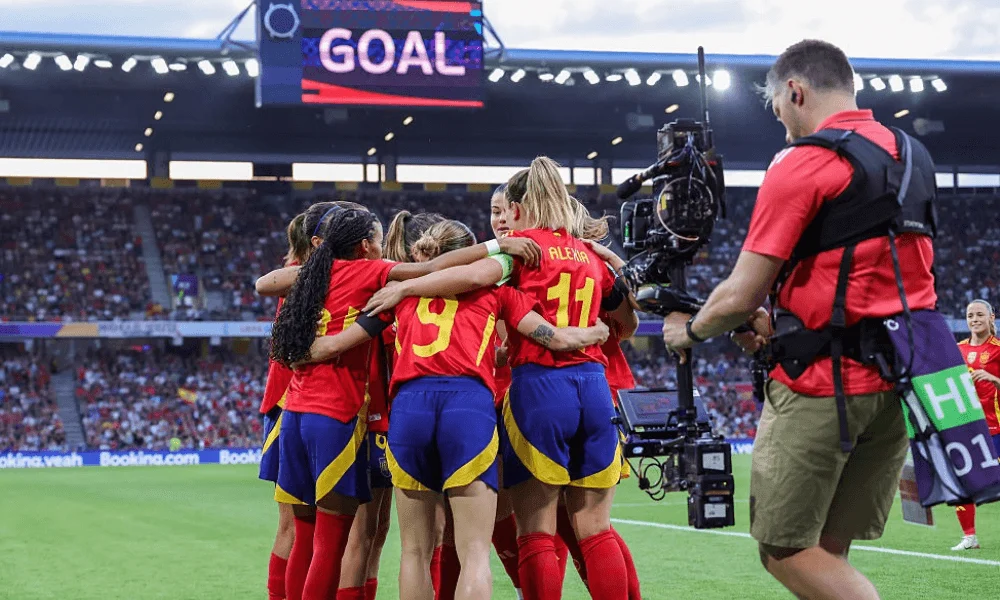
Before that milestone arrives, Netflix will embark upon its most ambitious live broadcast undertaking to date. The company has secured the exclusive home rights for FIFA Women’s World Cup coverage in the United States and Canada for both the 2027 and 2031 tournaments. It is a broadcast brief with considerable regional relevance and strategic geographic alignment, considering the 2027 tournament will be held in Brazil, while the 2031 edition will span the United States, Mexico, Costa Rica, and Jamaica.
Earlier this month, production giant IMG was officially named Netflix’s production partner for both editions of the Women’s World Cup. Speaking at the sports industry conference Leaders Week London at Stamford Bridge in the wake of that major announcement, IMG president Adam Kelly and Brandon Riegg, vice president of nonfiction series and sport at Netflix, sat down to discuss the sweeping scope of the project and its broader implications for live sports during the next phase of the streaming era.
"This is our first foray, obviously, into football, and it’s a massive crown jewel event," Riegg said during the panel. "And I think first and foremost, we want to execute in a way that pleases the fans who show up to watch."
Streaming the Women’s World Cup
The encouraging early performance of live sports on Netflix, coupled with an existing, robust documentary relationship with global soccer governing body FIFA, meant that when the live rights to the tournament went to market in 2024, there was hardly any internal debate over whether a streamer making aggressive inroads into the live event business should place a bid.
"Really, the Olympics and the World Cup, I would argue, are the two biggest global events," Riegg noted. "And so we threw our hat in the ring."
Riegg readily acknowledged the added commercial and logistical appeal of back-to-back competitions hosted in the Americas, with time zones that prove significantly more accessible for audiences in the United States. At the same time, he emphasized the opportunistic nature of the modern rights market, noting that in the sports industry, a broadcaster cannot always predict when a transformative opportunity will present itself, requiring an open-minded and agile approach.
Once the rights were secured, Netflix needed a production vision capable of satisfying discerning sports fans while simultaneously invigorating its commercial partners. Recognizing that the shortlist of production entities capable of managing such a colossal undertaking was exceedingly brief, IMG quickly emerged as the top choice for the streaming platform, leading to early and fruitful discussions between the two companies.
This major assignment arrives during a period of transition for IMG. Company president Adam Kelly admitted he had been eager to discuss the new partnership publicly for over a year. IMG is now a core part of TKO Holdings, the powerful parent company that owns the Ultimate Fighting Championship (UFC) and World Wrestling Entertainment (WWE), whose flagship Monday Night Raw series is also broadcast globally on Netflix.
While the Premier League’s recent decision to bring its production entirely in-house dealt a notable blow to traditional agencies, IMG has maintained a heavy and influential footprint in soccer. The company continues to work closely with major organizations like Major League Soccer (MLS), the National Women’s Soccer League (NWSL), and the Women’s Super League (WSL). Kelly expressed profound optimism about the future, predicting that Netflix will prove to be an incredibly powerful vehicle for women’s sports and women’s football.
"We talk often about trust," Kelly explained. "And one of the huge strengths that Netflix has is the trust of 320-plus million globally, who naturally, when they switch on the device — they hear the ‘tud-um!’ — they feel the trust that there is going to be great content for them to watch. And [Netflix has] earned the right through that trust to push content towards them that they might otherwise not have seen."
Kelly added his belief that the Women’s World Cup will subsequently drive extraordinary audiences and remarkable commercial growth, ultimately benefiting the entire football ecosystem and the broader sports landscape.
Netflix and IMG are not strangers to collaboration in the live sports arena. The two entities previously joined forces to introduce innovative broadcast technology to the Six Kings Slam men’s tennis tournament in Saudi Arabia, successfully deploying a fresh look and feel designed to bring viewers closer to the on-court action.
However, innovation simply for the sake of novelty is not part of the strategic agenda. Kelly expressed a clear wariness of over-engineering the on-screen product, placing a primary emphasis on finding authentic ways to communicate the narrative, the underlying storytelling, the passion, and the raw action to genuinely elevate the viewer’s experience.
A Broader Offer
Live sports is rapidly emerging as a critical commercial differentiator for major digital players, much in the same way it served as the bedrock for conventional linear broadcasters for decades.
"Between the various streaming services, the linear channels, social media and what not, the competition for people’s time and attention has never been greater," Riegg said. "Sports, I think, is proving that it’s one of the few categories of programming that can still aggregate a meaningful audience."
This shift is driven by clear economic imperatives. Even market-leading Netflix has had to battle diligently for steady subscriber growth since the peak of the subscription streaming boom in the early 2020s. Demonstrating the volatile economic realities of the modern media landscape, the company announced a wave of 1,000 redundancies just days after Riegg’s appearance at Leaders Week—marking its steepest workforce reduction since 2022.
Yet, "eventized" live programming uniquely complements Netflix’s broader entertainment catalog, both creatively and strategically. The platform originally established its robust sports presence through critically acclaimed docuseries, such as the pandemic-era basketball smash The Last Dance and the pioneering Formula 1 docuseries Drive to Survive.
During the men’s FIFA World Cup cycle, Netflix successfully captured a substantial share of the global soccer conversation through a strategic partnership with UK-based podcast studio Goalhanger, distributing the popular Gary Lineker-fronted show The Rest is Football. That collaborative partnership has since extended seamlessly into the domestic Premier League season.
By strategically surrounding live sporting events with complementary documentaries, feature films, and topical podcasts, Riegg explained that Netflix makes it remarkably easy for both casual viewers and die-hard enthusiasts to navigate the entire thematic universe of a given subject.
This density of targeted programming fosters another powerful dynamic within the platform. A highly personalized user experience has long stood as the company’s primary competitive advantage, and Riegg firmly believes this recommendation architecture can profoundly influence content discovery.
"Your Netflix is different than my Netflix," he noted, contrasting the platform’s data-driven model with his past experiences in linear television, where programming decisions relied heavily on intuition or historical performance.
According to Riegg, Netflix’s expansive data library frequently generates surprising, counterintuitive insights. For instance, platform analytics reveal that a massive number of subscribers who avidly watch the lavish period drama Bridgerton also faithfully stream Drive to Survive. Similarly, UK audiences who initially tuned in for gritty dramas like Peaky Blinders are frequently funneled toward high-concept Korean hits like Squid Game.
When it comes to high-profile live events, the algorithmic recommendation engine is increasingly bolstered by robust early marketing and promotional campaigns—an operational muscle Riegg insists Netflix has steadily improved over time.
Streaming and Sport’s Multiplatform Future
For Kelly, the broader streaming sector’s aggressive pivot toward live rights serves as a modern restatement of sport’s enduring viability in an increasingly fragmented media environment.
"The power of sport, the superpower of sport, is that live engagement — the scarcity factor and this demand to make and schedule time," he said. "I think that puts a super-premium on people’s commitment to engage with sport, and that commitment is highly valuable, particularly in today’s world."
He argued that the intrinsic authenticity and honesty of live sport become even more compelling when contrasted against the rise of artificial intelligence-generated "infinite content." At the same time, sports rights holders must fully appreciate the importance of maintaining an always-on presence.
"The surrounding content is increasingly important," Kelly added. "As well as creating that funnel, it’s creating the opportunity for non-core fans that have been ready and willing to make that commitment to get access and to be intrigued and to choose to sample and engage with sport in another way."
IMG has invested heavily in proving that establishing direct connectivity between audiences and engagement across traditional television and emerging digital platforms drives significantly better outcomes for commercial brands. This positive feedback loop ultimately delivers stronger results for media partners, encouraging them to reinvest capital into content creation to support deeper audience analysis and engagement.
Looking forward, Kelly expects the content distribution contest to intensify further, noting he wouldn’t be surprised to see major artificial intelligence firms or satellite internet providers like Starlink enter the bidding space. However, he emphasized that this evolving landscape demands a fundamentally different strategic framework for rights holders, moving away from the restrictive "walled gardens" of exclusivity that defined the traditional broadcast era. Instead, he advocates for a multi-touchpoint approach to building and monetizing fanbases by leveraging athletes, dedicated fan channels, and a mix of linear and digital platforms.
For its part, Netflix is steadily carving out a central role within that expanding sports ecosystem.
"We’re a general entertainment platform," Riegg concluded. "If you’re looking to serve your existing fanbase, there are a lot of great options to do that. If you’re looking to reach people that are either lapsed or never-fans or casual fans, we certainly believe that we’re in a great position to help provide that growth, and that comes a few ways."
With the technical infrastructure required to deliver seamless broadcasts now firmly established, Riegg anticipates that live sports—and its unique capacity to satisfy the inherent human desire for unpredictability and clear competitive stakes—will claim an increasingly prominent place within the overall Netflix programming mix.
"Sport transcends language and geography and culture," he added. "And I think storytelling is the same. And so, really, it’s just saying, ‘Who are the best storytellers for us to work with?’ And then going out and saying, ‘These are the stories that we think are the most interesting ones to tell.’ It is literally as simple as that."