


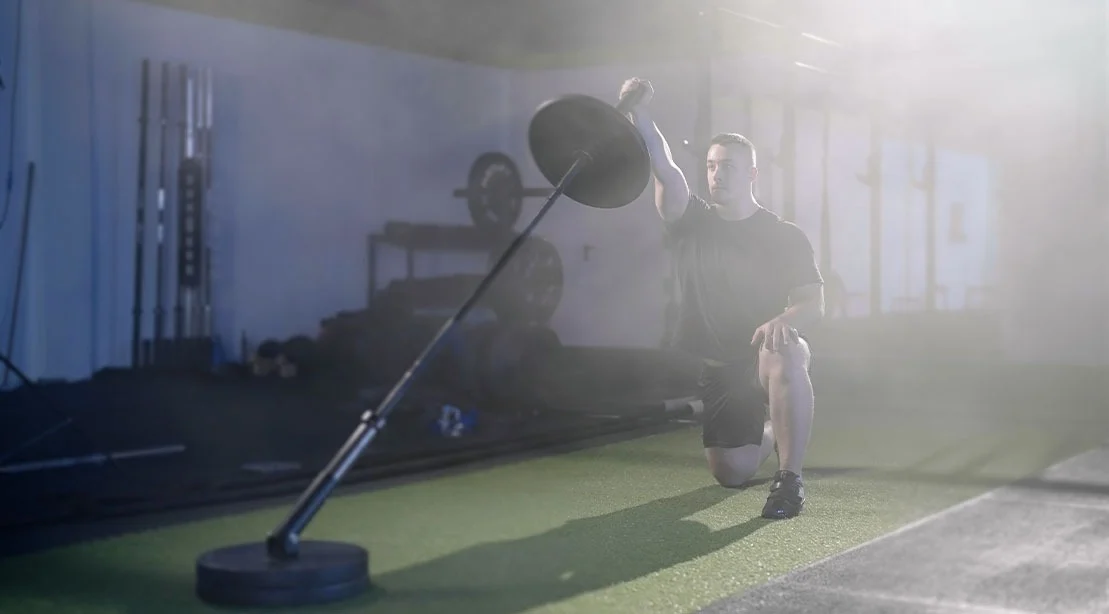
At first glance, the half-kneeling landmine press appears to be one of the most straightforward movements in modern strength training. It requires minimal equipment—merely a barbell anchored in a landmine sleeve and a single weight plate—and the pressing motion itself follows a natural, angled path that is generally kinder to the shoulder joint than a traditional vertical overhead press. Yet, beneath its seemingly simple exterior lies a complex web of biomechanical variables that can make or break the exercise.
Strength coaches and fitness professionals have long debated the finer points of the movement, noting that lifters frequently undermine their shoulder development not by lifting with poor intent, but by botching the initial setup. When a lifter dials in their mechanics, the half-kneeling landmine press becomes an exceptional tool for building robust, stable shoulders while reinforcing core engagement. When those details are ignored, however, the athlete spends the duration of the set fighting the barbell rather than driving force through it, ultimately leaking valuable gains before a single repetition is completed.
The underlying challenge of the movement is that no single configuration works universally for every athlete. Individual anatomical differences—such as limb length, torso proportions, and hand size—interact with the fixed geometry of the landmine apparatus to dictate the ideal starting position. Because these factors vary widely from person to person, mastering the lift requires a systematic approach to pre-lift preparation, focusing on critical decisions regarding knee placement, stance width, grip selection, distance from the anchor point, and core bracing.
Navigating the Stance: Knee Placement and Base Stability
The decision-making process for the half-kneeling landmine press begins with the lower body, specifically with the choice of which knee makes contact with the floor. When an athlete presses the barbell using the right arm, they are presented with two primary configurations. They can place the left knee down and the right foot forward, known in strength circles as an ipsilateral setup, or they can reverse the position by placing the right knee down and the left foot forward, creating a contralateral setup.
Both configurations offer distinct advantages, but they fundamentally alter how the body manages stabilization and rotational forces throughout the torso. Coaches often recommend that developing lifters experiment with both variations, beginning with the contralateral version before transitioning to the ipsilateral setup to determine which configuration produces the strongest press without triggering compensatory movement patterns in the lower back or hips.
Once the knee configuration is chosen, refining the half-kneeling stance becomes paramount. The front foot must be planted firmly with the ankle positioned directly beneath the knee, while the back knee should remain aligned beneath the hip rather than trailing too far behind the torso. To successfully resist the rotational forces introduced by pressing a weighted barbell from a lateral angle, lifters must maintain a wider lateral base between the front foot and the back knee, visualizing two distinct railroad tracks rather than a single tight line.
Establishing tension within this reduced base of support is critical. Lifters are routinely advised to actively squeeze the glute muscle on the side of the downed knee while ensuring the entire sole of the front foot remains glued to the floor. This deliberate engagement builds a stable foundation from the ground up, preventing the hips from shifting and ensuring that the force generated by the lower body is effectively transferred upward through the core.
Refining Grip, Distance, and Alignment
With the lower body secured, attention shifts to the upper body mechanics, starting with how the barbell is gripped. The end of a standard barbell sleeve can present challenges depending on hand size and sleeve thickness, meaning lifters must choose between a cupped grip—where the palm cups the end of the bar with fingers wrapped around the rim—and a sleeve grip, which involves wrapping the hand directly around the sleeve itself with the thumb positioned securely.
Regardless of the chosen grip, the objective is to maintain a wrist-over-forearm alignment that maximizes pressing power and prevents hyperextension. If a lifter forces themselves to use an awkward grip that compromises this wrist position, the entire kinetic chain suffers, placing undue stress on the wrist joint before the pressing phase even begins.
Distance from the landmine anchor point represents another critical variable that dictates success. Kneeling too close to the apparatus forces the barbell to crowd the shoulder, making it nearly impossible to establish a comfortable elbow and hand position while causing the lower back to arch and the ribs to flare outward. Conversely, positioning oneself too far away requires the lifter to lean or reach forward just to grasp the bar, disrupting the vertical stack of the ribcage over the hips. The ideal sweet spot allows the athlete to remain tall, with the elbow tucked underneath and slightly in front of the hand so that the forearm tracks parallel to the angled path of the barbell.
Before initiating the press, the final piece of the puzzle involves establishing a rigorous core brace. By taking a deep breath into the belly and locking the core, the lifter maintains pressure on the front foot and a light squeeze in the rear glute, keeping the torso square and tight with the belt zipper facing directly forward.
When all of these elements—stable knee placement, appropriate distance, secure grip, optimal bar positioning, and whole-body tension—are meticulously addressed, the half-kneeling landmine press delivers on its promise of building bolder, healthier shoulders. Overlooking even minor details, however, turns a powerful developmental exercise into an exercise in frustration, underscoring the reality that in strength training, the setup dictates the result.