

The opening weeks of the track and field season regularly present coaches with a demanding logistical puzzle. As dozens of athletes arrive on the track with varying degrees of physical maturity, technical competence, and conditioning, coaching staffs must quickly assess individual potential while building a sound athletic foundation. For Graham Eaton, a veteran sprint and hurdles coach at Triton, the start of every campaign brings a mix of anticipation and operational friction. Confronted with rosters that can reach up to 40 athletes spanning diverse disciplines, the primary objective is straightforward yet deceptively difficult: lay down technical fundamentals without overwhelming athletes or pushing them into overtraining.
At the core of Eaton’s coaching methodology is an uncompromising principle: hurdlers and jumpers are, first and foremost, sprinters. Rather than siloing technical events away from flat sprinting, Eaton structures his training philosophy around the premise that raw acceleration and maximum velocity establish the ultimate performance ceiling for horizontal jumpers and hurdlers alike. To effectively manage training loads while identifying emerging talent across large groups, Eaton relies on three versatile warm-up drills—the "rain dance," progressive galloping, and the standing triple jump. These exercises serve a dual purpose, functioning simultaneously as foundational teaching tools and low-stress talent screening mechanisms.
Historically, Eaton’s coaching responsibilities encompassed the entire speed-power spectrum, including the 100-meter through 400-meter sprints, sprint relays, both short and long hurdle races, the long jump, and the triple jump. Balancing such wide-ranging event groups under tight scheduling constraints demanded creative practice design. The addition of dedicated jumps coach Tyler Colbert has helped distribute the program’s tactical workload, allowing the staff to communicate and coordinate microcycles more effectively. By aligning jumping and hurdling sessions with daily training themes—such as acceleration, maximum velocity, or tempo—the Triton coaching staff keeps overall training density and impact volumes within sustainable boundaries while maintaining athlete health.
Even with improved coaching ratios, the challenge of developing athletes who compete across multiple disciplines remains. It is common for versatile athletes to contest the high jump, long jump, and hurdles alongside relay assignments. In the initial phases of the season, coaches often face the reality that technical refinement cannot be rushed across every event simultaneously. To prevent preparation gaps on competition day, Eaton embeds foundational movement patterns directly into daily warm-ups. These general drills establish essential movement prerequisites, require minimal equipment, and can be peer-coached by athletes when coaches are occupied with other event groups.
The ‘Rain Dance’ Drill for Hurdlers
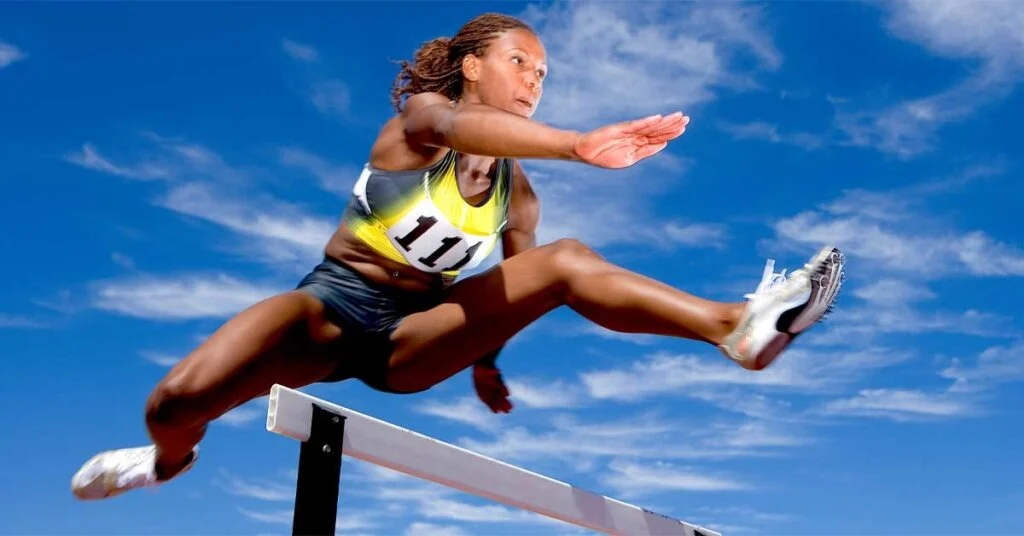
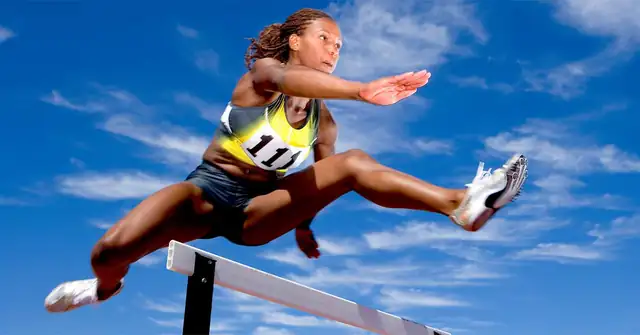
Within Eaton’s system, hurdle training is organized with the technical focus typically reserved for field events, yet grounded entirely in sprint capabilities. The rationale is direct: regardless of technical flexibility, an athlete who lacks fundamental foot speed cannot reach competitive heights over hurdles. In practice, hurdlers complete either the entirety or the vast majority of the sprint group’s running workouts before breaking off slightly early to initiate event-specific technical preparation. They subsequently finish their sessions with block starts over hurdles or reduced-volume repetitions with lowered heights and shortened spacing.
Talent identification in the hurdles hinges heavily on baseline speed. In high school and developmental settings, young runners frequently struggle to execute the conventional three-step rhythm between hurdles simply because they lack the requisite stride power and sprint velocity. Eaton notes that among male hurdlers in his program, every individual who successfully transitioned to efficient three-step mechanics possessed a 100-meter sprint capability under 12.0 seconds. As Eaton highlights, absolute speed remains the single most reliable predictor of future success across any track and field discipline.
To introduce hurdle mechanics to large groups without the risk of collision or fatigue, Eaton utilizes the dynamic "rain dance" drill. In doing so, he has moved away from traditional static lead-leg drills performed against hurdles or chain-link fences. While static barrier drills for the trail leg retain instructional value—especially for building isometric hip strength, active dorsiflexion, and proper clearance underneath the armpit—static lead-leg drills often backfire. When novice athletes perform stationary lead-leg work, the movements tend to become passive and detached from the physical realities of sprinting. Instead of attacking the ground, athletes frequently develop poor motor habits, casually flicking their feet over the crossbar without proper torso stability or aggressive arm coordination.
The dynamic "rain dance" drill rectifies these deficiencies by demanding dynamic rhythm and continuous self-organization. The drill teaches athletes how to attack the barrier with proper posture and active hip displacement rather than relying on an exaggerated, floating leap. By executing the exercise at speed, athletes learn to maintain balanced arm positioning and coordinate ground contact without the jarring impact of a standard hurdle landing.
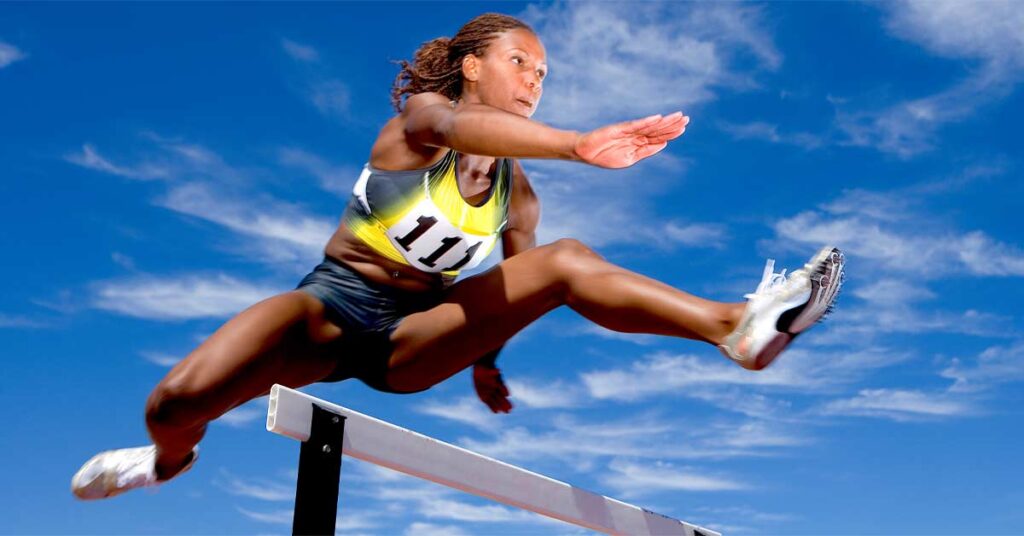
From a program management standpoint, the rain dance offers substantial practical efficiency. Because the drill can be performed simultaneously by dozens of athletes on flat ground, it functions as an immediate screening tool early in the season. Athletes who demonstrate natural cadence, rhythmic intelligence, and rapid foot strikes during the exercise reveal an innate aptitude for hurdling. In smaller school environments where coaches must actively recruit and allocate talent across events, this drill offers a reliable indicator of potential before an athlete ever lines up against a full-flight obstacle.
Gallop Drills and Takeoff Preparation in the Long Jump
In the horizontal jumps, converting raw runway speed into effective vertical projection represents the primary technical barrier for developing athletes. Basic physics suggests that sprinting prowess should translate directly into long jump success. Yet track programs regularly encounter fast sprinters who falter on the runway, repeatedly decelerating, reaching with an extended leg, stuttering before the take-off board, or planting passively on their toes. These technical breakdowns blunt horizontal momentum and elevate injury risk.
To bridge the gap between sprint mechanics and runway takeoff dynamics, Eaton utilizes the galloping drill, frequently referred to in jumping circles as the "Field Frolicker" progression. The gallop essentially isolates the penultimate foot strike and the subsequent takeoff action. By stripping away the psychological pressure of a full approach run and the spatial anxiety of hitting the plasticine board, the drill allows jumpers to rehearse high-quality takeoffs in continuous succession across the turf or track surface.
Eaton approaches the galloping progression through three distinct variations:
The sequence begins with the low repeated gallop, which focuses on rhythm, posture, and coordination rather than explosive displacement. In this low-intensity phase, the athlete concentrates on delivering a quick, active push off the penultimate foot, immediately followed by a flat, rolling plant of the takeoff foot. Athletes are instructed to lock their vision straight ahead at eye level to prevent the forward torso collapse that commonly ruins takeoffs.
Once athletes display consistent timing in the low variation, they progress to a higher, more dynamic gallop. The elevated iteration forces the athlete to strike the ground with greater authority, demanding rapid repositioning of the takeoff limb. In this phase, the takeoff leg extends more fully while the free knee drives dynamically, closely mimicking the postural alignments seen at the climax of a competitive long jump takeoff.
The final progression blends the gallop directly into a sprint. This transition drill tests whether an athlete can execute an aggressive takeoff movement without shedding sprint velocity. The arm mechanics in this variation become increasingly pronounced, requiring a firm arm block while the opposing arm drives back and up to counterbalance rotational forces.
Integrating galloping drills into regular training microcycles provides coaches with immense programmatic flexibility. Eaton incorporates these movements as neuromuscular warm-up exercises prior to 10-meter fly sprints on maximum-speed days, blends them into acceleration complexes, and employs them as preparation tools prior to short-approach jumping sessions. Beyond jump-specific preparation, the drill serves as an exceptional elastic plyometric exercise for the entire sprint roster. It challenges spatial awareness, posture, and reciprocal hip action, giving athletes a tangible physical reference point for how ground force application must feel at high velocities.
The Standing Triple Jump as a Foundation for Force and Rhythm
If the long jump requires a precise conversion of velocity into lift, the triple jump demands exceptional structural discipline and patience. Rushing novice jumpers into full-approach triple jumps is often counterproductive, exposing underdeveloped joints to extreme ground reaction forces and cementing technical flaws that are difficult to undo. This risk is particularly acute among multi-sport athletes, such as basketball players transitioning to the track in the spring, who may possess vertical spring but lack the specific multi-jump stability required for horizontal bounding.
Eaton utilizes the standing triple jump as a controlled pedagogical tool to teach phase distribution, landing control, and force application at moderate intensities. Conducted on grass or artificial turf to minimize orthopedic stress, the drill begins from a stationary, two-footed stance. Using an coordinated double-arm swing to initiate forward momentum, the athlete drives horizontally off both feet to land firmly on their primary takeoff leg. The opposite thigh is driven aggressively until parallel with the running surface, after which the jumper executes the second and third phases before finishing with a balanced, two-footed landing.
Throughout the initial stages of instruction, linear distance remains secondary. The emphasis rests entirely on posture, rhythm, and flat-footed, active ground strikes. Athletes are taught to keep the torso tall and upright, avoiding excessive forward lean that compromises the subsequent phases. Verbal rhythmic cues—such as "left-right-together" or "right-left-together"—are frequently used until the mechanical sequence becomes second nature.
As athletes master the cadence, they are encouraged to apply greater intent and extend their distance. Naturally, athletes begin to self-organize, learning that an overly steep, high takeoff on the initial phase inevitably destroys the balance needed to execute the second and third phases. This self-regulating mechanism teaches jumpers to adopt the lower projection angle off the board that is vital for successful full-approach triple jumping. During dense competitive periods featuring multiple meets per week, high-intent standing triple jumps can substitute for high-impact runway workouts, offering technical maintenance without inducing systemic fatigue.
Unifying Technical Events Through Movement Literacy
The integration of foundational drills reflects a pragmatic response to the modern reality of high school and collegiate track coaching. Eaton credits the structured coaching alignment at Triton—anchored by a distance-focused head coach alongside dedicated assistants handling sprints, jumps, and throws—with allowing the staff to refine their training schemes. However, for programs operating with smaller staffs, overlapping general preparation with technical skill development is an essential strategy.
Bridging the divide between flat sprinting and event-specific disciplines does not require complex or burdensome workout architecture. By investing heavily in movement literacy during the first several weeks of the general preparation phase, coaching staffs establish movement patterns that pay dividends throughout the championship season. The initial strides between the blocks and the first barrier, the mechanics of the penultimate step, and the discipline to maintain a tall torso through ground contact can all be introduced via low-impact, high-frequency exercises.
When drills are treated not as passive filler, but as intentional assessment protocols, they transform general warm-ups into valuable instructional periods. By prioritizing raw speed development and refining technical mechanics through dynamic exercises like the rain dance, multi-phase gallops, and standing triple jumps, coaches can successfully uncover and maximize talent across multiple events while safeguarding athlete durability for the long competitive season ahead.