

More than three decades after the cinematic debut of Rocky IV, gym-goers and athletes across the globe still routinely turn to the film’s driving, adrenaline-charged soundtrack to spark intensity during their hardest training sessions. The 1985 installment of the storied boxing franchise cemented Sylvester Stallone’s titular character, Rocky Balboa, as a lasting symbol of raw determination, grit, and Spartan work ethic. While the movie’s central plot focused on the dramatic clash between Balboa and the seemingly invincible Soviet powerhouse Ivan Drago, it was the film’s celebrated montage—showing Balboa preparing in the isolated, freezing expanse of the Siberian wilderness—that forever altered the visual language of sports training cinema.
Over the years, millions of viewers have marveled at Balboa’s primitive, snow-covered regimen, which pitted rudimentary farm implements and natural elements against Drago’s state-of-the-art sports science laboratory. Yet, while the aesthetic of dragging sleds across frozen tundras and chopping down timber in sub-zero conditions captures the imagination, it remains largely inaccessible to the average fitness enthusiast bound to a municipal fitness center or neighborhood commercial gym.
Bridging that gap between cinematic lore and practical fitness application, Russian boxer and digital content creator Artem Puzin—widely recognized across social media platforms under the moniker "Puzin the Motivator"—recently took on the task of reimagining Balboa’s historic regimen for modern indoor facilities. Puzin meticulously reverse-engineered the movements showcased in the film, adapting each drill so that ordinary athletes can experience the same conditioning stimulus indoors without facing the threat of hypothermia or frostbite.
The ambitious project quickly caught fire across social channels, ultimately reaching the highest possible authority on the subject: Sylvester Stallone himself. The Hollywood veteran and creator of the Rocky saga officially signaled his approval by liking Puzin’s Instagram Reel showcasing the routine. For Puzin, the Hollywood star’s digital nod was far more than an ordinary piece of social media engagement; it served as a deeply meaningful validation of his craft, discipline, and artistic intent.
Following the interaction, an visibly moved Puzin addressed his growing audience directly on camera to reflect on what the gesture represented to him as an athlete. He noted that the recognition from Stallone confirmed that authentic effort and respect for the craft resonate far beyond superficial digital trends.
"This is a sign for me to not just copy the workout and put it on the internet," Puzin stated when describing the experience. "Hard work and discipline is seen by legends, so I’m sure everything I do is worth it."
Puzin has steadily established himself within the combat sports community by crafting high-intensity, functionally grounded workout material. Rather than leaning on trendy exercise fads, his training style draws deep inspiration from revered combat champions, including former undefeated UFC lightweight champion Khabib Nurmagomedov and legendary three-time Olympic Greco-Roman wrestling champion Aleksandr Karelin. By combining the grinding endurance of wrestling, the hand speed and agility of competitive boxing, and the uncompromising conditioning of old-school strength athletics, Puzin has cultivated a dedicated following of combat practitioners and general gym-goers seeking authentic physical development.
In his Rocky IV tribute, Puzin deconstructs the key physical attributes Balboa needed to prepare for his fictional battle with Drago: kinetic chain strength, neck and trap endurance, rotational abdominal power, footwork, and unyielding cardiovascular stamina. By translating these traits into traditional gym exercises, Puzin offers a complete blueprint that honors the spirit of the silver screen while adhering to sound conditioning principles.
Artem Puzin’s Rocky IV-Inspired Gym Workout
The conceptual foundation of Puzin’s program is rooted in functional resistance and metabolic conditioning. In the 1985 classic, Balboa was forced to strip his training back to the absolute bare essentials, relying on improvised tools in an unheated barn surrounded by snow drifts. Drago, by contrast, was monitored by squads of sports scientists, heart-rate monitors, and pneumatic resistance machines.
The thematic brilliance of the film was its celebration of human will over mechanized perfection. Puzin takes that philosophy and turns it inside out: he brings Balboa’s rustic, improvised movements directly into the modern weight room, proving that the heart of old-school preparation lies in the movement patterns themselves rather than the geographical setting.
To replicate the session, an athlete needs only a standard commercial gym setup equipped with a pull-up bar, free weights, an adjustable cable pulley station, a flat or incline bench, and basic boxing accessories. The routine moves systematically through upper-body structural integrity, lower-body foundation, cardiovascular speed, dynamic rotational core strength, and multi-joint overhead pressing power.
Artem Puzin’s ‘Rocky IV’ Workout, Reviewed
The workout kicks off with an exacting upper-body test drawn directly from one of the montage’s most visually memorable strength exercises: Stallone’s alternating pull-up variations. In the film, Balboa is seen gripping an overhead wooden beam, pulling his chin smoothly to the front of the beam before alternating and raising the back of his neck toward the support on the subsequent repetition.
Puzin recreates this sequence on a standard gym pull-up bar. The alternating mechanics serve a distinct biomechanical and combat-specific purpose. Pulling to the front emphasizes the latissimus dorsi and biceps, while raising the bar behind the head recruits the upper trapezius, rhomboids, and rear deltoids, alongside significant isometric demands on the cervical spine and neck musculature. For a boxer facing an opponent possessing devastating punching power like Drago, developing a heavily fortified neck, upper back, and shoulder girdle is critical for absorbing blunt-force trauma and mitigating head acceleration upon impact.
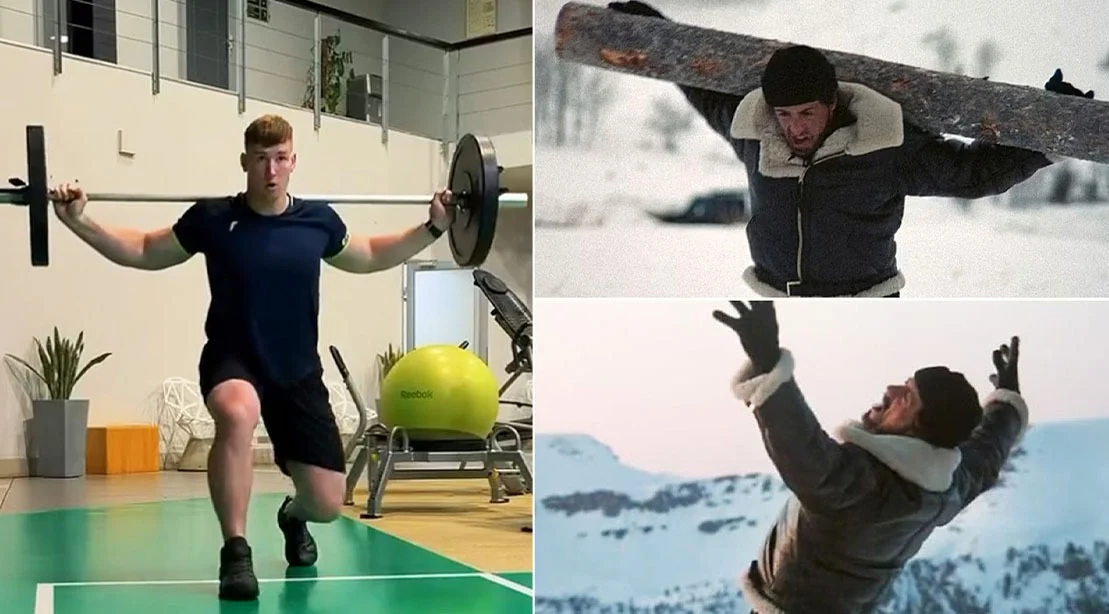
Moving from the upper body down to the hips and legs, Puzin transitions into barbell walking lunges. In the cinematic narrative, Rocky developed lower-body drive and stabilizing endurance by trudging through waist-deep Siberian snowpacks and dragging sleds across uneven, icy terrain. Walking lunges with a loaded barbell across the shoulders replicate that grinding, unilateral resistance. The movement forces the quadriceps, glutes, and hamstrings to fire continuously while demanding constant micro-adjustments from the stabilizing muscles of the ankles and hips. By performing this movement on solid gym flooring, athletes can build a rock-solid, grounded foundation without the real-world hazard of slipping or sustaining joint injuries on frozen surfaces.
With the foundational strength work established, Puzin turns up the metabolic heat, transitioning into a pairing of coordination, foot speed, and core endurance. The athlete takes up the jump rope, focusing on blistering cadence, rapid double-unders, and rhythmic footwork to elevate the heart rate and hone the light-footed agility necessary for high-level boxing.
Immediately following the jump rope interval, the routine moves down to the mat for twisting sit-ups combined with shadow boxing at the apex of each repetition. As the torso rises through the concentric phase of the sit-up, the athlete unleashes sharp, crisp rotational punches into the air. This combination taxes the rectus abdominis while demanding rotational force production from the internal and external obliques, directly reinforcing the mechanical link between a braced core and striking mechanics.
One of the montage’s most inventive moments featured Balboa standing beneath an overhead pulley in the barn rafters, repeatedly hoisting a heavy burlap sack filled with rocks. To translate this unique functional movement to the gym floor, Puzin turns to the adjustable cable station. Selecting a dual-rope attachment on a high-to-mid pulley, he executes a compound pulling movement that initiates with a dynamic trunk rotation and finishes with a pronounced triceps extension. This multi-joint exercise effectively mimics the uneven, full-body demand of the original rock-pulley hoist, heavily engaging the abdominal wall, lats, posterior shoulders, and triceps in a smooth, continuous loop.
Puzin then shifts the focus back to targeted trunk stability through bench-assisted straight-leg hip raises. Performing this exercise requires the athlete to maintain strict control over the lower kinetic chain, initiating the movement from the lower abdominal wall and hip flexors before elevating the hips vertically off the bench. The exercise intensely recruits the rectus abdominis, obliques, adductors, and quadriceps, developing the deep abdominal compression needed to maintain posture and defensive stability during prolonged physical exertion.
No boxing-inspired routine would be complete without defensive fundamentals, and Puzin channels Balboa’s Philadelphia slugger identity through focused slip rope drills. By setting up a taut cord across the training space, the athlete bobs, weaves, and shifts head position smoothly beneath the line. The drill sharpens spatial awareness, reinforces hip mobility, and ingrains the muscle memory required to evade incoming power punches while remaining balanced and primed to counter.
In the film, Rocky’s rustic strength training also famously featured a heavy wooden yoke balanced across his shoulders, which he twisted rhythmically against the resistance of the elements. While specialized strongman facilities might house dedicated iron yokes, Puzin demonstrates that standard gym equipment works just as effectively: an athlete can rest an Olympic barbell across the upper traps and perform controlled rotational twists. The exercise demands deliberate anti-rotational and rotational resistance from the core, strengthening the lower back and obliques while forcing the lower and upper body to work in unison to stabilize the spine.
To address total-body power output, the routine tackles one of the film’s most dramatic spectacles: the moment Balboa hoists an entire wooden wagon loaded with his wife Adrian, brother-in-law Paulie, and trainer Duke. For the solo gym practitioner, Puzin translates this feat of agricultural strength into a strict or push barbell overhead press. Pressing heavy iron overhead demands rigid core bracing, leg drive, and massive vertical pressing power from the shoulders, triceps, and upper chest, capturing the raw athletic intent of Balboa’s cinematic lift.
While the routine captures the uncompromising spirit of the 1985 classic, it represents an undeniably grueling physical test. Athletes looking to incorporate Puzin’s program into their weekly regimens are encouraged to tailor the overall volume, adjusting the sets and repetitions to match their personal training background and conditioning thresholds.
For those who navigate the entire routine and still wish to emulate Balboa’s final, triumphant sprint to the summit of the mountain—where he stood victorious in the snow shouting the name of his Russian adversary—Puzin’s workout leaves only one logical conclusion: heading straight to the gym’s stair climber for a high-intensity cardiovascular burnout.