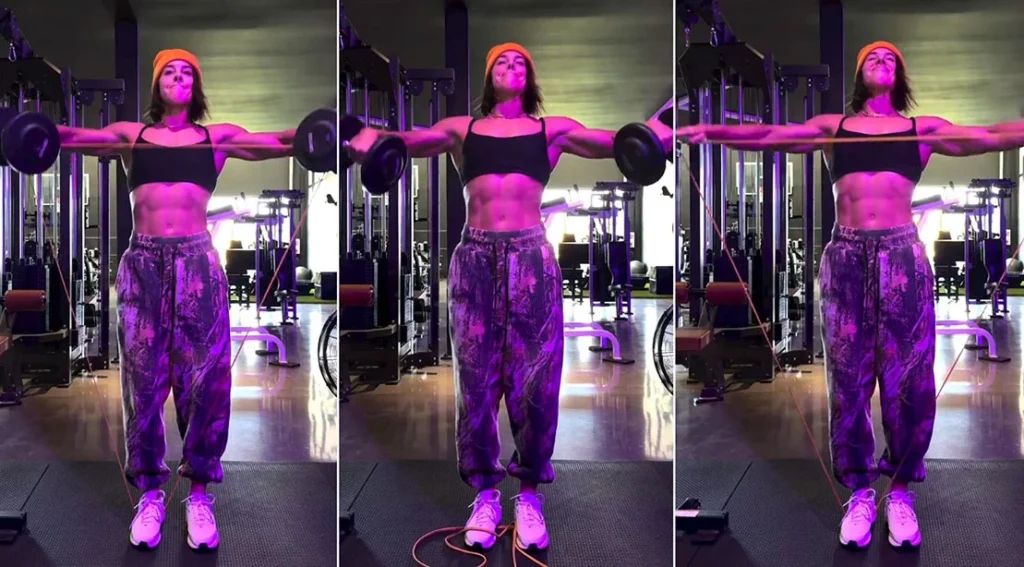

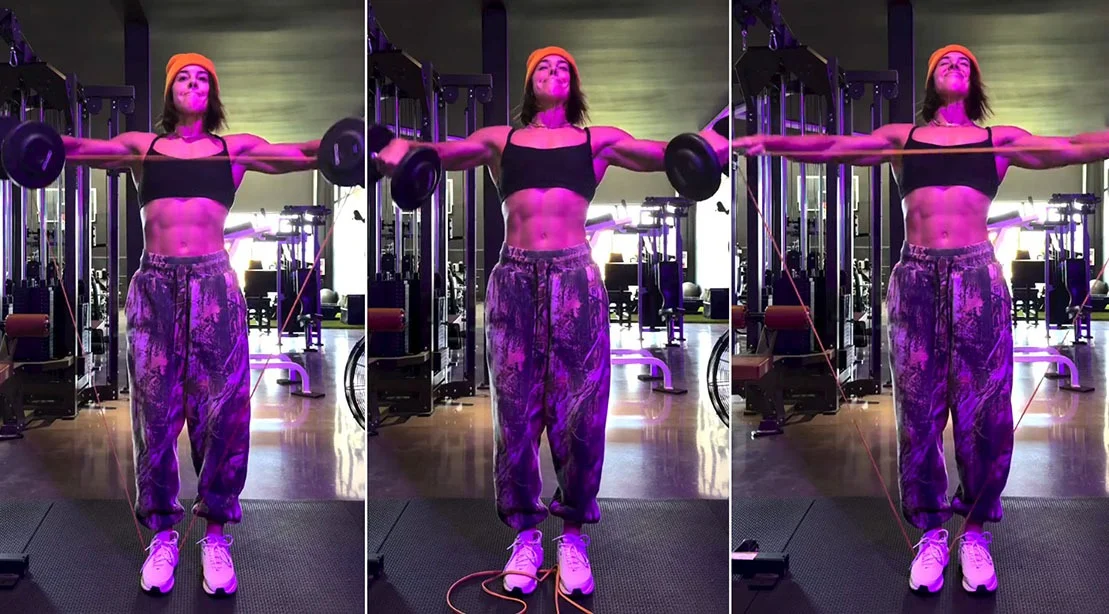
If you have spent any significant amount of time in the weight room, you are likely familiar with the quiet dread of workout monotony. Cranking out the exact same number of repetitions, set after set, week after week, can lead to both physical and mental plateaus. For lifters looking to inject some fresh intensity into their routines, 2013 Olympia Women’s Physique champion Dana Linn Bailey has recently stepped forward with a specialized shoulder workout designed to shock the muscles into new growth. In a recent update shared with her millions of followers on Instagram, Bailey demonstrated how she replaces the traditional, straightforward dumbbell lateral raise with a punishing technique she refers to as the "Extended Set."
The core movement behind this training philosophy is the classic dumbbell lateral raise, a highly efficient isolation exercise engineered to add mass, width, and sharp definition to the upper body by specifically targeting the lateral deltoid. As a lifter raises the dumbbell up and away from the body in an arc, the side delts are intensely activated. Taking this particular muscle group to absolute exhaustion not only adds visual width to the upper physique but also contributes significantly to overall upper-body strength and improved posture.
While there are numerous traditional set protocols that gym-goers routinely apply to lateral raises—ranging from standard three-sets of eight to 12 repetitions up to complex drop sets and ascending pyramid sets—Bailey’s approach offers a uniquely punishing alternative for anyone looking to completely obliterate their shoulders and shatter their existing training limits.
Why Extended Sets Build Bigger, Wider Side Delts
When the primary objective of a shoulder session is to generate maximum tension and push the deltoids to a point of deep exhaustion so they can recover and grow back larger, standard routines sometimes fall short. Bailey’s extended set protocol is deliberately designed to deliver that exact stimulus by combining multiple variations of resistance into one continuous, unbroken block of work.
The sequence begins with the banded dumbbell lateral raise. According to Bailey, who boasts an audience of over two million followers on Instagram, lifters should select a dumbbell weight heavy enough to successfully complete approximately ten repetitions with proper form. The inclusion of the resistance band fundamentally changes the mechanics of the lift. The band provides progressive tension, becoming heavier and more demanding as the weights are raised away from the body. Crucially, that same band also exerts downward tension during the eccentric, or lowering, phase of the movement. Bailey emphasizes to her followers that they must actively resist the pull of the band on the way down rather than simply letting it snap their arms back to their sides prematurely.
Once those initial ten banded reps are completed, the lifter immediately transitions to the second phase of the set by dropping the band entirely while retaining the exact same dumbbells. Without taking a break to rest, the lifter continues performing standard lateral raises with the dumbbells alone, repping out until they reach muscular failure. This seamless transition ensures that the muscle fibers, already fatigued from the banded resistance, are driven deeper into exhaustion under a slightly altered resistance profile.
The final phase of the extended set pushes the shoulders to their absolute limit by eliminating the dumbbells and returning exclusively to the resistance band. With the weights put down, the lifter picks the band back up to execute rapid quarter repetitions, often described as pulses, and continues these until they hit complete failure. This final phase guarantees that every last drop of physical energy is squeezed out of the working muscles.
Reflecting on this specific movement, Bailey notes that these continuous quarter reps have become an absolute staple in her own training regimen. She acknowledges that while the pulsing motion might deceptively feel manageable during the very first few seconds, the metabolic stress and burning sensation accumulate at an accelerated rate. Despite the intense discomfort, Bailey maintains that a brief pause of only five to ten seconds is all that is required before pressing forward to the finish line. In her coaching notes to her audience, she explains that she typically squeezes out an additional twenty to thirty repetitions during this final burnout phase, encouraging her followers to embrace the intense muscle burn rather than shying away from it.
For Bailey, the primary appeal of utilizing extended sets lies in their unique ability to extend the duration of the working set far beyond the limitations of traditional rep schemes. Even though the final pulses involve a much shorter range of motion, she points out that there is zero break in tension. The muscle remains under constant, unbroken tension at peak contraction throughout the entire sequence.
Sharing further insight into her execution, Bailey mentions that she prefers to use the lightest available resistance band to anchor these extended sets. While she acknowledges that the resulting burn can be intense, her primary message to aspiring lifters is to push straight through the discomfort.