

In modern youth sports, early specialization, highly structured drills, and rigorous travel schedules have increasingly replaced traditional playground free play. Yet, according to youth athletic development specialist Jeremy Frisch of Achieve Performance, the key to building well-rounded, resilient, and high-performing athletes may lie in the simplest activity known to childhood: playing games.
Through carefully designed and modified playground games, coaches can manipulate rules, spatial environments, and participant dynamics to achieve targeted athletic outcomes. Far from being mere entertainment or time-fillers, games such as tag variations, evasion contests, and relay challenges cultivate fundamental motor skills, improve cardiovascular endurance, and foster autonomous problem-solving in ways that rigid, adult-driven drill routines frequently fail to match.
Why Games Outperform Youth Sports
From the perspective of young children, playing games is the most instinctive, recognizable, and engaging pursuit available. Given open space and unstructured time, children naturally gravitate toward chasing, evading, and wrestling. From a coaching standpoint, these instinctual behaviors offer an ideal vehicle for teaching movement mechanics while maintaining high levels of motivation and joy.
Historically, before the widespread rise of private training academies, specialized facilities, and year-round competitive travel teams, children honed their physical literacy in backyards, alleyways, and vacant lots. These spontaneous neighborhood games—often loosely modeled on sports but adapted with participant-created rules—established an environment where young participants experimented with a broad spectrum of physical capabilities.

Crucially, those classic activities took place largely without direct adult intervention. In the absence of an instructor prescribing precise mechanical executions, children were forced to independently devise movement solutions to dynamic challenges. This autonomy nurtured versatile problem-solving faculties and spatial awareness, laying an adaptable foundation that athletes could later apply to the complex, structured environments of competitive sports.
At training facilities like Achieve Performance, foundational movements such as sprinting, leaping, throwing, and catching are initially practiced during warm-ups and skill-acquisition segments. However, the objective with youth athletes is not immediate mechanical perfection, but rather functional foundational competence. Once basic competency is established, coaches transition athletes into dynamic, unpredictable game settings where those skills are tested and reinforced under chaotic conditions.
The following nine games illustrate how coaches can manipulate constraints to target specific athletic qualities while keeping young athletes deeply invested in physical activity.
Flag Tag
Tag remains arguably the single most foundational and athletically valuable game in youth training. Children understand the basic premise without formal instruction, instinctively responding to the thrill of pursuit and evasion. Beyond this simplicity, tag requires virtually no specialized equipment, needing only open space to deliver an extensive array of physical adaptations.
Engaging in tag cultivates rapid decision-making, tracking abilities, tactical evasion, spatial strategy, acceleration, rapid deceleration, sharp changes of direction, and body-control adjustments. Simultaneously, the spontaneous bursts of high-intensity pursuit generate substantial cardiovascular conditioning.
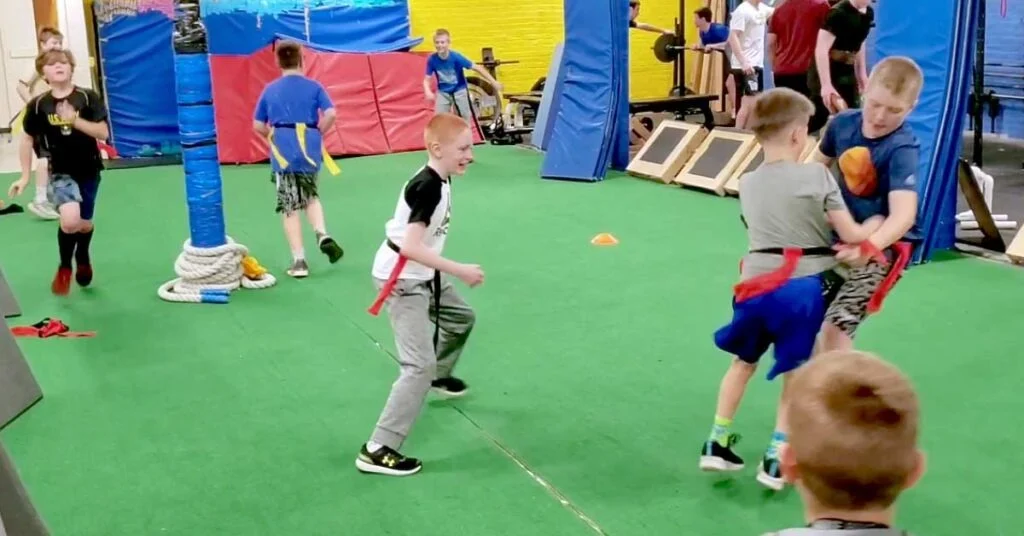
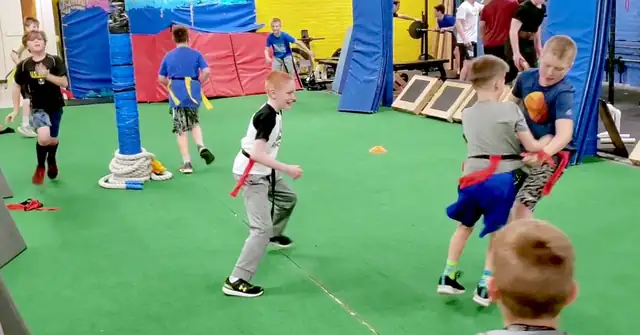
In Flag Tag, coaches add flag-football belts into the equation. Rather than designating a single chaser, every participant simultaneously acts as an attacker and an evader in a last-person-standing competition. The objective is to pull an opponent’s flag while safeguarding one’s own, continuing until a lone winner remains with their flag intact.
Crucially, Flag Tag introduces technical precision by targeting a specific anatomical zone: the hips. For field and contact athletes—particularly in sports like American football, rugby, and soccer—tracking an opponent’s hips is essential for successful defensive positioning and tackling trajectories. The game ingrains this defensive discipline naturally, requiring athletes to lower their center of gravity and track targets precisely under dynamic conditions.
Team Relay Tag
Team Relay Tag introduces a structured time element to the classic game of pursuit, operating inside a defined grid, typically measured at 10 yards by 10 yards. The boundary can be scaled up or down depending on the number of participants. The group is divided into two squads: pursuers and runners.

In this format, each member of the chasing squad takes a turn attempting to tag a runner. Crucially, when an evader is tagged, they are not eliminated from the field; instead, they remain active within the boundary until all chasers have completed their individual turns. The coaching staff records the aggregate time it takes for the chasing team to register tags against the opposing squad. Once the cycle concludes, the teams switch roles, with the fastest overall chasing performance securing the win.
By restricting play to a compact space, the game challenges athletes to execute sharp changes of direction and maintain efficient footwork in tight quarters. Furthermore, having multiple active bodies in a small perimeter creates visual chaos, forcing athletes to rapidly process high volumes of perceptual information under the pressure of a ticking clock.
Power Ball
Inspired by the classic television competition American Gladiators, Power Ball transforms evasion and defensive containment into a structured team contest. In each 30-second round, an offensive player attempts to deposit three separate balls into scoring buckets located across the floor, carrying only one ball at a time. If a defender tags the runner prior to a successful score, that specific ball is eliminated from play for the remainder of the round.
The tactical dynamic of Power Ball hinges on an intentional spatial mismatch: the field always contains one more bucket than there are defenders. For instance, three defenders must collaborate to protect four separate scoring targets. This deliberate numerical disadvantage forces defensive players to communicate, execute lateral shuffles, anticipate angles, and work cohesively to cut off passing or running lanes.

Conversely, the offensive player must scan the floor, recognize shifting vacancies, and exploit defensive overcommitments. The drill sharpens invasion tactics, defensive tracking, and lateral displacement, providing young athletes with realistic perceptual-cognitive training inside a competitive structure.
Move the Mountain
Move the Mountain reinterprets the traditional linear relay race by integrating obstacle negotiation and loaded carries. Rather than asking young athletes to simply sprint back and forth across a flat surface, this event requires them to navigate obstacles while transporting weighted implements.
Relay competitions naturally generate high engagement and team cohesion. By balancing squads—pairing faster sprinters with developing runners against teams of comparable aggregate ability—coaches maintain competitive tension throughout the event.
When obstacles and external loads are introduced, the event transcends basic running mechanics. Athletes are forced to manage shifting loads, brace their midsections, negotiate physical barriers, and regulate pacing while under competitive fatigue, establishing a broad athletic base that simple track sprints cannot replicate.

Runners and Gunners (Pickle)
Rooted in the traditional street game "Pickle"—historically played in neighborhood streets between two throwers passing a ball—Runners and Gunners modernizes the concept for youth athletic facilities. While the 1980s street variation typically involved only a few runners attempting to avoid tags between bases, the updated format utilizes foam or coated-foam balls (such as Gator Skin balls) and accommodates larger groups of runners crossing a central corridor.
In this version, throwers positioned on the perimeters attempt to eliminate runners either by tagging them directly or by hitting them below the waist with a thrown ball. Play continues until only one surviving runner remains.
At Achieve Performance, Runners and Gunners is frequently positioned at the conclusion of training sessions as a conditioning finisher. Because participants are fully immersed in dodging, tracking throwers, accelerating, and evading incoming projectiles, they routinely cover between 300 and 400 total yards of high-intensity running without experiencing the mental monotony associated with traditional conditioning shuttles.
Kings and Pawns
Kings and Pawns blends movement principles derived from wrestling, rugby, and American football into a contained, physical contest. The game pits two opposing teams against each other in a confined area. Each squad designates a "King," who starts standing at the back, positioned behind their teammates, designated as "Pawns," who begin the round kneeling.

The objective is for each King to navigate across the playing surface to the opposing end zone without being tackled or restrained to the ground by an opposing Pawn. Simultaneously, the King’s own Pawns must actively block, engage, and physically redirect the opposing Pawns to create a clear corridor of passage for their leader.
The intense physicality of Kings and Pawns introduces athletes to contact fundamentals in a controlled environment. Aspiring contact-sport athletes learn to tolerate disruptions to their personal space, brace against incoming resistance, maintain base balance while being engaged, and utilize leverage to manipulate opponents.
Boulder Ball
Particularly popular among younger cohorts, Boulder Ball utilizes a large Swiss ball or stability ball—designated as the "boulder"—to create high-engagement evasion and speed drills. The game is executed in two distinct formats.
In the evasion variation, athletes occupy a padded playing zone positioned between two coaches. The coaches gently roll and bounce the oversized stability ball into the playing area, attempting to touch the participants. Athletes must dive, duck, twist, and jump to avoid contact. If a participant manages to cleanly catch the bounding stability ball before it hits the floor, all previously eliminated teammates are restored to the playing area.

The second variation transforms the setup into an acceleration contest inspired by cinematic pursuit scenes. Two athletes start alongside a rolled stability ball and must outsprint the rolling "boulder" toward a landing mat, diving safely onto the target before the ball catches up to them or strikes the mat. This setup encourages aggressive forward lean, rapid acceleration mechanics, and fearless body control.
Hill Sprints
While sprint training on steep inclines may initially sound punishing, contextualizing hill work through competitive games shifts the experience entirely. High-speed running demands sophisticated inter-muscular coordination, a capacity that develops significantly between the ages of 5 and 12.
Hill sprints offer an ideal technical framework for young runners because an incline mechanically enforces proper sprinting posture. The slope naturally promotes the forward body angle required during the acceleration phase of a sprint without requiring intricate mechanical cues from a coach. Concurrently, hill work builds lower-body force output and cardiovascular work capacity under reduced impact stress.
To preserve motivation and ensure appropriate recovery, sprints on inclines are structured as paired match races rather than continuous conditioning drills. Athletes line up in pairs to compete directly against one another, creating built-in rest periods as successive pairs cycle through. This structure ensures that efforts remain focused on maximal speed development rather than fatigue accumulation. When hills are unavailable, heavy sled pushes or resisted sprint devices provide comparable mechanical acceleration demands.

Tug of War
When developing full-body strength in young athletes, traditional Tug of War contests offer functional, high-threshold stimulus without the need for specialized weight-room equipment. Gripping, pulling, and anchoring against an opposing force demands intense quasi-isometric muscle contractions across the hands, forearms, lats, core musculature, and lower extremities.
The contest can be adapted into multiple formats: large squads contesting a heavy rope, pairs battling over a medicine ball or wooden dowel, or athletes attempting to pull each other out of hula-hoops while balancing on a single leg.
At Frisch’s facility, Tug of War is frequently incorporated into multi-station movement circuits for children ages 8 to 10. A representative sequence might combine 20 yards of bear crawls, lateral hand-over-hand travel across a pull-up bar, resisted sled drives, and a final Tug of War bout. This combination challenges total-body stability, grip capacity, and functional pulling strength under high levels of peer engagement.
Playing Now Helps Athletic Performance Later
To construct robust, game-ready athletes, youth training environments must mirror the dynamic, chaotic unpredictability inherent in sports. Standard mechanical drills are inherently pre-programmed, repetitive, and rigid; while valuable for refining specific techniques in later developmental stages, they do not replicate the rapid perception-action coupling demanded by live competition.

Early athletic development should prioritize a broad base of diverse, general movement experiences over narrow specialization. Games achieve this objective by demanding continuous visual scanning, rapid decision-making, and autonomous physical adaptation under fluctuating rules and constraints.
Equally important is the psychological impact on young participants. With youth sport burnout and attrition escalating globally, often driven by hyper-structured environments and premature adult expectations, play-based training rekindles the intrinsic joy of movement. By keeping training engaging, diverse, and fundamentally enjoyable, coaches can build both physical literacy and a sustained, lifelong dedication to athletic activity.