As Peter Farrel
ly’s new film, I Play Rocky, brings fresh attention to the extraordinary, against-the-odds creation of a cinematic milestone—telling the story of a plucky, untried young screenwriter who fought to star in his own script—cinemas and streaming audiences are turning their eyes back to the original source. Fifty years after its initial release, the 1976 classic Rocky is receiving a special anniversary reissue, inviting a new generation to experience its forthright, rousingly idealistic spirit. Wholesome in its essential patriotism, the film unselfconsciously shrugs off the gloomy generic inheritance of the traditional boxing movie, cheerfully discarding the grim baggage of tragedy, cynicism, and loss that so often defined sports dramas of its era. At the same time, it functions effortlessly as a heartfelt love letter to Philadelphia, the historic cradle of American democracy.
When it first debuted, the film introduced the world to writer and insurgent star Sylvester Stallone in the role of Rocky Balboa, a heavy-handed puncher who has just turned 30. Rocky makes peanuts slugging it out with minor-league bums in local rings and is reduced to collecting debts for the Philadelphia mob—an indignity that deeply infuriates his grizzled old trainer and former mentor, Mickey, played with weathered intensity by Burgess Meredith. Mickey once saw genuine greatness in Rocky and is disgusted to see him selling out his physical potential. Curiously, Rocky remains entirely oblivious to the nationwide preparations currently underway to celebrate the 1976 United States bicentennial. In the fabric of the film, boxing serves a cultural role akin to what country music represented in Robert Altman’s Nashville, albeit entirely stripped of that film’s deep disorientation and pessimism.

Our hero is poignantly and quietly in love with Adrianna, universally known as Adrian, played by Talia Shire. Adrian is an almost cartoonishly nerdy young woman from the neighborhood who serves customers from behind the counter at a local pet shop. She lives under the same roof with her shlubby, protective brother, Paulie, a meat packer who vocally hates both his grueling job and his stagnant life. A telling photograph hanging in their shared home displays a younger, much slimmer man proudly wearing a Navy uniform, hinting at a past full of unfulfilled promise. Paulie is constantly attempting to set Rocky up with his sister, aggressively desiring a brother-in-law relationship with the tough guy so that he might secure a coveted job working for Rocky’s wiseguy employer, Gazzo, played by Joe Spinell. Throughout these interactions, Stallone shows how intensely irritated he is by Paulie’s naive demands, not simply because of Paulie’s manifest lack of qualifications for such violent underworld work, but because Rocky deeply hates that he is forced to do it himself.
Having thoroughly established this gritty urban reality, screenwriter Stallone unveils his second act with an exhilarating narrative flourish. World heavyweight champion Apollo Creed—portrayed with an easy, breezy, charismatic confidence by Carl Weathers—arrives in town to defend his title. To his absolute dismay, his scheduled challenger is forced to pull out of the bout due to a sudden injury. Seizing an opportunity for theatrical spectacle, Creed decides to transform his title defense into a living embodiment of the American dream come true. He resolves to fight a local Philadelphia boxer and ultimately selects Rocky simply because he is captivated by his memorable nickname, the "Italian Stallion." Creed and his corporate retinue figure the event will be a thoroughly amusing public relations pastime, fully expecting that the champion will charitably grant a local no-hoper a brief moment in the ring before effortlessly putting him on the canvas.
Yet the tough, canny, big-hearted Rocky has entirely different ideas about his destiny. He begins waking up at four every morning for punishing roadwork, struggling at first just to drag his exhausted body up those monumental steps of the Philadelphia Museum of Art—puffed out and fatigued, but utterly determined to make it to the top. As Rocky, Stallone is clearly a very big, strong man who looks exceptionally convincing inside the ring, even if his physique lacks the razor-sharp, hyper-defined musculature that would later become an absolute cinematic prerequisite for action stars. (Oddly, the film features no traditional weigh-in scene between him and Apollo Creed.) In many ways, the narrative functions as a form of hero-worship directed at the great real-life heavyweight champion Rocky Marciano, whose iconic image is repeatedly invoked throughout the story, while also capturing an Italian-American’s gallant, non-bigoted rearguard action against the inexorable dominance of African-American fighters in the sport. Real-life heavyweight champion Joe Frazier even makes a memorable walk-on appearance in the film.
Rocky thoughtfully explains to Adrian just how punishing professional boxing can truly be, noting how heavily loaded the system is against fighters from his background and how the sport is almost systematically designed to turn resilient men into physical wrecks. When a movie audience hears that Rocky has been promised a life-changing $150,000 as his share of the championship purse, they inevitably wince with anticipation at the impending betrayal that surely must be lurking just around the corner. Viewers expect that he is going to get ruthlessly cheated out of that hard-earned fortune. Similarly, when the loathsome Gazzo hands Rocky a modest $500 for training expenses, the audience winces once again, fully aware that Rocky is now slipping deeper into debt with a dangerous gangster and that Gazzo will eventually demand some sort of quid pro quo. Will Rocky be asked to take a dive in the ring?
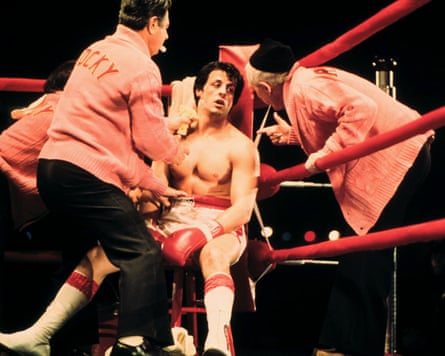
The answer to both questions, by a kind of cinematic miracle, is a resounding no—or at least, viewers can safely assume the answer to the first is no, and it is definitely no to the second. The film appears to acknowledge the melancholy, tragic destiny of Marlon Brando’s character in On the Waterfront and even echoes the ugly racial contests depicted in historical dramas like The Great White Hope, which starred James Earl Jones as the Jim Crow-era Black heavyweight champion Jack Johnson. Yet, remarkably, Rocky manages to turn systemic despair completely on its head.
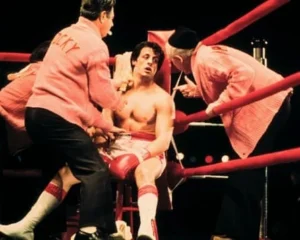
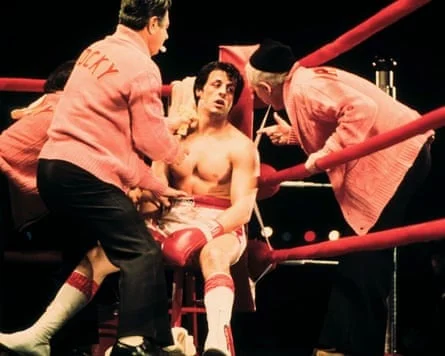
Stallone’s film was famously produced by Hollywood titans Irwin Winkler and Robert Chartoff, who four years later would team up behind Martin Scorsese’s Raging Bull, a masterpiece that restored the raw darkness, psychological agony, and monochrome grit to the boxing genre. Despite the shared genre, the stylistic differences are vast, though thematic similarities occasionally surface. Adrian’s first, extended, and deeply uncomfortable visit to Rocky’s bachelor room bears a striking resemblance to Vickie LaMotta’s first hesitant encounter with Jake in his home. Furthermore, the very notion of a boxer simply wanting to stay upright, absorb punishing blows, and symbolically go the distance mirrors the secular ordeal of Robert De Niro’s self-pitying martyr LaMotta. In fact, Rocky features one distinctly gruesome detail that does not appear in Raging Bull: toward the climax of the bout, Rocky explicitly asks his cornerman to take a blade and cut the tape over his eyebrow, deliberately reopening a severe wound so his swollen eye will gash open and he can finally see his opponent.
That cinematic resemblance, however, essentially ends there. Rocky ultimately secures a powerful moral victory against Creed, who is portrayed not as a villain, but as a complex man with very real human faults. Before the major fight even occurs, audiences see Creed casually discussing lucrative business opportunities in Canada specifically because of favorable tax advantages. Canada, during the American bicentennial celebrations, represented a level of existential disloyalty to Uncle Sam that Hollywood storytelling of the era was never going to let go unpunished. By the final bell, Rocky has succeeded in knocking his formidable opponent down to the canvas at least once while also securing the genuine love of a good woman. It is a timeless story that director John G. Avildsen tells with remarkable simplicity, often moving at a steady walking pace and largely dispensing with stirring, grandiose music on the soundtrack, save for those iconic road-running sequences. Half a century later, the film retains a remarkably enduring kind of innocence.