


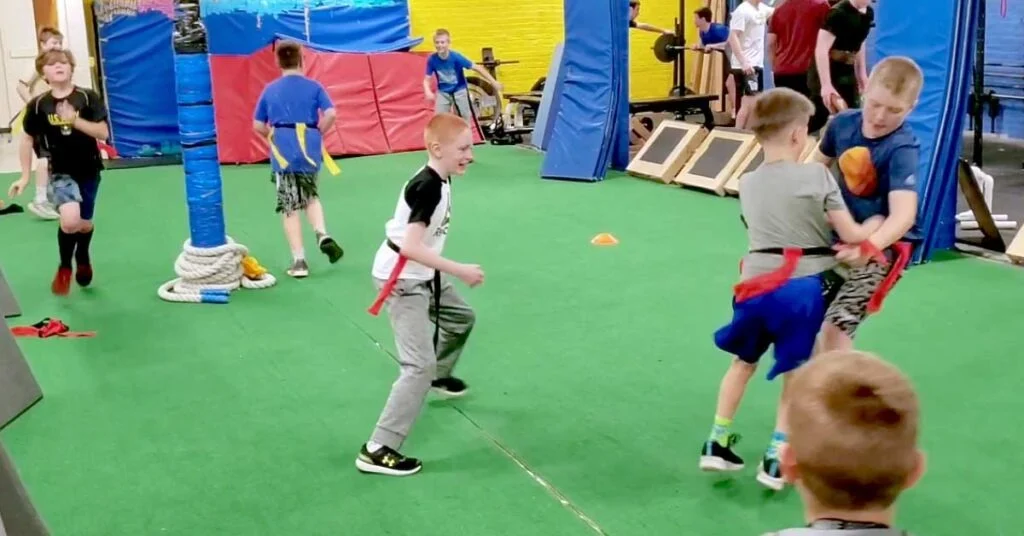
It is no secret that children naturally love to play. Given time and open space, youngsters can be found effortlessly chasing one another in games of tag, wrestling until they tumble to the ground, or inventing elaborate rules for impromptu neighborhood matches. From a child’s perspective, playing games represents the most natural, recognizable, and inherently enjoyable activity in existence. However, viewed through the lens of athletic coaching, these spontaneous activities offer a powerful vehicle for development. Experienced coaches can intentionally harness this natural inclination by adjusting rules, environments, and participant dynamics to foster fundamental athletic capabilities in young athletes.
Renowned coach Jeremy Frisch has long advocated for this approach, highlighting how simple modifications can transform standard playground activities into structured vehicles for motor skill acquisition and overall physical preparedness. In the modern sporting landscape, manipulating the parameters of a game allows coaches to target specific outcomes without stripping away the joy of play. By altering the dimensions of a playing area, changing the rules of engagement, or modifying the number of participants, trainers can elicit vastly different physical and cognitive responses from children.
For instance, expanding the boundaries of a simple game of tag forces players to cover greater distances, thereby enhancing cardiovascular conditioning. Conversely, shrinking the playing area shortens travel distances, placing a premium on rapid decision-making, spatial awareness, and sudden changes of direction. This adaptability makes game-based training an invaluable asset for youth athletic development, bridging the gap between unstructured childhood play and the structured demands of organized sports.

Why Play-Based Training Outperforms Rigid Youth Sports
To truly understand the value of game-based conditioning, one must examine how children historically developed their physical capacities. Long before the advent of specialized training facilities, expensive equipment, and heavily organized travel teams, children spent their afternoons in backyards, neighborhood streets, and improvised fields. These spontaneous, loosely structured games—featuring rules and guidelines invented on the fly by the participants themselves—created an ideal environment for experimentation. Children practiced a diverse repertoire of movement skills organically, without adult intervention or micro-management.
In these self-directed environments, no coaches hovered nearby to dictate precise mechanics. Instead, youngsters were forced to explore varied movement solutions independently. This autonomy fostered high levels of problem-solving adaptability across diverse physical situations. Later in life, these children naturally transferred those foundational competencies into more complex, organized athletic disciplines. Modern youth sports, by contrast, often lean heavily toward early specialization and rigid, drill-based training. This hyper-focus frequently strips away the chaotic, open-ended problem-solving that builds robust motor control.
Within Frisch’s academy, foundational movement patterns—such as sprinting, jumping, catching, and throwing—form the bedrock of athletic potential. Because these basic movements underpin countless sports-specific skills, young athletes must develop an adequate baseline of competence. Rather than seeking immediate mastery, coaches focus on establishing fundamental movement literacy, frequently introducing these patterns during warm-ups or specialized skill-development blocks. Once introduced, these skills are tested within open, chaotic environments where games truly shine as tools for motor skill refinement.
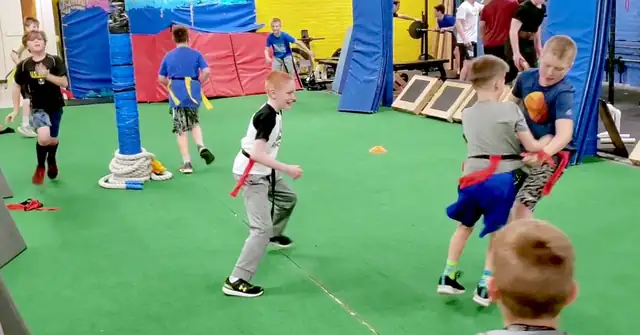
The following collection details several games utilized within Frisch’s training facility, outlining the specific athletic objectives each activity targets. While not an exhaustive list, these suggestions provide coaches with actionable strategies to cultivate general physical preparedness through engaging, movement-rich scenarios.
Classic Tag and Flag Tag Variations
At its core, tag may be the simplest yet most athletically beneficial game available. Children understand the rules intuitively, requiring no formal instruction to grasp the thrill and implicit danger of evasion. Beyond pure enjoyment, standard tag demands nothing more than an open space and a willingness to move.
A standard game of tag naturally develops a sweeping array of athletic capabilities, including decision-making, visual tracking, evasion, tactics, strategy, acceleration, deceleration, changes of direction, and spatial repositioning. Furthermore, the cardiovascular benefits are immense. When modified into flag tag variations, the game introduces an even higher level of precision and tactical awareness.

By attaching football flags to every participant, the dynamic shifts from a single pursuer to an all-against-all, last-person-standing competition. Every athlete acts simultaneously as both hunter and hunted, tasked with pulling opponents’ flags while protecting their own. What makes flag tag particularly effective is the specificity of the target area. Instead of touching an opponent anywhere on the body, flag pulling focuses strictly on the hips. This mechanical detail mirrors the principles taught in collision sports like football, where defenders must leverage a ball carrier’s hips to execute sound tackling fundamentals.
Team Relay Tag and the Element of Time
Introducing time constraints into tag variations fundamentally alters the competitive dynamic, mirroring the temporal structures found in most organized sports. In team relay tag, participants are divided into distinct groups of "chasers" and "runners" typically confined within a 10-by-10-yard grid. Each chaser takes a turn attempting to tag members of the opposing team, while tagged runners remain active within the game until every chaser has completed their turn.
Coaches simply time how long it takes the chasing team to successfully tag all runners before teams switch roles. The group recording the fastest cumulative time wins. This structure emphasizes rapid changes of direction, efficient movement in tight spaces, and the rapid processing of visual stimuli amidst group chaos.

Time creates natural urgency, encouraging efficient movement patterns under pressure. While sports like baseball and golf operate independently of a running clock, nearly all other team sports rely on time elapsed to determine outcomes. Combining scoring metrics with time constraints effectively accelerates the development of movement efficiency in young participants.
Power Ball: Translating Strategy and Evasion
Drawing inspiration from classic television entertainment, Power Ball introduces a focused objective into chaotic movement. In this setup, an attacking player has thirty seconds to deposit three distinct balls into a target bucket, holding only one ball at a time. Defenders attempt to tag the attacker before they can secure a score; if successful, that specific ball is removed from play for the remainder of the thirty-second interval.
The structural setup remains vital to the game’s success. Coaches always ensure there is one more target bucket available than the total number of defenders. For example, a three-person defensive unit must guard four separate buckets. This mathematical imbalance forces defenders to communicate, collaborate, and exert maximum effort to cover open targets. Meanwhile, attackers constantly scan the floor for open scoring opportunities, reading defensive positioning and exploiting gaps created by teammates. This environment reinforces evasion, tracking, defensive sliding, and visual perception.

Move the Mountain and Complex Relevancy
Moving beyond traditional running races, "Move the Mountain" intensifies relay competition by incorporating obstacle traversal and object carriage. While standard sprints evaluate linear speed, adding heavy objects and physical obstacles transforms the event into an entirely different test of functional strength and agility.
Team races allow coaches to balance participant groups carefully, pairing faster children with slower peers to ensure tight, competitive finishes. By forcing athletes to carry weighted items across challenging paths, the activity shifts the physical stimulus far beyond simple maximum velocity, demanding full-body coordination and grit.
Runners and Gunners: High-Volume Conditioning Through Play
Often recognized by its traditional moniker "Pickle," the game known as Runners and Gunners serves as an exceptional tool for cardiovascular conditioning and reactive agility. Historically played with tennis balls in neighborhood streets, modern adaptations utilize soft Gator Skin balls and accommodate large groups of simultaneous runners, continuing until a single participant remains untouched.

Coaches frequently employ Runners and Gunners at the conclusion of training sessions because it drives high-volume running without feeling like traditional conditioning. Young athletes routinely cover hundreds of yards of total distance during a single match, entirely unaware of the cardiovascular strain due to their complete immersion in the game. Attempting to force a ten-year-old to complete repetitive linear sprints of equal distance would yield poor engagement, making dynamic, competitive games an essential strategy for physical development. The activity builds acceleration, deceleration, evasion, dodging, visual tracking, and throwing accuracy.
Kings and Pawns: Introducing Controlled Contact
Combining elements of wrestling and football, Kings and Pawns operates within a confined space to introduce physical contact safely and effectively. Teams feature designated "kings" who stand upright behind crouching "pawns." The primary objective is for a team’s king to traverse the playing area to the opposite side without being brought to the ground by opposing pawns, while their own pawns work collaboratively to block defenders and clear a safe pathway.
Youngsters frequently gravitate toward the chaotic nature of Kings and Pawns. For athletes aspiring to participate in contact sports, the activity normalizes physical proximity, pushing, pulling, and minor collisions. Participants learn to maintain balance while reacting dynamically to an opponent’s movements in tight quarters, fostering physical confidence and spatial awareness.

Boulder Ball: Evasion and Acceleration Scenarios
Utilizing stability balls as rolling hazards, Boulder Ball offers two distinct variations focusing on either evasion or acceleration. In the evasion-focused version, children occupy a padded central zone while coaches gently roll large stability balls toward them, requiring participants to duck, dodge, dive, or lean out of the path of the oncoming sphere. If a player successfully catches the giant ball out of the air, all previously eliminated participants return to play.
The second variation transforms the activity into an acceleration race inspired by cinematic chases. Competitors race against the rolling stability ball toward a protective crash mat, diving safely out of harm’s way before the sphere impacts the landing zone. This gamified approach injects excitement into standard linear sprinting and deceleration drills.
Uphill Sprints and Resisted Acceleration
While traditional conditioning sprints are often viewed negatively by children, intentional uphill running offers a natural solution for proper acceleration mechanics. Running uphill naturally enforces a forward-lean posture, mirroring the ideal biomechanics of the acceleration phase during a sprint. Furthermore, the topography provides built-in strength and cardiovascular stimuli for developing athletes.

To maintain enthusiasm, coaches structure uphill runs as head-to-head competitions, pairing children in duals while maintaining generous rest intervals. Because the objective centers on velocity rather than endurance, adequate recovery ensures high-quality movement execution. When natural inclines are unavailable, resisted pushing mechanics indoors can yield similar developmental benefits for lower-body drive.
Tug-of-War and Total-Body Strength Concepts
Traditional tug-of-war remains an indispensable tool for introducing strength development concepts to youth athletes. Beyond fostering fierce competitive spirit, pulling a rope demands maximum-effort, isometric tension across the grip, arms, shoulders, back, and lower body. While large groups utilize standard ropes, smaller cohorts can engage using medicine balls, resistance bands, or direct hand-to-hand grips.
Creative modifications—such as standing inside hoops on one foot while attempting to unbalance opponents—add further complexity to strength circuits. Combining pulling activities with animal movements, hanging holds, and sled pushes creates a comprehensive, functional circuit that engages nearly every muscle group in a fun, challenging format.

Ultimately, preparing young athletes for the unpredictable nature of actual sporting environments requires exposing them to diverse movements and chaotic scenarios. While structured drills remain valuable for refining specific mechanics, games encourage creativity and self-directed problem-solving. By prioritizing play and generalized movement during formative years, coaches can foster a lifelong appreciation for physical activity while building robust, adaptable athletic foundations.