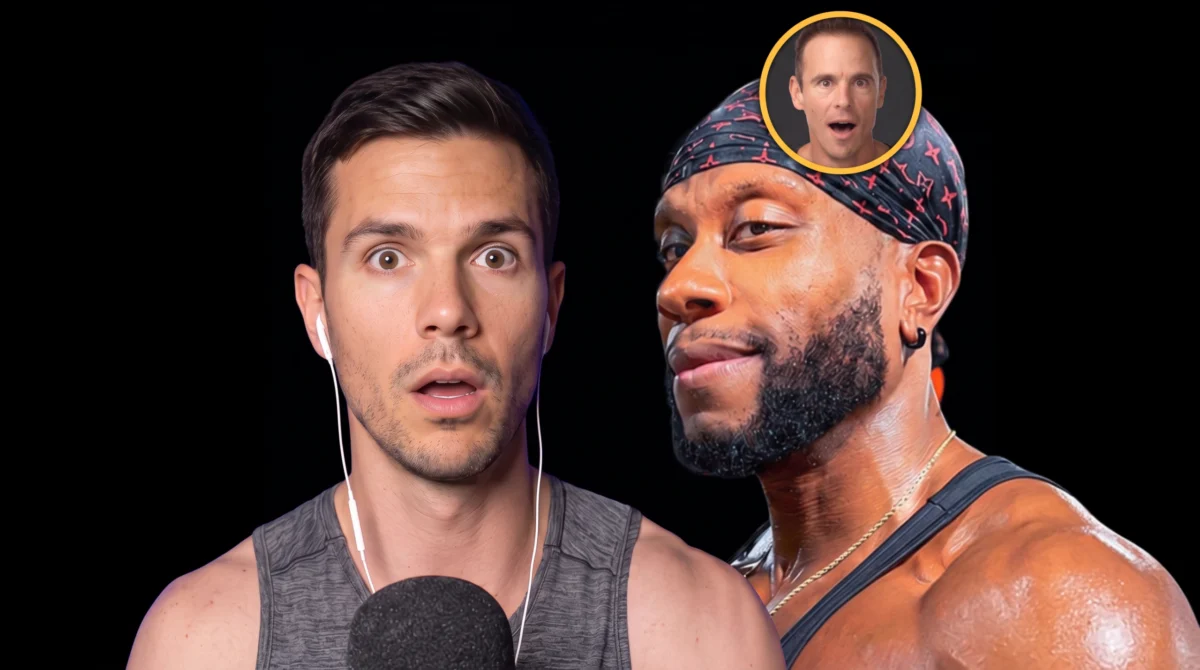
Natural bodybuilding demands a level of focus and personal restraint that borders on spiritual devotion, according to veteran fitness influencer Chris “Beast Mode” Jones. In an era dominated by rapid physical transformations and widespread pharmaceutical enhancement, Jones argues that true natural progression requires an entirely different psychological framework—one anchored in extreme patience, realistic genetic acceptance, and long-term joint preservation.
In an extensive dialogue with fitness educator Daniel of Fitness FAQs, Jones explored the mental models that separate lifelong drug-free athletes from those who eventually turn to performance-enhancing drugs (PEDs). What emerged from their discussion was a comprehensive philosophy that frames physique development less as an aesthetic hobby and more as a lifelong discipline defined by distinct rituals, deliberate sacrifices, and non-linear rewards.
For drug-free athletes pursuing muscular development without chemical intervention, their exchange provides an unvarnished examination of what sustainable progress entails once the initial years of rapid development have passed.
The Spiritual Framework of Natural Lifting
Jones drew a direct comparison between spiritual devotion and drug-free physique development, arguing that adherence to strict principles governs both pursuits.
“It works a lot like a religion,” Jones explained during the discussion. “Notice if Jesus said you got to hate sin. Well, if you want to be that crispy physique, you got to hate cheat meals. You got to hate not hitting your macros, right?”
While the analogy may appear striking at first glance, Jones explained that the underlying mechanics of both disciplines are fundamentally aligned. Both paths require adherence to demanding behavioral codes, an acceptance of delayed gratification, and prolonged faith in a gradual process that does not offer immediate reinforcement.
Within this framework, Jones identified patience as the governing virtue. When lifters lack the patience to endure plateaus, he noted, they frequently gravitate toward unnatural compounds to fulfill unrealistic physical aspirations. Jones argued that this widespread patience deficit is the primary reason many lifters migrate to anabolic steroids or testosterone replacement therapy (TRT) well before exhausting their natural genetic capacity.
Reassessing the Value of Physique Maintenance
A central theme of the conversation was the overlooked and often dismissed concept of maintenance. Within an industry heavily focused on continuous hypertrophy and constant visual evolution, the idea of remaining static is frequently treated as stagnation. Jones countered that maintaining an established physique is precisely what natural lifters should embrace once they pass their first decade of serious training.
“If you’re trying to get bigger every year, when do you maintain what you built? When do you enjoy what you built?” Jones asked.
Daniel echoed this observation, pointing out that audiences frequently react with confusion or skepticism whenever he discusses training for maintenance rather than perpetual growth. Both creators noted that maintenance remains deeply neglected because it lacks commercial viability. Marketing an established, stable physique does not generate program sales or engage consumers in the same way as dramatic thirty-day physical overhauls. The fitness marketplace depends heavily on the allure of perpetual change rather than long-term contentment.
Beyond commercial dynamics, the conversation touched on the biological realities of natural muscle growth. After approximately a decade of structured, progressive training, most athletes approach their ceiling for muscle accrual. Pushing beyond that baseline naturally yields heavily diminishing returns, demanding disproportionate systemic fatigue, higher injury risks, and extreme recovery requirements for fractional physical adjustments.
By contrast, shifting focus toward maintenance requires considerably less training volume, liberating physical and mental energy for other essential areas of life, including career development, family, and broader personal pursuits.
The Distortion of the Digital Comparison Pool
The two fitness educators also examined the psychological toll inflicted by modern digital platforms. Jones identified social media as a primary driver of distorted physique standards and the resulting pressure to turn to chemical enhancement.
Reflecting on his early training years, Jones highlighted the contrast between previous generations and current lifters: “Back in the day when I was in school, I wasn’t able to get on my phone and get on the internet. So I’m really in the moment. You know, I’m only absorbing so much information.”
Today, beginners and intermediate lifters are continuously exposed to curated content highlighting genetic outliers, enhanced athletes, and carefully manipulated imagery featuring optimal lighting and specific posing. The peer group against which lifters evaluate their progress has expanded from the individuals in a local weight room to millions of curated feeds across the globe.
While acknowledging these pressures, Daniel offered a measured perspective on digital media. He noted that while social feeds can foster unhealthy comparisons, platforms also provided him with drug-free role models like Jones when he launched his own training journey in 2012. The critical challenge for athletes, Daniel argued, lies in treating exceptional physiques as sources of inspiration rather than immediate benchmarks against which they must evaluate their own worth.
Movement Quality and Training for Joint Longevity
As Jones has accumulated training mileage, his day-to-day methodology has evolved from strict visual bodybuilding toward movement quality, structural balance, and connective tissue resilience. His present routine places higher value on fascial conditioning, neuromuscular control, and working through comprehensive ranges of motion across varied mechanical angles.
“I’ve looked my best at times. Shoulders aching, knees tight, low back stiff,” Jones admitted. “So with the fascia stuff, now I’m more conscious of hitting my muscles from a variety of angles.”
This transition represents a deliberate departure from traditional bodybuilding conventions that prioritize heavy, locked-in isolation movements at the expense of functional mechanics. Rather than forcing the body into rigid pathways regardless of joint wear, Jones prioritizes multi-planar engagement, dynamic loading, and joint longevity.
Daniel shared a parallel experience regarding movement patterns and structural imbalances. After dedicating years to heavy barbell bench pressing while neglecting fundamental bodyweight variations like push-ups, Daniel developed chronic shoulder discomfort. The issue was eventually traced to compromised scapular stability and an underdeveloped serratus anterior. By reincorporating full-range push-ups—which allow natural scapular movement rather than pinning the shoulder blades against a flat bench—he resolved his shoulder discomfort and simultaneously improved his bench pressing mechanics.
The Single-Dimensional Identity Trap
Jones and Daniel also explored the psychological vulnerability of athletes who anchor their entire identity to physical development. Jones highlighted the danger of pouring all available effort into muscular development while neglecting emotional, relational, and professional maturation.
“Where you put your energy is where you’re going to grow,” Jones observed. “So if all I work on in 10 years is my body, that’s all I’m going to have. I might be living in a shack, you know, car barely holding up.”
This observation addresses issues surrounding exercise dependence and body image concerns within the fitness community. When an individual’s identity is tied entirely to muscularity and gym numbers, normal biological events such as injury, aging, or natural plateaus can precipitate severe psychological distress.
Jones advocates for applying physical discipline to multiple pursuits. The consistency, focus, and work ethic cultivated through lifting should be redirected toward business ventures, intellectual development, personal relationships, and community obligations. In Jones’s view, the gym serves as a catalyst for overall maturity rather than an escape from adult responsibilities.
Working Within Genetic Parameters
Throughout the discussion, Jones addressed the realities of genetic limitations without euphemism. He emphasized that natural lifting requires honest self-assessment regarding skeletal structure and muscle insertion patterns.
“The universe don’t make no mistakes,” Jones stated. “If you were meant to be Shaq’s height, Shaq’s weight, you’ll have those bone structures.”
Acknowledging genetic reality, Jones explained, does not mean settling for poor performance. Instead, it involves measuring success against one’s individual baseline rather than comparing oneself to dissimilar body types. Standing at 5 feet 7 inches, Jones noted that he had to develop dense muscularity and sharp conditioning to stand out, given that he could not rely on a towering frame.
That structural constraint directed his work ethic and reinforced his training ethos: optimizing what one naturally possesses rather than lamenting inherent genetic boundaries. Both Jones and Daniel emphasized relying on objective metrics—such as tracked training volume, progressive overload, longitudinal photographs, and circumference measurements—rather than comparing results to non-natural lifters or statistical genetic outliers.
The Endocrine Consequences of Early Enhancement
When discussing the decision to use PEDs, Jones focused heavily on the long-term biological consequences of using performance-enhancing drugs to achieve goals that could otherwise be reached through natural training.
“Since you took these unnatural things because you had these unnatural goals, now you’re in an unnatural predicament,” Jones said. “It’s not natural for your body to not produce its own test anymore.”
Addressing physical realities such as testicular atrophy and endocrine disruption, Jones warned that many young athletes treat performance-enhancing cycles as casual, temporary experiments without recognizing the potential for permanent hormonal shutdown. In many cases, early and ill-advised compound usage results in a lifelong reliance on medical hormone replacement to maintain normal baseline physiological function.
Jones framed his perspective not as a moral critique, but as an assessment of risk versus reward. For individuals pursuing fitness for personal health, aesthetic confidence, and daily well-being, accepting irreversible endocrine consequences to accelerate achievable physical progress represents a fundamentally flawed trade-off.
Discipline as an Instrument of Personal Stability
Looking at the broader effects of training, Jones described physical discipline as an organizing principle that provides mental clarity across daily life.
“Aristotle said it himself, discipline is the key to freedom,” Jones noted. “It just helps keep you grounded. That’s what discipline is.”
However, Jones emphasized that daily discipline cannot survive on passing emotion alone; it requires a durable, long-range objective. For Jones, that foundation grew out of a personal commitment to stand out and build exceptional capability despite his shorter physical stature. For other athletes, that motivation might center on family longevity, mental stability, or personal accountability. Regardless of the exact motivation, a deeper underlying commitment is essential to sustain consistent effort once novelty fades.
Daniel supported this view, adding that physical commitment serves as a barometer for personal resilience. He noted that whenever his gym consistency falters, he observes a simultaneous decrease in his willingness to confront difficult workplace challenges and uncomfortable interpersonal conversations. Consistent, demanding training operates as a practical testing ground for managing discomfort across other life domains.
Training for Multi-Decade Longevity
As their discussion concluded, both athletes emphasized the necessity of planning for multi-decade training rather than focusing entirely on short-term lifting blocks. Sustaining physical activity across thirty or forty years requires moving away from the conventional industry demand to be continuously bigger, leaner, and stronger with every passing season.
“You can’t train hard if you got aches and pains,” Jones pointed out. “If your rotator cuff isn’t functioning well, good luck trying to do overhead press, bench press, those key movements.”
A sustainable training structure prioritizes complete joint integrity, active connective tissue recovery, and varied movement pathways over sheer load progression. Jones highlighted technical details such as training the calves through their entire range of motion, pointing out that the Achilles tendon loses compliance with age and that chronic partial repetitions fail to load the tendon across functional positions. These minor technical habits, maintained across years of training, determine whether an individual enjoys fluid movement or experiences chronic joint limitations in later decades.
Navigating the Natural Plateau
Daniel detailed the inevitable crossroads that every serious drug-free athlete eventually encounters: the period, typically occurring between five and ten years of consistent training, when visual and strength improvements slow to a crawl.
Faced with this plateau, athletes generally confront three distinct pathways: abandoning training out of frustration, turning to pharmaceutical intervention to force continued rapid gains, or adopting a mature mindset centered on maintenance and subtle physical refinement.
Jones and Daniel both advocated for the third path as the only sustainable option for lifelong fitness. Choosing this route requires recognizing that annual performance gains may only register in modest increments, that physical alterations will manifest as minor refinements rather than dramatic overhauls, and that the daily practice of movement must itself become the primary reward. By making this mindset shift, natural athletes can protect against burnout and sustain both physical capability and health over a lifetime of lifting.