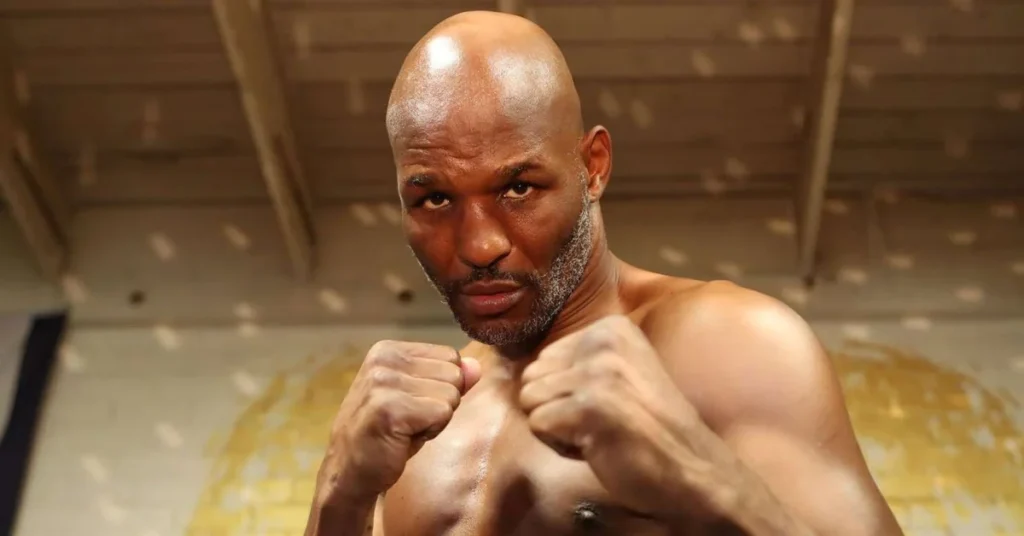

Bernard Hopkins has long been recognized as one of the craftiest, most disciplined, and intellectually commanding figures to grace the sport of boxing over the past three decades. Renowned for an encyclopedic understanding of ring generalship and an uncanny ability to dismantle opponents both psychologically and mechanically, the former multi-division world champion rarely concedes superiority to anyone he shared the ring with during his illustrious career. Yet, when reflecting on the supreme talents he encountered across an era defined by legendary champions, the Philadelphia native offered an uncharacteristically absolute appraisal of his longtime rival, Roy Jones Jr.
Speaking to The Ring Magazine, Hopkins looked back across the landscape of modern boxing and openly evaluated how his own formidable arsenal would have fared against Jones at the absolute zenith of his powers. In an unvarnished and candid assessment, the fighter universally known as "The Executioner" stated unequivocally that an early-career incarnation of Jones operated at a plane of athletic and technical brilliance that placed him beyond the reach of any competitor in boxing history.
Hopkins’ reflections were rooted in the unique challenges Jones presented inside the ropes. During his prime, Jones possessed an extraordinary blend of blinding hand speed, lightning-fast footwork, and reflex-driven defense that defied the traditional conventions of the sweet science. According to Hopkins, the greatest difficulty in facing Jones lay not merely in his ability to unleash dazzling flurries, but in his innate talent for neutralizing an adversary’s primary strengths before they could even be deployed.
"He was smart enough to neutralise my best weapons and smart enough to not get hit by my big shots," Hopkins told The Ring Magazine. "Even though I got my shots in he wouldn’t get hit by more than one. Like if I got one in … and that’s the thing about fighting unique guys … if a guy lands that one shot, normally there’s another coming behind that."
Hopkins elaborated further on what made Jones such a singular problem to solve in the ring, emphasizing that the Pensacola, Florida native combined defensive intuition with explosive offensive precision in a manner that broke the spirit of even the most accomplished champions. While standard boxing methodology teaches fighters to follow up a clean landing with combinations, Jones possessed an uncommon spatial awareness that allowed him to slip, pivot, or reset immediately after absorbing contact, completely extinguishing any potential momentum his opponent sought to build.
"He was an all-around thing – best boxer, best defence, offence…," Hopkins explained when summarizing the attributes that set Jones apart during that golden phase of his development. "Early career Roy Jones Jr. – speed, reflexes, unorthodox, that type of thing. No one, no one would have beat Roy Jones at that level, where he was at right there and then."
Coming from a fighter of Hopkins’ stature, the admission carries profound weight within the boxing community. Hopkins built his reputation as a master tactician who spent his professional life solving seemingly impossible stylistic riddles. His journey to elite status was not immediate; it was forged through grit, patience, and relentless self-improvement following a professional debut that began in disappointment.
Hopkins launched his professional career back in 1988, suffering an unexpected defeat in his very first four-round bout. Rather than allowing the early misstep to derail his ambitions, the setback served as the foundation for an extraordinary transformation. He rebounded with remarkable resolve, steadily climbing through the ranks and honing the suffocating, cerebral style that would eventually define his identity as "The Executioner."
By the middle stages of the 1990s, Hopkins had established himself as a dominant force within the middleweight division. His ascension culminated in 1995, when he seized the vacant IBF world middleweight championship by stopping Segundo Mercado in the seventh round of their high-stakes rematch. That victory inaugurated one of the most prolific and formidable title reigns in boxing history.
Over the years that followed, Hopkins defended his middleweight crown with unrelenting consistency, turning away top contenders and steadily unifying the weight class. His long tenure atop the 160-pound division reached its crowning moment in September 2004, when he faced the superstar champion Oscar De La Hoya in a high-profile superfight. Hopkins delivered a tactical masterclass, systematically breaking down De La Hoya before landing a devastating body shot in the ninth round to become the first fighter ever to knock out the "Golden Boy." The historic victory consolidated the world titles and solidified Hopkins’ status as the undisputed middleweight champion of the world.
Rather than resting on his middleweight accomplishments, Hopkins continually sought challenges that defied conventional expectations regarding an athlete’s physical longevity. He ultimately advanced to the 175-pound division, stepping up to light heavyweight where he continued to collect world titles against much younger champions. In 2011, Hopkins defeated Jean Pascal to claim the WBC world light heavyweight title, writing his name into boxing lore by setting a new milestone as the oldest fighter to ever capture a major world championship.
Even when faced with adversity late in his career, Hopkins remained a persistent threat at the championship level. After dropping the light heavyweight title to Chad Dawson in 2012, Hopkins bounced back once again. He entered the ring against the previously undefeated puncher Tavoris Cloud, outpointing the younger champion over twelve rounds to capture the IBF light heavyweight belt and rewrite his own records in the sport’s history books.
Throughout that long and storied journey, Hopkins’ career remained intrinsically linked to that of Roy Jones Jr. The two future hall-of-famers met inside the professional ring on two separate occasions, framing a rivalry that spanned nearly two decades.
Their first encounter took place in May 1993, when both men were undefeated contenders vying for the vacant IBF middleweight championship. On that night, Jones relied on his rapid reflexes, awkward angles, and blistering hand speed to secure a unanimous decision victory over Hopkins, claiming his first career world title in the process. For Hopkins, the defeat represented a crucial learning curve, prompting him to refine his craft, bolster his defensive awareness, and cultivate the patient, surgical approach that would guide his championship reign after Jones vacated the belt to move up in weight.
It would take seventeen years for Hopkins and Jones to share a ring again. By the time their rematch materialized in April 2010, both fighters had accumulated vast legacies, achieved multi-division world titles, and navigated the natural physical wear of extended careers at boxing’s elite level. In that long-delayed second meeting, Hopkins succeeded in avenging his initial setback, outpointing Jones over twelve rounds to earn a unanimous decision win and level their personal series at one victory apiece.
Despite the scoreline standing deadlocked at 1-1, a third deciding bout never materialized. The absence of a rubber match has left boxing enthusiasts, historians, and analysts to endlessly debate how a potential trilogy clash would have concluded—and more intriguingly, how the two legends would have matched up had they collided when both were firing on all cylinders at the pinnacle of their respective primes.
In his remarks to The Ring Magazine, Hopkins offered an honest perspective on that enduring hypothetical. Setting aside personal rivalry and the competitive pride that sustained his Hall of Fame career for nearly thirty years, Hopkins credited Jones with possessing a peak standard of excellence that was untouchable, acknowledging that during those early, electric years, no fighter in the world could have unseated his greatest adversary.