


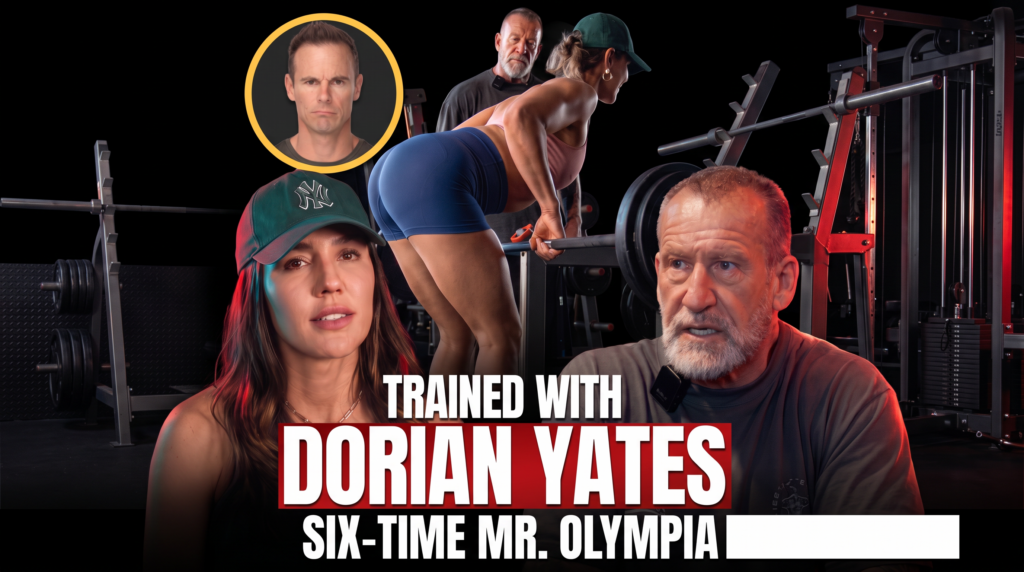
Six-time Mr. Olympia champion Dorian Yates recently stepped back into the training environment to put fitness creator Vana through one of his signature, grueling back workouts. The high-intensity session offered a live demonstration of why the British bodybuilder earned the formidable nickname “The Shadow” during his reign atop the sport in the 1990s.
The workout was defined by relentless intensity, precise biomechanics, and a philosophy of muscle building that treats every repetition as a calculated assault on human tissue. Yet, beyond the forced negatives and the heavy iron, the collaboration evolved into something much deeper. Yates opened up about a topic rarely discussed in mainstream fitness circles: the psychological price of competitive bodybuilding, the identity crisis that follows retirement, and how one of the sport’s most feared competitors eventually learned to move beyond the obsessive drive that once defined his entire existence.
Understanding Muscle Function Before Moving Weight
The session began well before any heavy plates were loaded onto a bar, with Yates conducting an anatomy lesson that many modern gym-goers tend to skip entirely. Standing in the gym, he mapped out the precise muscle groups they would target during the session, detailing their anatomical origins and insertions, and explaining the specific mechanics required to activate them effectively.
Pointing to the massive V-shaped upper body architecture that made him famous, Yates outlined the latissimus dorsi, the expansive trapezius muscles running up the spine, the rear deltoids, and the underlying rhomboids. He emphasized that before attempting to move external resistance, an athlete must understand the primary function of each muscle. For the lats, that fundamental movement involves pulling the upper arm down and relative to the torso.
Yates noted that spinal alignment is critical during these pulling motions. For the lats to contract fully, the spine must remain in a neutral position or exhibit a slight, deliberate arch. If the upper back rounds forward during the movement, the target muscle loses its mechanical advantage, transferring the workload away from the lats and diminishing the overall contraction. Sports science increasingly supports this concept, demonstrating that maintaining an internal focus on the working muscle can enhance neuromuscular activation and potentially improve hypertrophy outcomes when paired with proper training variables.
The Pre-Exhaustion Protocol: Isolate, Then Compound
To maximize the efficiency of the back session, Yates utilized a strategic training methodology known as pre-exhaustion. This approach involves performing an isolation movement to fatigue a specific muscle before moving on to a compound exercise that recruits multiple muscle groups.
The workout kicked off with a unique lat pulldown variation that utilized specialized elbow pads instead of a traditional overhead bar. By pressing down with the elbows rather than gripping a handle with the hands, Yates completely removed grip strength and biceps involvement from the equation, forcing the latissimus dorsi to work in pure, unadulterated isolation.
Once the lats were heavily fatigued from the elbow-pad pulldowns, they transitioned directly into traditional reverse-grip pulldowns, where gripping power and the biceps naturally re-entered the kinetic chain. The underlying theory of this protocol is that by pre-exhausting the primary target muscle, it becomes the definitive limiting factor during the subsequent compound movement, ensuring that the lats receive maximum stimulation even when smaller, assisting muscle groups begin to tire out. While scientific literature regarding pre-exhaustion remains mixed—with some studies indicating enhanced muscle activation and others suggesting it may slightly reduce overall performance on heavy compound lifts—it remains a hallmark of Yates’ historical training system.
Three Phases of Every Rep: Positive, Static, Negative
As the session progressed into heavier compound movements like bent-over rows, Yates broke down the physics of a single repetition into three distinct phases: the positive, the static, and the negative. According to Yates, human strength varies significantly across these distinct phases, with the eccentric, or lowering, phase capable of handling the heaviest loads.
Throughout the sets, Yates continuously coached Vana to deliberately slow down the negative portion of every repetition. He explained that even when an athlete reaches a point where they can no longer lift the weight concentrically, significant strength and untapped growth potential still remain within the eccentric lowering phase.
This philosophy aligns closely with established exercise science, which consistently shows that eccentric muscle actions produce high levels of mechanical tension, drive significant muscle hypertrophy, and can sometimes outpace concentric-only training for building mass. When Vana finally reached absolute concentric failure during her bent-over rows, the set was far from over. Yates stepped in to lift the weight back to the top position, instructing her to lower the heavy barbell under strict, controlled resistance for multiple additional negative-only repetitions.
Training to True Failure and Beyond
The intensity of the workout escalated rapidly as the working sets commenced. Following adequate warm-up sets designed strictly to establish proper movement patterns without inducing premature fatigue, Yates pushed Vana to absolute muscular failure on every working set.
During a particularly grueling series on the elbow-pad pulldowns, Yates stood close by, offering direct verbal commands to maintain posture and squeeze the target musculature. When Vana hit the wall of concentric failure, Yates implemented forced negatives, physically assisting her in lifting the weight so she could continue controlling the descent.
This relentless approach formed the bedrock of the "Blood and Guts" training philosophy that propelled Yates to six consecutive Mr. Olympia titles. For Yates, every set was treated as a definitive test of will, leaving nothing in reserve. While modern exercise science continues to debate the necessity of training past absolute failure—noting that while training close to failure is highly effective, pushing past it introduces significant central nervous system fatigue and elevates injury risk—it undeniably defined the golden era of Yates’ competitive dominance.
Form Over Ego: The Weight Doesn’t Matter
Despite his legendary reputation for high-intensity training to absolute failure, Yates remained remarkably meticulous regarding proper form, execution, and appropriate weight selection. When Vana performed bent-over barbell rows, Yates frequently corrected her torso angle, preventing her from lowering her upper body too close to a parallel position relative to the floor.
He explained that while dropping lower was not inherently wrong, adjusting the torso slightly more upright would grant her better mechanical leverage, enabling her to handle heavier loads safely and target the upper back more effectively. When discussing common pitfalls in commercial gyms, Yates pointed directly to ego lifting as a primary hindrance for young male lifters.
He criticized the widespread habit of loading a barbell with excessive weight and relying on momentum, body english, or partial ranges of motion just to move the mass. Yates emphasized that if an athlete cannot complete the full range of motion under control, they should lock in the posture and execute strict partials rather than sacrificing form for the sake of a heavier number on the plates.
Rep Ranges, Time Under Tension, and What Actually Matters
Addressing the perennial debate surrounding optimal rep ranges for muscle growth, Yates offered practical, experience-based guidelines rather than rigid, inflexible rules. He noted that for the upper body, anywhere between six and twelve repetitions per set is generally effective, though the actual time under tension matters far more than the raw count of repetitions.
This practical observation closely mirrors modern sports science consensus, which indicates that muscle hypertrophy can be stimulated successfully across a wide spectrum of rep ranges, spanning roughly six to thirty repetitions per set, provided those sets are executed close to muscular failure. The critical driver is achieving sufficient mechanical tension and metabolic stress rather than adhering to arbitrary numbers.
Yates underscored that bodybuilding differs fundamentally from other athletic training modalities because its singular objective is muscle growth and structural remodeling rather than skill acquisition, cardiovascular conditioning, or maximal power output. That specific stimulus is achieved through short, intensely focused training bouts followed by absolute rest and recovery.
Recovery: The Other Half of Bodybuilding
Yates was adamant that physical adaptation and muscle growth do not actually occur inside the gym. The intense workout serves merely as the stimulus, while the structural adaptation takes place entirely during periods of recovery.
He described bodybuilding as a demanding lifestyle that requires complete, round-the-clock dedication. While athletes in other sports may leave their training at the facility and enjoy considerable downtime, competitive bodybuilding requires constant attention to nutritional timing, caloric intake, adequate sleep hygiene, and stress management. This unrelenting, 24/7 commitment to the recovery process is ultimately what separates elite champions from recreational gym-goers.
The Dark Side: When Competitive Bodybuilding Isn’t Healthy
When the conversation turned to the broader health implications of the sport, Yates provided a candid assessment that sharply distinguished recreational resistance training from elite competitive bodybuilding. He noted that competitive sports at the highest level are rarely designed with natural human health in mind; instead, they are engineered strictly for performance, dominance, and victory.
Drawing a parallel to athletes in contact sports who routinely suffer joint degradation, Yates maintained that elite professional bodybuilding is an extreme pursuit that pushes the human body far beyond its natural evolutionary boundaries for the sake of competitive success.
However, Yates was equally passionate about the profound health benefits of non-competitive resistance training, particularly for aging populations. He asserted that maintaining or building back muscle mass through weight training is arguably the single most important intervention an individual can undertake as they age. This perspective is strongly supported by decades of clinical research linking resistance exercise and muscle mass preservation to superior metabolic health, enhanced bone mineral density, greater functional independence, and increased longevity in older adults.
Clinical Depression and Loss of Identity
Perhaps the most poignant and candid moment of the training session occurred when Yates reflected on the profound personal challenges he faced after his competitive career ended abruptly due to injury. He described the transition into retirement as a period marked by absolute clinical depression, driven by the sudden absence of the intense psychological high and singular mission that competitive preparation provided.
For an individual who had constructed their entire identity around the relentless pursuit of the Mr. Olympia title, stepping away from the stage was not merely a career pivot, but a severe existential crisis. When asked what ultimately helped him navigate that dark chapter, Yates credited the passage of time, perspective, and a gradual reframing of the immense personal sacrifices he had made during his prime years—including social isolation and the avoidance of travel that might disrupt his strict training regimen.
Sports psychology literature extensively documents the psychological distress and depressive symptoms frequently experienced by elite athletes following career termination, particularly those whose self-worth is deeply intertwined with their athletic performance.
Dorian 2.0: Training for Mobility, Not Mass
Today, Yates’ approach to physical fitness has undergone a profound transformation. Rather than chasing maximal muscle mass, his current training regimen focuses heavily on joint mobility, functional fascial work, and addressing the physical imbalances created by decades of heavy, single-plane weightlifting.
He noted that traditional bodybuilding exercises operate almost exclusively within a linear, sagittal plane of motion, rarely challenging the body to rotate under power or move laterally. To counteract the classic postural habits associated with heavy bodybuilding—such as rounded and internally rotated shoulders—Yates incorporates hanging exercises, extensive mobility drills, and multi-planar movements designed to support long-term joint health and physical independence.
The Philosophy Behind the Intensity
Reflecting on the psychological framework that fueled his championship run, Yates emphasized the inseparable link between mental visualization and physical action. He argued that while imagination, mental focus, and unwavering belief are essential prerequisites for success, they remain entirely inert without concrete physical execution in the real world.
For Yates, who navigated a turbulent youth before finding his calling in the gym, bodybuilding served as a vital, positive outlet that offered autonomy and self-directed achievement. The discipline forged through years of heavy iron ultimately translated into personal freedom, allowing him to shape his own destiny outside the conventional structures of traditional employment.
After observing Vana complete her final sets of rear delt work, Yates offered his professional assessment, praising her athletic background, body awareness, and ability to translate coaching cues into immediate physical execution. The session ultimately concluded as a mutual exchange of knowledge—with the legendary bodybuilder passing on the hard-earned lessons of his high-intensity training philosophy, while reminding observers that true physical mastery requires a lifelong willingness to adapt, recover, and evolve.