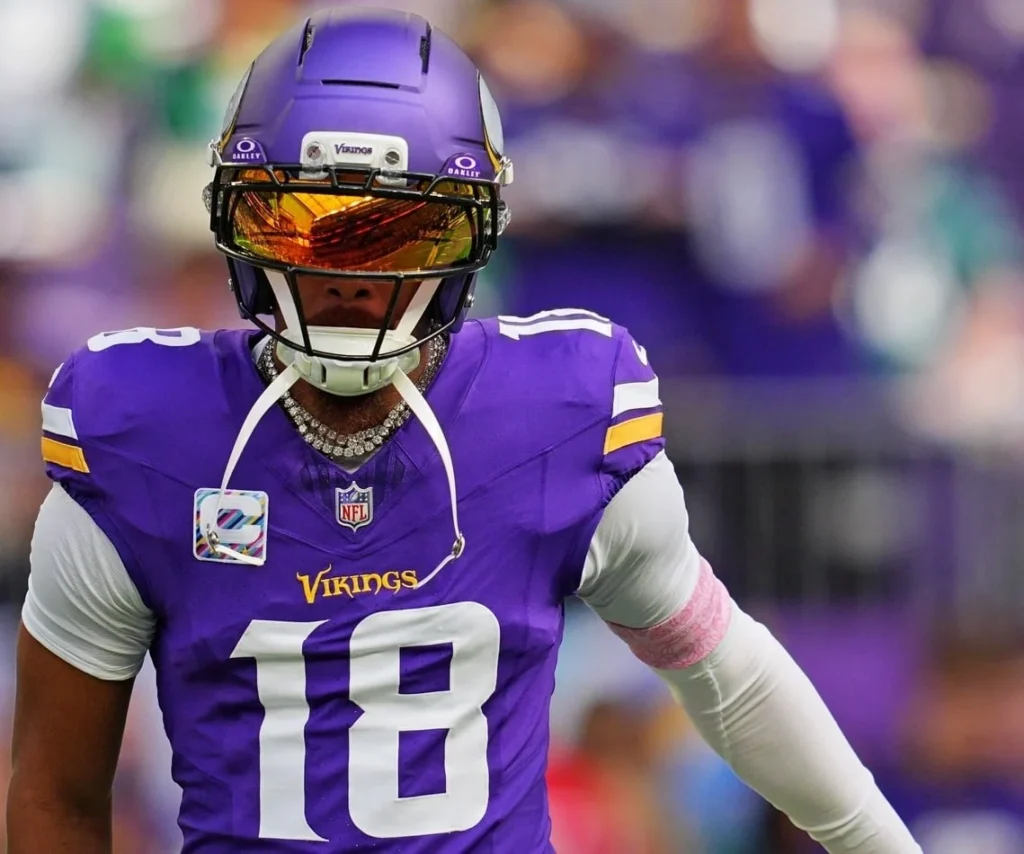

As the Tampa Bay Buccaneers prepare for the upcoming campaign, running back Rachaad White finds himself at a fascinating crossroads in his professional career. Widely recognized as one of the premier passing-down backs in the National Football League, White enters the new year with his role as the undisputed workhorse under a different kind of microscope. While his exceptional receiving abilities and durability have cemented his value to the offense, a contrasting running style from emerging teammates and questions surrounding his efficiency between the tackles have introduced new variables into the Buccaneers’ offensive equation.
The dynamic of Tampa Bay’s backfield shifted noticeably last season with the introduction of Bucky Irving, a rookie who offered a stark, compelling alternative to White’s approach. While White has traditionally relied on a gliding, more patient style of running, Irving emerged with a reputation for zero hesitation and maximum aggression. In direct comparison, White’s method often appeared more cautious, seemingly waiting for a running lane or crease that occasionally failed to materialize behind the line of scrimmage.
This stylistic difference highlights a fundamental truth about White’s game: he is considerably more comfortable operating in open space than fighting through congested traffic in the interior. As long as that distinct preference remains, it will prove challenging for White to command an overwhelming majority of touches at Irving’s expense. For fantasy football managers and NFL analysts alike, the primary appeal of White continues to stem from his elite pass-catching prowess and a strong historical track record of durability. These traits suggest that if Irving were to miss any significant time, White could easily inherit a massive workload.
At the same the time, however, the depth chart presents other considerations. Sean Tucker demonstrated impressive bursts during his limited opportunities, averaging a robust 6.2 yards per carry across 50 attempts. Should an injury strike the primary ball-carriers, Tucker could easily siphon off a meaningful share of early-down work, leaving White with a potentially reduced workload compared to what a fully healthy Irving would typically handle.
Examining the broader context of the Buccaneers’ offense reveals that the unit was a surprising and vital bright spot, with White playing a monumental role in that success. Drafted in the third round out of Arizona State in 2022, White steadily settled into a premier role for Tampa Bay, absorbing a much heavier workload than he had ever previously managed at any level of football, whether in the NFL or his collegiate career.
White held up remarkably well in this expanded capacity, appearing in all 17 games and leading all running backs across the league with an astonishing 823 snaps played. He was particularly lethal as a weapon in the passing game, turning 70 targets into 64 receptions, accumulating 549 receiving yards, and finding the end zone three times through the air. By standard running back metrics, that level of production translates to elite efficiency—a performance standard that cannot simply be attributed to sheer luck over such a substantial sample size.
The primary catch in evaluating his overall profile, however, lies in his rushing production. White’s output on the ground was predictably less efficient behind an offensive line that featured three new starters and experienced considerable struggles on the interior. Managing a rushing average of just 3.6 yards per carry, White opened the door for speculation that other running backs would inevitably work their way into the game plan.
Good as White undeniably was during that campaign—particularly for fantasy football enthusiasts—it is equally true that his immense volume was granted, in part, because the Buccaneers had precious few alternative options established in the backfield. The subsequent addition of Bucky Irving via the fourth round of the draft introduces a slight concern for White’s absolute monopoly on snaps, especially given that the rookie is also a capable receiver out of the backfield.
Even so, White retains distinct physical and experiential advantages. The veteran back boasts favorable size, speed, and tenure, having clocked a 4.48-second forty-yard dash at 6-foot and 214 pounds during his pre-draft evaluation, contrasting with Irving’s measurements of 4.55 seconds at 5-foot-9 and 192 pounds. With Irving and veteran Chase Edmonds serving as the primary threats to command playing time, White maintains a strong path to ranking among the league leaders in both total snaps and touches once again.
While questions occasionally linger regarding his absolute ceiling as an every-down runner, the reality remains that the Buccaneers lack a running back on their current depth chart who can unequivocally outplay the 2022 draft pick. Historically, when evaluating the broader running back room, the team has cycled through various veteran options like Chase Edmonds, Ke’Shawn Vaughn, and Patrick Laird. In past offseasons, the greatest threats to his workload were viewed through the lens of emerging rookies, such as undrafted additions Sean Tucker from Syracuse and Ronnie Brown from Shepherd.
Reflecting on his progression, observers often recall that it would have been encouraging to see White flash even greater dominance than he did during his initial transition to the professional level. His standout performance as a runner—highlighted by a 22-carry, 105-yard outing—was viewed by some critics as slightly less imposing because it came against a notoriously disheveled Seattle run defense. Across his earlier development, he averaged 5.8 yards on a smaller sample of catches and 3.7 yards on 129 carries, occasionally drawing attention for registering more fumbles than rushes of twenty yards or more.
Furthermore, concerns regarding per-touch efficiency were once tied to periods of offensive transition, such as the summer quarterback battles that defined the team’s shift following the Tom Brady era. Yet, through it all, White proved to be a reliable and competent check-down option, reliably securing passes and minimizing dropped balls when targeted out of the backfield.
Tracing back to his collegiate days as a one-year starter at Arizona State, White arrived in Tampa Bay with a clear mandate to carve out a role behind then-starter Leonard Fournette. During those early evaluations, scouts noted that he flashed an impressive, diverse array of skills, proving to be a natural pass catcher who navigated open space with notable vision and agility.
Initial concerns surrounding his top-end speed were emphatically answered when he posted his impressive combine numbers. While analysts occasionally pointed out that he was not traditionally the most physical runner and occasionally struggled to escape the grasp of the initial defender, he consistently demonstrated an innate knack for locating creases in the defense and a reliable nose for the end zone.
As personnel changes swept through the organization—with names like Ronald Jones moving on to Kansas City and Ke’Shawn Vaughn struggling to secure a consistent foothold over multiple seasons—White seized the opportunity to establish trust with the coaching staff and legendary quarterback Tom Brady. By demonstrating reliability in pass protection and consistency as an outlet receiver, he successfully vaulted himself past competing veterans to command the backfield.
As the franchise moves forward, Rachaad White remains central to their offensive identity. Whether he can fend off the surging challenge of Bucky Irving and maximize his opportunities behind an evolving offensive line will ultimately define the next chapter of his career in Tampa Bay.