

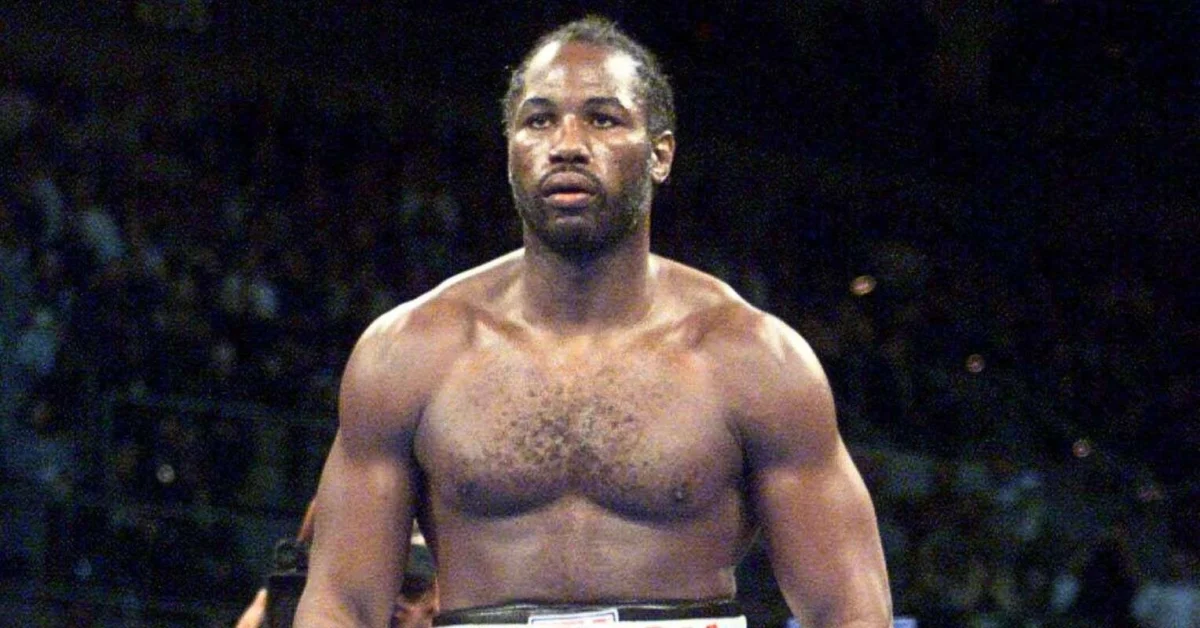
Lennox Lewis stands firmly in the history books as one of the most dominant and complete heavyweight champions of the modern era. Standing at six feet five inches with an imposing physical presence, a devastatingly refined jab, and an exceptional ring IQ, the British-Canadian champion ruled the division with an iron fist. He became the undisputed heavyweight champion of the world and systematically defeated nearly every top-tier contender of his generation. Yet, the sport of professional boxing has always operated under a strict and unforgiving law: even the greatest champions remain entirely vulnerable, particularly when the trap of complacency is sprung and an opponent is gravely underestimated.
In April 2001, Lennox Lewis traveled to South Africa for a high-profile world championship defense against Hasim Rahman. At the time, the bout was widely perceived by the global boxing community, promoters, and media outlets not as a genuine threat to Lewis’s reign, but rather as a lucrative tune-up fight. It was intended to serve as a final bridge before an anticipated, blockbuster, multi-million-dollar mega-fight against Mike Tyson. The boxing world was already looking past Johannesburg, projecting the astronomical financial figures and pay-per-view records of a Lewis-Tyson showdown.
Hasim Rahman, while recognized as a skilled and dangerous puncher with a respectable professional record, entered the equation as a massive 15-to-1 underdog. Crucially, Rahman had never before fought for a world championship, lacking the seasoned experience of competing at the absolute highest echelon of the heavyweight division. Given these dynamics, almost every observer and boxing expert expected Lewis to step into the ring, implement his technical superiority, and secure a routine victory.
However, the preparation for the fight had been far from ideal for the reigning champion. Nicknamed “The Lion,” Lewis had spent a significant portion of his crucial training camp distracted by Hollywood commitments, filming a cameo appearance in the movie Ocean’s Eleven. Consequently, Lewis arrived in Johannesburg, South Africa, quite late in the training schedule. He was fundamentally ill-prepared to deal with the unique environmental challenges of the region, most notably the taxing altitude of the host city, which severely impacted his physical conditioning and cardiovascular readiness.
In stark contrast, Hasim Rahman arrived in South Africa weeks in advance. The challenger was fully acclimatized to the local climate and the high altitude, locking in his focus with a level of dedication and desperation that matched the magnitude of his first-ever world title opportunity. Rahman was determined to rewrite boxing history, and he approached the challenge with a razor-sharp mindset.
When the opening bell rang, it immediately became apparent that something was amiss with the champion. As the rounds unfolded, Lewis looked visibly sluggish, heavy-legged, and entirely flat. His usual crisp timing was absent, and his punches lacked their customary authoritative snap. Rahman, sensing the vulnerability of the champion, pressed forward with disciplined aggression and unwavering confidence, capitalizing on every opening provided by a fatigued and underprepared Lewis.
The dramatic turning point arrived in the fifth round. Rahman orchestrated a brilliant sequence, finding an opening and landing a devastating, clean overhand right that caught the champion flush on the jaw. The blow was executed with pinpoint precision and catastrophic force. Lewis went down hard to the canvas, completely incapacitated by the impact. He was knocked out cold, unable to beat the referee’s count as the arena erupted in sheer disbelief.
The result instantly went down in the record books as one of the most shocking and monumental upsets in the entire history of the heavyweight division. Hasim Rahman was crowned the new unified heavyweight champion of the world, though his reign at the top would prove to be brief. Driven by a fierce sense of pride and a desire for redemption, Lennox Lewis immediately invoked his contractual clause for an immediate rematch later that year.
When the two fighters met again inside the ring months later, a drastically different Lennox Lewis showed up. Focused, meticulously prepared, and carrying a burning intensity, Lewis dismantled the narrative of his previous defeat by delivering a brutal, clinical knockout of Rahman to reclaim his hard-earned world titles.
Despite avenging the loss, Rahman’s historic upset victory remains an enduring cautionary tale within the sport of boxing—a stark reminder of the extreme dangers of complacency and the immutable truth that, in the heavyweight division, a single punch possesses the power to alter the course of history.
Reflecting years later on the tumultuous two-fight saga and the profound impact it left on his storied career, Lennox Lewis offered candid insight into the darkest chapter of his boxing journey:
"When Hasim Rahman knocked me out in 2001, it was the lowest point of my career," Lewis later said. "I’d been champion, undefeated for years, and I got careless. People said I was done, that I’d never get the title back. I took it personal, he talked about my mom, my life, and I couldn’t let that stand."
Detailing the grueling road to redemption, Lewis emphasized the psychological battle required to reclaim his throne: "Training for the rematch was hell, I had to prove I wasn’t a fluke. When I knocked him out in the fourth round, it wasn’t just about the belt, it was about showing the world I could come back from a loss and still be the best. That’s what boxing is: you fall, you rise."