


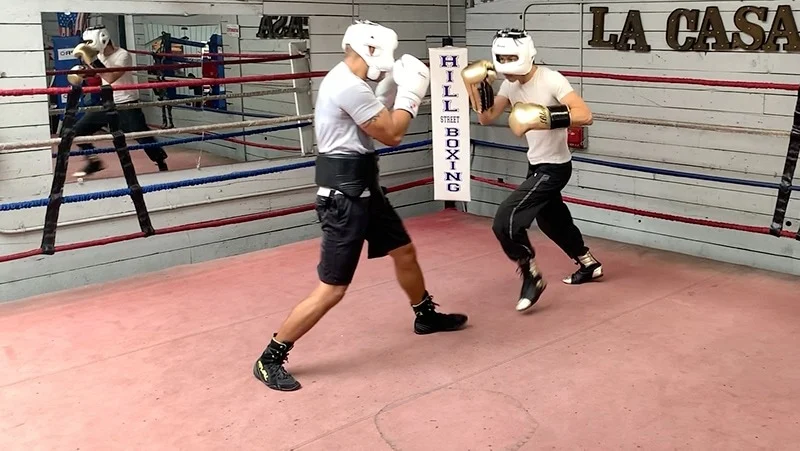
In the sweet science of boxing, few concepts are as widely misunderstood as the art of "fighting on the outside." For generations, fighters and trainers alike have treated long-range combat as a defensive refuge, relying on distance and linear retreat to neutralize incoming pressure. However, a closer examination of ring generalship reveals that the traditional notion of fighting on the outside—specifically relying on straight backsteps to escape danger—is fundamentally flawed.
The misconception largely stems from how fighters interpret long-range fighting. Too often, novices and even seasoned competitors attempt to maintain distance by backing straight up, treating the linear backstep as an emergency exit from pressure. While it is true that a swift backstep can temporarily remove a fighter from the path of an oncoming punch—statistically offering a higher immediate avoidance rate than blocking or slipping—it ultimately fails to alter the tactical landscape.
The primary Achilles heel of the linear retreat is space management. In the confines of a squared ring, a fighter has a strictly limited runway. A centre-ring position affords at most two full backsteps before the competitor collides with the canvas ropes. The first step creates a temporary gap, and the second anchors the fighter dangerously close to the perimeter. Even in exceptionally large rings, repetitive backward movement quickly erodes a fighter’s tactical options and instills a psychological disadvantage.
Furthermore, relying on pure linear footwork assumes an idealized set of conditions that rarely exists in a competitive bout. It depends heavily on possessing vastly superior endurance and agility, facing an opponent with sluggish lateral movement, and operating under the assumption that the adversary’s confidence will not swell at the sight of a retreating target. When a fighter constantly jumps backward, they inadvertently surrender the initiative, inviting a relentless opponent to close the distance repeatedly until the defender is trapped and overwhelmed.
To truly maintain range and control the pace of a bout, elite practitioners have long favored lateral movement over linear retreat. Rather than moving straight back, successful outside fighters circle continuously around their opponents, either clockwise or counter-clockwise. This lateral displacement ensures that the fighter never runs out of spatial currency, retaining the freedom to maneuver indefinitely while keeping the adversary off balance.
The tactical superiority of lateral movement rests on several foundational principles of ring mechanics. First and foremost, circling prevents spatial exhaustion. By moving laterally, a fighter always retains alternative routes of escape, including the ability to step backward as a last resort rather than a primary reflex.
Second, lateral movement keeps the opponent within effective punching and countering range. The primary flaw of the panic backstep is that it pulls the defender completely out of range, rendering effective counter-punching impossible. When a fighter retreats in a straight line, they often throw counter-punches into empty air while off-balance, allowing the attacker to close the gap safely during the recovery phase. In contrast, legendary ring technicians like Muhammad Ali and Sugar Ray Leonard mastered the illusion of retreat. A careful examination of their archival footage reveals that they were rarely running straight backward; instead, they combined lateral motion with precise, flicking jabs, maintaining offensive pressure while frustrating their pursuers.
Finally, a laterally moving target presents a profoundly difficult geometric problem for an attacker. Punching mechanics dictate that strikes are most naturally thrown along straight lines directly in front of the body. When an opponent is constantly shifting to a diagonal or lateral angle, the attacker is forced to adjust their punching trajectory awkwardly, disrupting their balance and diminishing the power of their combinations.
The execution of lateral movement requires precise physical adjustments, particularly regarding body angles and posture. Fighters can alternate between various circling angles, shifting between tighter arcs that force the opponent to constantly pivot and wider sideways motions that neutralize forward momentum. While some athletes maintain a squared-up, defensive posture reminiscent of lateral sliding drills, advanced practitioners often incorporate subtle backward hops while circling sideways, creating a dynamic rhythm that perpetually confounds the opponent’s timing.
Crucially, maintaining proper posture during lateral movement is vital. Fighters frequently make the mistake of popping their upper bodies straight upright during retreat in an effort to feel farther away from danger, inadvertently exposing their chins to swinging hooks and crosses. Retaining a slight torso hunch, with the head positioned slightly forward or tucked, preserves defensive integrity and allows the fighter to duck under incoming fire while maintaining mobility.
Ultimately, the true definition of fighting on the outside is not about standing rigidly at a distance or executing endless linear retreats. It is about sustained, intelligent movement. As long as a fighter utilizes continuous lateral displacement, changes of direction, and active head movement, they remain effectively outside the opponent’s optimal striking zone. By breaking the ingrained habit of the straight backstep and embracing multi-directional mobility, a fighter retains the ultimate control over range, neutralizing pressure before it ever reaches the ropes.