
For decades, the traditional barbell back squat has occupied an almost untouchable status within strength and conditioning. Long regarded as an indispensable movement for lower-body development, the exercise has served as the foundational pillar for athletes, bodybuilders, and general fitness enthusiasts seeking to build significant quadriceps mass. However, the physical toll of hoisting a heavily loaded bar across the upper trapezius is not universally sustainable. For mature lifters, individuals navigating past injuries, or anyone contending with mobility constraints, the intense downward force and axial spinal compression associated with heavy back squats can frequently result in lower back fatigue, joint irritation, and compromised movement mechanics.
Recognizing that longevity and targeted muscular stimulus often require moving beyond conventional dogmas, International Fitness and Bodybuilding Federation (IFBB) Bikini Pro and physique transformation coach Tanya Johansen has brought renewed attention to an effective lower-body alternative: the Spanish squat.
“Try a Spanish squat,” recommends the professional competitor and coach, highlighting the movement’s ability to deliver intense muscular fatigue without the systemic wear and tear of a barbell. “It fries your quads… when done correctly.”
Johansen, who specializes in coaching clients over the age of 40, emphasizes that the journey toward leg development does not mandate subjecting the spine and knees to crushing external loads. By shifting the biomechanical focus away from axial loading and toward direct tension, the Spanish squat provides a viable, joint-friendly pathway for both physique enhancement and physical longevity.
What Is a Spanish Squat and How Do You Do It?
The Spanish squat has deep roots in the world of sports rehabilitation and athletic performance. While it is widely recognized by physical therapists and athletic trainers as a therapeutic exercise designed to alleviate patellar tendon stress, the exercise also creates an exceptionally demanding environment for quadriceps hypertrophy. The movement isolates the front of the thighs through constant tension, requiring no external barbell weight to produce deep muscular engagement.
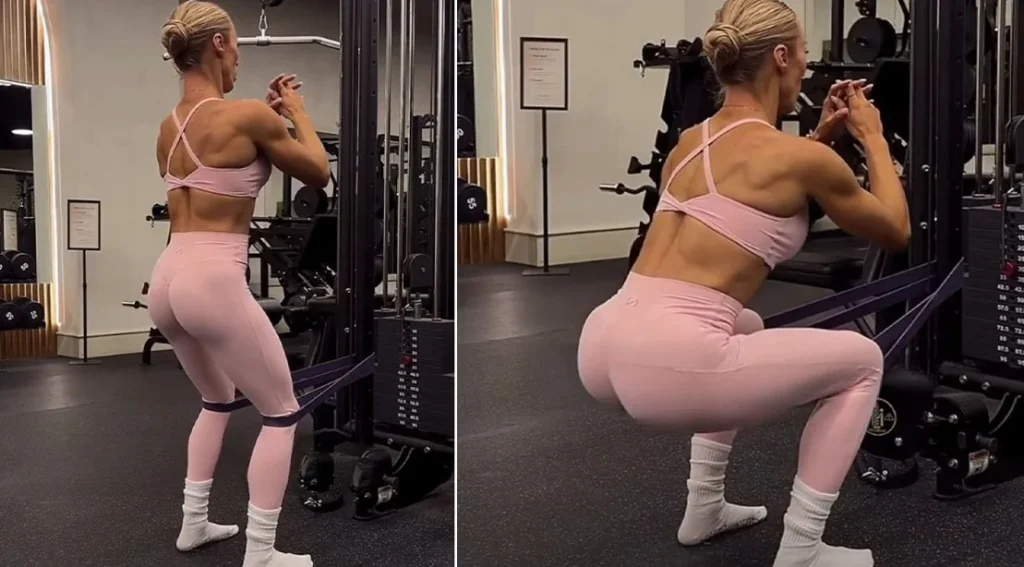
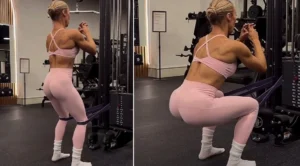
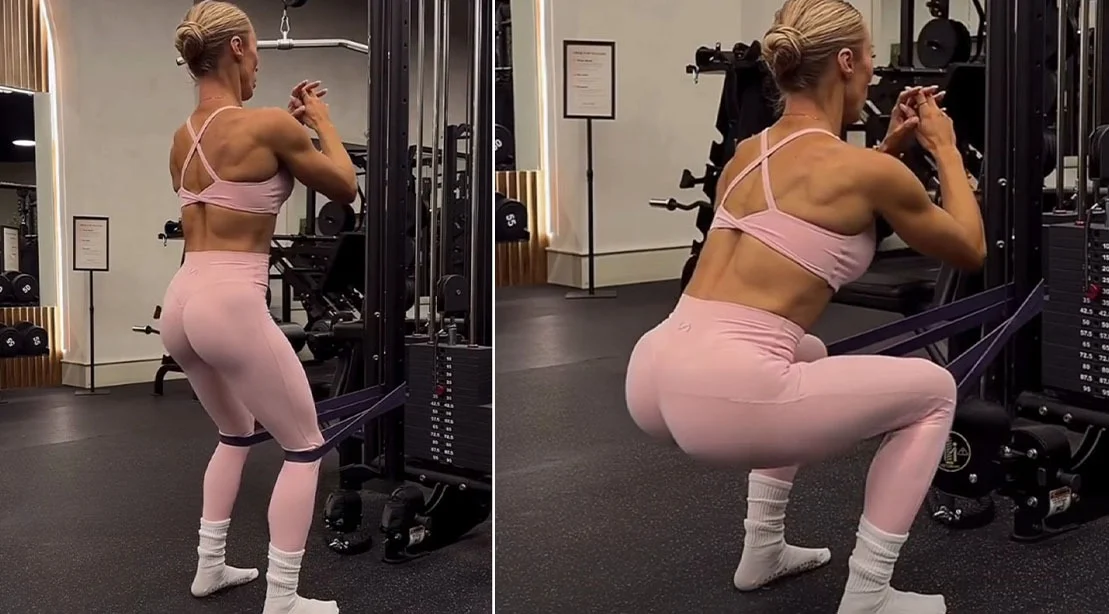
Setting up the exercise requires minimal equipment, making it an accessible addition to most gym environments. The movement relies on a heavy-duty resistance band anchored securely to a rigid, immovable structure, such as the vertical upright of a power rack or a cable station. The lifter positions themselves facing the anchor point and steps into the band, looping it directly behind the knees. According to Johansen, lifters have options in how they configure the band: one can either stand inside a single continuous loop or wrap the band individually around each knee to ensure balanced resistance across both limbs.
Once the band is in position, the practitioner steps backward to establish significant tension. This backward step is critical, as the elasticity of the band provides the horizontal counterforce that defines the mechanics of the movement. With the band firmly supporting the back of the knees, the lifter is able to descend into a squat by sitting backward into the movement while maintaining an unusually upright torso.
Johansen summarizes the fundamental cues needed to execute the lift properly: “Band behind your knees, sit back into it, stay tall, let your knees come forward.”
In a traditional back squat, the lifter must continually balance their center of mass over the midfoot, a demand that frequently necessitates forward torso lean, hip hinging, and substantial stabilization from the lumbar spine and erector spinae. In contrast, the Spanish squat alters the line of resistance. The band provides an anterior pulling force that essentially supports the lower body, allowing the athlete to keep their shins in a vertical or near-vertical position as they descend.
By keeping the shins vertical and the torso upright, the hips and lower back are spared from excessive shearing forces. The tension is channeled directly into the quadriceps muscles, which must contract continuously both to control the descent and to extend the knee joint against the band’s resistance during the ascent. The result is a concentrated muscular stimulus that avoids the balance limitations and spinal fatigue common to traditional squat variations.
The Benefits of the Spanish Squat
The primary appeal of the Spanish squat lies in its unique balance of high muscular stimulus and low joint stress. Because the exercise eliminates the barbell resting across the shoulders, the body is completely freed from axial spinal compression. This makes the movement especially advantageous for mature gym goers, athletes with prior disc injuries, or individuals whose hip and ankle anatomy makes parallel squatting under a bar uncomfortable or hazardous.
Beyond sparing the lower back, the Spanish squat plays an important role in knee health and preservation. By modifying the angle of the lower leg and utilizing the band’s horizontal support, the exercise reduces the patellofemoral compressive forces that often trigger anterior knee pain during conventional squats. Instead, it provides controlled loading to the patellar tendon and its surrounding connective tissues, making it an exceptional tool for rehabbing existing tendon irritation while simultaneously fortifying the joint structure against future injury.
For Johansen, the exercise represents a broader, more mature philosophy regarding training methodology—particularly for individuals navigating fitness in their fourth decade and beyond.
“Over 40? Even better reason,” the coach advises when discussing the merits of adopting the Spanish squat. “You don’t need a heavy bar on your back to grow your legs. Forget heavy. Make the muscle do the work.”
This perspective challenges a common mindset within gym culture, where progress is often mistakenly measured solely by the amount of weight loaded onto a barbell rather than the quality of tension delivered to the target musculature. For lifters who view heavy back squats as an ego-driven necessity, Johansen offers a direct critique.
“You’re not in there to impress anyone,” she explained. “You’re in there to make sure your quads earn it.”
To maximize the muscle-building stimulus of the Spanish squat without adding external weight, Johansen recommends manipulating training variables such as cadence and time under tension. Lifters can significantly elevate the difficulty of the movement by introducing an isometric hold at the top of the squat, deliberately pausing and flexing the quadriceps against the band before beginning the next descent. Additionally, slowing down the eccentric phase—the lowering portion of the movement—forces the quadriceps fibers to work harder through a full range of motion.
For optimal programming, Johansen suggests aiming for 3 sets of 8 to 12 repetitions. When performed with deliberate tempo and focused intent, this rep range is more than sufficient to generate intense muscular fatigue, metabolic accumulation, and subsequent growth, entirely bypassing the need for heavy spinal loading.
As training methodologies continue to evolve toward longevity and joint preservation, exercises like the Spanish squat illustrate that intelligent movement design can produce high-level physique outcomes without compromising orthopedic health. Johansen’s own career as an IFBB Bikini Pro serves as clear evidence that progressive physical development depends on mechanical efficiency rather than sheer load.
“It’s not the weight. It’s the work,” Johansen concluded, reinforcing a principle that prioritizes long-term musculoskeletal health alongside muscular performance.