

Climbing is what happens when you take a gym rat’s obsession with grip strength, remove the floor, and let gravity do its thing. There is no bench to lie on, no belt to tighten, and no place to hide a weak link. You have to get your body up a wall using holds that sometimes look so bleak the edge of a credit card looks like it might offer more purchase. And if you screw up, you better hope your rope is knotted correctly.
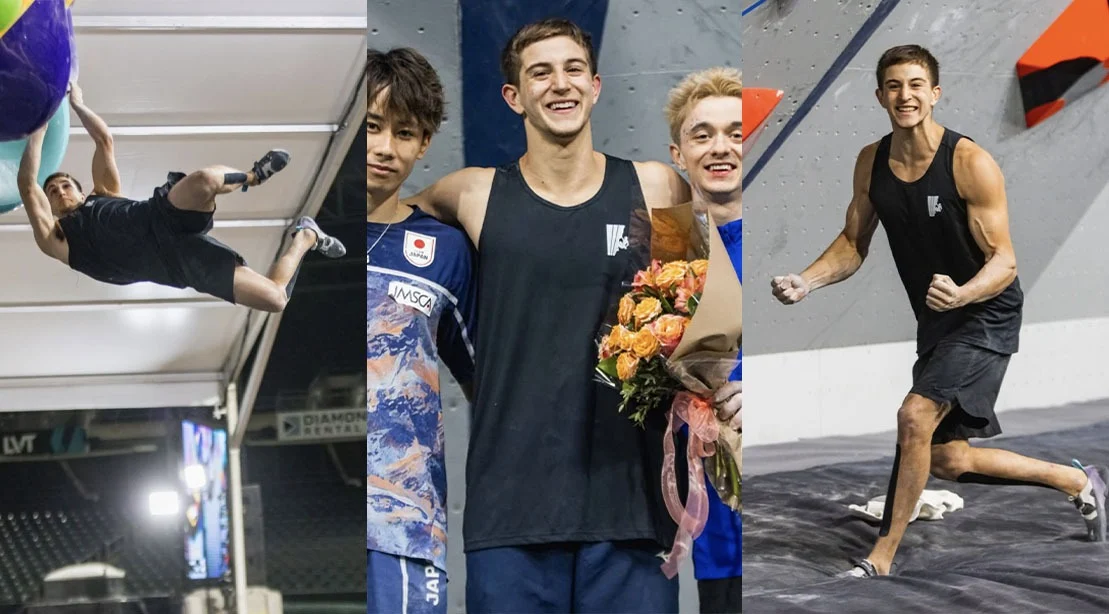
That raw, unforgiving reality was on full display at the World Climbing Series bouldering finale in Salt Lake City, held from October 16 to 18. In the men’s final, Israel’s Yonatan Katz captured the gold medal on only his second start in the senior international series. He went into the final problem trailing behind Britain’s Maximillian Milne and came out the victor after pulling off a complex sequence that nobody else in the final had managed to crack.
World Climbing Series Salt Lake City Results Breakdown
Here is how the gripping showdown unfolded on the walls. The last boulder of the men’s event was a nasty coordination problem that demanded absolute precision, timing, and nerve. Before Katz stepped up to the mat, the other finalists who had attempted the route hadn’t even managed to reach the scoring zone, which is a designated hold partway up the wall that marks a baseline level of progress.
On his fourth try, Katz finally unlocked the movement, drove past the zone, and powered his way to the top. He finished his campaign with 69.7 points. Milne, who had held a strong position, couldn’t formulate an answer on his final turn and ultimately took the silver medal with 59.7 points. Japan’s Rei Kawamata rounded out the podium in third place with 54.2 points. For a sport that might look to casual outsiders like a simple group of people climbing a wall, there was an immense amount of drama hanging off those plastic holds under the arena lights.
The women’s final the following evening delivered its own compelling narrative. France’s Oriane Bertone claimed victory with a score of 84.6 points after distinguishing herself as the only finalist to successfully complete the opening boulder. Britain’s Erin McNeice finished a strong second with 69.7 points, beating out Japan’s Mao Nakamura by the slimmest of margins, as Nakamura finished right behind at 69.6 points.
While McNeice did not take home the individual gold medal that single night, her consistency over the entire circuit secured her the season-long Boulder title. Her path to the overall championship was marked by incredible resilience; she had opened the series down in 11th place at the first stop and methodically climbed her way back through the rankings, following that initial setback with a gold medal and four consecutive silver medals.
Even the King Can Be Shut Out at Salt Lake City
While the podium battles provided high drama, the qualification rounds offered a humbling reminder of how volatile the sport can be. Japan’s Sorato Anraku had already locked up the men’s overall championship earlier in the circuit after dominating the field and winning five of the six bouldering events. However, in Salt Lake City, he stumbled during the early rounds and failed to advance from the qualification phase.
Even the athlete who had entirely dominated the season could get humbled by a fresh set of plastic holds and an unforgiving route-setting layout. It served as a reminder that familiarity guarantees nothing in this discipline. If bodybuilding judges suddenly decided to replace their predictable comparison rounds with physical problems that changed completely every single week, the sport would likely see a few very interesting new faces standing backstage.
To understand the magnitude of these performances, it helps to understand the nature of the discipline itself. Bouldering is conducted on relatively short artificial walls equipped with thick foam landing mats instead of safety ropes and harnesses. The competing athlete has to solve a complex sequence of physical movements, reach designated intermediate holds, and ultimately demonstrate complete control of the top hold.
Raw physical strength obviously matters a great deal. However, success is equally dependent upon an athlete’s ability to precisely position their hips, push efficiently through their feet, generate explosive momentum, and calculate their next move before their forearms literally turn into concrete from lactic acid buildup. Some individual moves are slow, deliberate, and surgical. Others look remarkably like an Olympic gymnast being thrown unexpectedly into a hardware store. The best climbers in the world are not simply pulling their body weight upward with brute force; they are meticulously figuring out how to make the least-wasteful movement possible while under immense competitive pressure.
The Wall Rewards Skill and Technique More than It Does Muscle
There is a profound lesson hidden in those movements for anybody who trains in a traditional gym setting. A giant back and a crushing handshake do not automatically translate into being good at a discipline that fundamentally requires timing, balance, and high-level technical skill. Nor does being smaller mean you are inherently weak. Climbing brutally exposes the vast difference between merely owning strength and actually knowing how to apply it effectively under gravity.
For those tempted to step off the sidelines and try the sport firsthand, experts recommend starting gently with a basic introductory session rather than marching straight toward an advanced overhang with a heroic declaration. A 2026 review of 45 comprehensive climbing-injury studies found frequent medical problems involving fingers, hands, shoulders, and ankles among participants. Those delicate little finger pulleys simply were not designed to absorb an uninitiated person’s entire ego on day one.
There is a certain type of athletic competition that inherently punishes pretense, and competitive climbing sits comfortably near the top of that list. There is no score awarded for looking intimidating while you meticulously chalk your hands, and there is no bonus credit given for explaining to your peers how strong you would supposedly be if only the holds on the wall were larger.
Katz won gold in Salt Lake City because he successfully solved a physical problem that had completely stopped everyone else. McNeice captured the season crown because she kept delivering dependable performances round after round. The wall does not care about your athletic résumé, your physique, or your excuses. It only cares whether you possess the skill, grit, and execution to get yourself to the top.