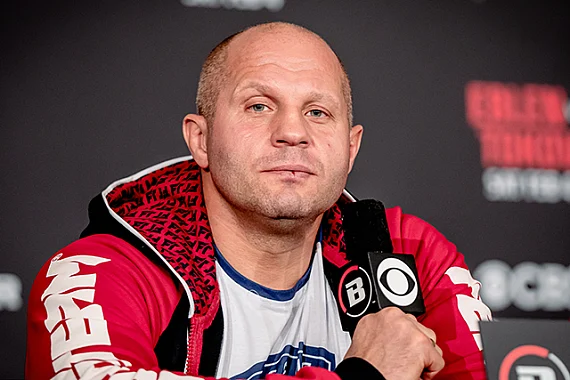
Mixed martial arts legend Fedor Emelianenko has launched a scathing critique of Ultimate Fighting Championship (UFC) CEO Dana White, taking aim at the promotion’s long-standing attempts to sign him during his storied career. The heavyweight icon accused the prominent executive of repeatedly altering his public narrative regarding why negotiations ultimately fell through, while also addressing and dismissing recent rumors concerning a potential matchup with former UFC heavyweight champion Francis Ngannou.
Speaking candidly in a recent interview with the prominent Russian YouTube channel Ushatayka, Emelianenko questioned White’s overall approach to fighter recruitment and recalled the frustrating timing of the promotional offers he received over the years. According to the veteran fighter, the UFC routinely approached him only after he had already committed his services to competing organizations, effectively creating an impossible scenario for any potential cross-promotional or direct signing agreements.
During the conversation, Emelianenko also took the opportunity to clear up persistent rumors regarding a heavily discussed matchup with Francis Ngannou. The Russian legend categorically denied that he ever actively negotiated a mixed martial arts bout against the powerhouse former UFC champion. Instead, Emelianenko clarified that the extent of their discussions was limited purely to a hypothetical boxing matchup, rather than a full-scale return to active MMA competition in the twilight of his illustrious career.
Fedor Emelianenko explains why UFC negotiations failed and questions Dana White’s changing account
The core of Emelianenko’s frustration stems from the peculiar timing of the UFC’s pursuit of his contract throughout the peak years of his athletic prime. The Russian icon pointed out that the premier MMA organization consistently failed to secure his signature during windows when he was entirely uncontracted and operating as a free agent. Bizarrely, those same executives would suddenly ramp up their pursuit and express intense public interest immediately after he had already inked deals to compete elsewhere—such as his memorable run with rival promotion Strikeforce.
Emelianenko noted that the timing of these approaches made it practically impossible to entertain them without inviting severe legal complications. Accepting a multi-fight offer from the UFC while legally bound to an exclusive promotional contract with another organization would have instantly exposed him to extensive breach-of-contract lawsuits and potential injunctions.
The Russian veteran suggested that these protracted contractual disputes could have easily resulted in him being sidelined, preventing him from competing altogether while lawyers and executives battled out the legalities in court.
"Honestly, I didn’t understand," Emelianenko said during the Ushatayka interview, reflecting on the confusing nature of the UFC’s outreach. "I didn’t understand the point of his actions. He came over saying, ‘I want you to fight for me.’ He made that very clear, but one fight earlier, I’d been a free agent. I was free and they didn’t sign me. … It happened every time."
Emelianenko elaborated on the recurring pattern of missed opportunities and mismatched timelines that ultimately kept him out of the UFC Octagon throughout his competitive career. For many fans and analysts, seeing "The Last Emperor" compete inside the UFC was long considered the ultimate dream matchup, but administrative hurdles and promotional friction continually blocked the path.
"When I’m free, they aren’t interested. When I’m under contract, the offers start coming, but if you’re under contract, you can’t sign another one. There would be legal proceedings," he added, emphasizing the professional impracticality of Dana White’s negotiating tactics.
Reflecting more broadly on White’s character and operational philosophy, Emelianenko drew a sharp contrast between the UFC frontman and other figures he has encountered within the international combat sports landscape over the decades. The heavyweight legend expressed a preference for traditional, honor-bound business arrangements over what he perceives as a volatile and shifting public relations strategy.
Speaking candidly about White, Emelianenko remarked, "There are different kinds of businessmen. Some are decent and respectful. Some people don’t even need a contract. A handshake is enough, they keep their word. But now Dana is talking all sorts of nonsense. First he wanted me, then he didn’t. Then he regretted it, then he’s glad he never signed me. The man talks and changes his story. He simply doesn’t stand by his words. His way of doing business doesn’t sit well with me."
The remarks highlight a decades-long tension between two of the most influential figures in the history of mixed martial arts. While Dana White has often spoken publicly about his past efforts to bring Emelianenko into the UFC fold—frequently citing differing financial expectations or management demands as the stumbling blocks—Emelianenko’s perspective paints a picture of inconsistent timing, shifting narratives, and fundamentally incompatible approaches to professional sports management. As both men look back on eras that shaped the modern combat sports industry, these differing accounts continue to define one of the sport’s greatest "what-if" scenarios.