


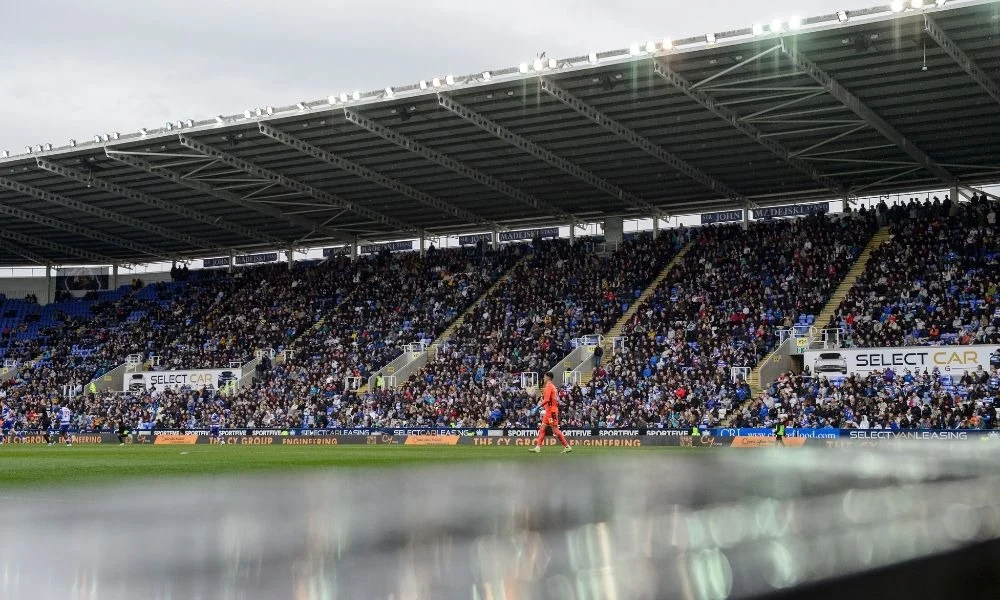
Emerging technologies produce recurring effects. Things change quickly in the spaces around them, and innovation often comes from the most unexpected sources. For Reading Football Club, deliverance from a dark period of financial instability has arrived not just through traditional managerial changes or heavy spending, but through a pioneering embrace of artificial intelligence.
In the spring of last year, the historic English club was perched squarely on the brink of oblivion. A disastrous eight-year spell under the ownership of Chinese businessman Dai Yongge had brought ever-worsening financial chaos, multiple English Football League (EFL) points deductions, and a painful relegation to the third-tier League One.
That period of corporate neglect reached a terrifying crossroads in April. With Yongge disqualified as an English soccer director, the Royals were warned they had to provide immediate proof of funding or find a new buyer. Failing that, they faced the catastrophic threat of expulsion from the EFL. Mercifully, for a club founded back in 1871, deliverance arrived just a few weeks later.
American businessman Rob Couhig, who had previously enjoyed a successful tenure owning nearby Wycombe Wanderers, returned following an earlier failed bid to take full control of the club. Immediately, he set about reintroducing stability and pointing the club’s ambitions back toward the upper echelons from which they had fallen. A return to the Championship, and ultimately the Premier League, once again became the stated target.
A few months into his tenure, Couhig was approached by Stuart Fenton, a lifelong Reading fan working as a private consultant in artificial intelligence. Fenton brought a wealth of diverse experience to the table, having previously worked in telecoms, the academic sector, and the UK’s Department for International Trade. Impressed with his demeanor and operational philosophy over a series of detailed exchanges, Couhig hired Fenton last August as the first-ever head of AI at any professional English soccer club.
“They wanted to think differently, and they took a bet,” says Fenton. “The bet wasn’t on AI. The bet was on timing. We know this is the way the game’s going. We know that teams are looking to be more intelligent. We want to make sure that we’re at the forefront of that.”
Fenton elaborated on this strategy during an on-stage presentation and an interview at SportsPro AI and Tech, held at the London Stadium. He detailed precisely what that calculated bet could mean for the Royals as they navigate their long, challenging journey back to English soccer’s elite tier.
“I mean, the goal is to get out of this division,” he states plainly. “Ask anyone at Reading Football Club, and we’re talking about promotion. We shouldn’t be a League One club. Our infrastructure is Premier League. We have fantastic owners; we have fantastic coaches and staff and manager. So AI is a contributor to it. It won’t be the only reason we go up. You can’t say it was just AI. It’s everything at the club. Every single thing that everyone does contributes to it. AI will contribute to it, but it’s still the success of humans.”
Starting with Culture
For a club operating at Reading’s current financial and competitive level, automation naturally carries the promise of vital cost savings and operational efficiency. Still, Fenton’s prospects in West Berkshire ultimately depend on his ability to successfully sell the project to his colleagues across the entire organization.
“When I joined the club, what I didn’t want people to see me [as] was the Grim Reaper,” he quips. “`If I come and sit next to you in a week’s time, you’re gone.’ I would never have the trust if that happened.”
Instead, his absolute first priority has been helping members of staff think critically about where AI can genuinely improve their daily working lives. That often means using the technology more intelligently rather than simply more frequently. Fenton is especially wary of awkwardly "shoehorning" software into processes just because it happens to be available on the market.
“We are human-centric, data-fuelled,” he says. “That is the mantra we have across the club. AI will never make the decision for us. People are in control of their own destinies; they can do things how they want. It will never make the decision. We try to empower people with as much information as possible, and how they use that is up to them.”
That internal education process has taken several distinct forms during Fenton’s first year on the job, ranging from building foundational skills and general awareness to actively “de-fearing” AI among the workforce.
“There’s a lot of hype, there’s a lot of fear in the media around it,” Fenton notes. While he stresses that there is no single mandated way for staff to adopt AI—noting that “some people like Claude, some people like ChatGPT, some people like Grok”—enforcing safe practices regarding commercial protections and sensitive player medical information remains strictly non-negotiable.
“Privacy, IP, and security—it’s a massive thing for us, especially for our academy,” he confirms. “We’re really hot on who we work with in our academy. Everybody wants to be involved in academy football. The biggest challenge is it’s kids’ data and it’s kids’ health data. We have to be very protective about who we use. We’ve put an AI policy in place with our academy and across the club, so people know what they can and can’t do.”
Achieving the right level of buy-in is essential for Fenton, whose entire mission is engineered around bringing the rest of the organization along with him on the digital journey.

“I don’t have an AI department,” he reveals. “We see my role as a capability across the club. And that was deliberately done. I think once you have an AI department, it can kind of live and die in that department. When we’re looking at transformation across the club, we want everyone to take ownership of it.”
As Fenton sees it, this culture-first approach means subject-matter experts can turn AI loose on their own genuine, everyday problems, rather than trying to force applications onto tools they never requested in the first place. He believes this philosophy is organically producing some remarkably positive outcomes, citing how ground staff have successfully applied AI algorithms to grass maintenance formulas at both the training centre and the Select Car Leasing Stadium.
“I’ve done some really cool things at this club,” he recalls, “but probably if anyone asks me, that’s one of the best things I’ve done. These guys never used AI. They never thought about using AI. Now we have someone like myself here able to bring this into the club, they feel comfortable to do it. And they’re starting to see the results in their work now.”
Whatever external media attention Fenton’s arrival at Reading has generated, it will ultimately be those tangible, practical returns that matter most to the ownership and the fans.
“For us everything is about value,” he says. “Does it help us win? Does it make us money? Does it save us money? If it doesn’t, why are we doing it? There’s no vanity metrics at League One level.”
An Innovation Hub
Despite its relatively unassuming profile as a town of just under 205,000 people located roughly 35 miles from central London, Reading serves as a fitting crucible for AI-led innovation and industrial collaboration.
The region is a massive, established regional tech hub. Reading acts as the UK corporate home for huge multinational heavyweights like Microsoft, Oracle, Huawei, and Cisco, all of which take strategic advantage of easy access to the capital and Heathrow Airport. Thousands of other technology companies have naturally been drawn to the area by that corporate presence, alongside regional initiatives like the University of Reading’s Thames Valley Science Park.
“We’re really lucky where we’re based,” Fenton notes. “We have some brilliant companies around us, but it’s finding the right fit for Reading Football Club as well. So we’re trying to be a bit more intelligent in how we do this, leveraging commercial packages, leveraging data to say, ‘Actually, how can we put the best proposals forward for our sponsors and how do they get maximum impact as well?’”
Currently, brands based in the local “Silicon Corridor” are perhaps underrepresented in the club’s traditional commercial portfolio, which is currently headed by betting company Mr Vegas and Select Car Leasing. Already, however, the heavy emphasis on AI development is generating some tangible opportunities to work directly with the tech sector and carve out a distinctive corporate identity.
“We’re already heavily engaged with our tech ecosystem,” Fenton says. “We have a very good business club that our commercial team run, but we’re having very good conversations with everybody in the region about what we can potentially do together.”
The past year has yielded a sequence of formal agreements that are steadily building toward Reading’s broader AI vision. World-leading AI chipset manufacturer Nvidia is another technological giant with a key regional office situated in Reading. Together with hardware partner Lenovo—which maintains its own local base in nearby Basingstoke—and London-based frontier AI company Stelia, Nvidia is actively supporting the newly established Reading Football Club AI Centre of Excellence.
Announced back in June, this initiative aims to pursue best practices for professional soccer across a variety of both on- and off-field activities, while simultaneously providing educational and integration schemes across Reading and the wider Thames Valley region.
“There’s a great opportunity to do things differently,” says Fenton. “And being positioned as the AI club, it’s actually about doing stuff. The only way we can really do stuff at the pace that we want to is by working with partners, so it’s really changed the conversations that we’re having with people. But it’s putting Reading FC on the map as well.”
All of this pioneering work has also created healthy grounds for open dialogue with other professional sports teams who are curious about the project.
“We’re not competing for the same fans,” Fenton points out, “so there is an openness, and I think because we’re at the quite early stages of AI in football, people are kind of in that experimental stage.”
That collegiate spirit may not quite extend to guarding “the secret sauce about performance” and player recruitment—areas where clubs naturally protect their own competitive advantages—yet there remains a genuine appetite for sharing foundational knowledge across the sport. In that cooperative spirit, Reading recently hosted an AI in Football Summit at their Bearwood Park training complex. The event brought prominent tech providers together with top-level European sides like Ajax, Como 1907, Crystal Palace, and UEFA Champions League winners Paris Saint-Germain.

“I was asked a question about PSG joining,” Fenton recalls. “‘Are you starstruck by PSG coming to League One Reading?’ No, we’re not starstruck, because we want to be the leaders in this. We want to embrace what we’re doing here at the club, and equally, we’re not starstruck.”
The club is also keenly aware that commercial returns will ultimately come through a much deeper understanding of their own loyal fanbase. In May, Reading unveiled the One Royal subscription programme, which offers a curated selection of supporter benefits, including the practical option to spread the cost of a full season ticket across 12 monthly payments.
“That’s allowed us to get a bit more insight into our fans,” Fenton explains. “We want to be in a position where we can really hyper-personalise things for them, but do it in a controlled way. No one wants AI slop or things thrown down your throat, and we’re really conscious of that.”
Reading hopes that these strategic initiatives will demonstrate concrete benefits over the course of the upcoming campaign.
A Decisive Advantage
After the severe trials of the past decade, there is one particular area where Reading fans might welcome operational improvement most of all: the pitch. Yet, in the competitive middle of the English soccer pyramid, clubs driving hard for promotion face an obvious central problem, as most of their direct rivals share that exact same ambition.
“We can’t outspend teams,” concedes Fenton. “We’re a League One club. It is very challenging being in League One. You see the amount of teams dropping down the divisions. They’ve got parachute money. They’ve got ownership that are willing to throw things, throw money at the league. That’s not what our owners want to do. They want to create a sustainable business.”
The fundamental objective of the Reading experiment, therefore, is to accelerate sporting progress on the field through smarter resource allocation.
“Football has tonnes of data,” Fenton says. “Football doesn’t have a data problem; it has a time problem. Can people do things quickly? Can they understand it? And can they actually use it?”
Equipped with the right datasets and the advanced tools required to interrogate them properly, AI promises vital performance advantages in expensive and decisive areas such as player development and comprehensive injury prevention. While analytical products addressing those specific challenges have existed across the game for a few seasons, Reading’s customized strategy is intended to meet the club’s exact needs without overextending their operational limitations.
“When you look at recruitment,” Fenton suggests, “you get hundreds of names thrown at you. On transfer deadline day, you could get 20 different names thrown at you. You can’t scout every player. You don’t know every single thing. It’s essentially about how do we have as much data as possible blended with our human insight to be able to actually make a decision.”
To that exact end, Reading is now turning partner Marquee’s machine-learning models directly toward the demands of the transfer market.
“We don’t need 30 names,” he adds. “We can take a shortlist of 1,000 names, take it to 100, and from the 100, have three players that we want.”
The idea of a traditionally unheralded sports team using advanced data analytics to outsmart much richer opposition naturally invites some inevitable external comparisons.
“Everyone calls it Moneyball, which I absolutely hate,” Fenton says. “I call it Readingball because we want to differentiate away from Moneyball.”
Joking aside, he readily acknowledges the “fantastic job” done by clubs like Brentford, Bournemouth, and Brighton and Hove Albion—lower-tier mainstays who utilized proprietary algorithms and smarter business models to achieve sustained Premier League success. To emulate those remarkable achievements, however, a team in Reading’s unique position must now look beyond past models.
“Everybody’s trying to be data-driven,” he says. “Everyone’s trying to go down that approach, and when everyone’s doing it, it becomes standard. I wanted to do things differently. I wanted to be the AI team. I want people to think of us as that team. When people look at the metrics of success here, everyone says Brentford, Brighton. I want people to look back in the next three years and say: ‘Oh yeah, that Reading model is the one that got them up.’”