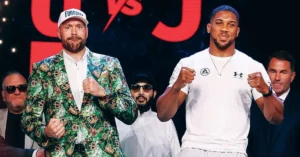
The long-awaited showdown between Tyson Fury and Anthony Joshua has finally arrived on the global sporting stage, yet the inaugural press conference for the historic heavyweight clash took an astonishingly surreal turn when boxing financier Turki Alalshikh launched an unexpected tirade against pop superstar Dua Lipa. Addressing media, dignitaries, and fans during the high-profile launch event on Wednesday evening, the influential Saudi powerbroker claimed that the Grammy-winning British singer had flatly rejected an offer to perform at what is being billed as the biggest boxing event in modern British history.
The clash between Britain’s two preeminent heavyweight champions of the past two decades represents the culmination of years of intense speculation, protracted negotiations, and public clamour. When Fury and Joshua finally stood face-to-face on Wednesday for the first time since their monumental encounter was officially confirmed last week, the atmosphere was expected to be dominated exclusively by sporting theatre, fierce staredowns, and the fierce sporting rivalry that has defined an entire generation of heavyweight boxing. Instead, Alalshikh, who has served as the key financial architect behind the undisputed and heavyweight revival, added an extraordinary chapter of celebrity drama to the narrative.
Taking the stage to outline the complex logistical journey behind finalizing the ‘Battle of Britain’, Alalshikh spoke openly about the various hurdles encountered during the planning process. While both fighters, along with Matchroom Boxing promoter Eddie Hearn and numerous other stakeholders, spent portions of the evening praising Alalshikh for his decisive role in underwriting and facilitating the blockbuster bout, the boxing chief did not hold back when reflecting on the entertainment roster and the negotiations that took place away from the canvas.
In the middle of explaining how the fight’s host venue was ultimately selected, Alalshikh pivoted without warning to address the global chart-topper. Delivering a blunt appraisal of the situation from the podium, he claimed that Dua Lipa had shown no interest in sharing the stage with Britain’s premier prizefighters.
"I will be honest today, I know that London wouldn’t give me the stadium until 2am, and I know that Dua Lipa will not perform in the stadium, because she doesn’t like boxing, and maybe she doesn’t like me," Alalshikh declared to an astonished room of journalists and sporting figures.
The public swipe immediately sent shockwaves across both the sporting and music worlds. Dua Lipa, one of the United Kingdom’s most successful musical exports of recent years, has headlined major global stadium tours and world-renowned festivals, yet according to Alalshikh, she had zero appetite for taking part in the extravagant fight-night festivities scheduled to accompany Fury and Joshua’s collision. Her representatives have since been approached for comment regarding the remarks and her alleged refusal to perform.
Alalshikh’s candid venting over the pop star came as part of a much broader, unusually transparent breakdown of the logistical and commercial challenges involved in staging the heavyweight spectacle within the borders of the United Kingdom. Prior to the formal announcement, high-level discussions had explored multiple iconic international locations. New York’s historic Madison Square Garden had emerged as a serious contender to export the all-British rivalry to American soil, while London’s Wembley Stadium had long been considered the sentimental favourite to host what many regard as the most commercially lucrative domestic fight in British boxing history.
However, the final announcement confirmed that the Principality Stadium in Cardiff, Wales, had ultimately won the bidding race to host the contest. During the press launch, Alalshikh pulled back the curtain on why Wembley and London as a whole had fallen short, citing rigid local operational restrictions and stadium curfews as a primary dealbreaker for an international broadcast of this magnitude.
According to Alalshikh, authorities in London were simply unwilling to permit the stadium to remain operational until 2am—a timeline that organizers deemed essential in order to align the main event walkouts with prime-time pay-per-view audiences across key global markets, most notably North America. The refusal of London officials to accommodate those late-night operational demands, combined with the entertainment snags highlighted by his remarks regarding Dua Lipa, proved to be decisive in redirecting the entire production west to Wales.
Beyond the logistical friction in the capital, Alalshikh also laid bare the profound financial sacrifice required to bring the fight to a British venue at all. By choosing to stage the bout in the United Kingdom rather than in an overseas market with more advantageous international broadcast windows and fewer commercial compromises, Alalshikh revealed that organizers were absorbing an immense financial hit.
"Nobody questioned me about UK," Alalshikh said, speaking impassionedly about his affection for British boxing culture while highlighting the realities of the event’s balance sheet. "I love the British people, I try to deliver everything for them. Put yourself in my shoes; there’s a situation to lose $70million (£52.8m); the best is to have it in a good time zone."
The staggering potential shortfall of roughly $70 million (£52.8 million) underscored the commercial stakes at play. For major pay-per-view spectacles, the scheduling equation is often governed ruthlessly by international television rights, advertising streams, and time zones. By prioritizing the domestic fan base over more lucrative alternatives, the organizers accepted a substantial hit to maximize the atmosphere for the local crowd.
Alalshikh made it clear that despite London’s perceived operational intransigence and the commercial penalties involved, his commitment to keeping the event on British territory never wavered once a viable partner stepped up. In Cardiff, organizers found the flexibility they required, alongside a venue renowned for accommodating major indoor sporting spectacles thanks to its retractable roof.
"I have two reasons, and I know London won’t deliver it; they won’t give me the stadium until 2am… Wales delivered it; it’s still the UK, the town of Ryan Giggs, let’s do it," Alalshikh added, concluding his explanation with an offbeat tribute to the former Welsh international footballer.
The determination to hold the fight within the UK had also been a central crusade for Anthony Joshua’s longtime promoter, Matchroom chairman Eddie Hearn. Hearn had repeatedly emphasized both his own and Joshua’s desire to deliver the bout on domestic soil, viewing the clash not merely as a high-stakes heavyweight contest, but as the defining cultural moment of a generational British boxing era.
Taking to the stage at the British Airways ARC during Wednesday’s launch, Hearn made a point of addressing Alalshikh directly. While acknowledging that negotiations had not always been seamless behind closed doors, Hearn praised the boxing financier for ultimately acceding to the demands of the British sporting public.
"I’m excited," Hearn told the audience. "Turki, I know we’ve fallen out, but I promise you this’ll be the greatest night you’ve ever had in boxing."
Hearn continued by emphasizing the immense historical gravity of what Joshua and Fury had built over the course of their respective careers, making the case that taking the contest away from the British public would have been a fundamental disservice to the sport’s domestic renaissance.
"On a serious note, when we talked about this fight, you envisaged it for British boxing," Hearn stated. "This guy (Joshua) has changed boxing in this country. So has Tyson Fury. We are the envy of the boxing world. We can’t stage it anywhere else. Thank you to the British public for putting the pressure on. We couldn’t do it, we failed."
Hearn’s candid admission that the traditional promotional apparatus had previously failed to close the deal on British soil served as a testament to the immense financial backing provided by Alalshikh. Without that external underwriting, the commercial realities and venue stumbling blocks might have pushed Fury and Joshua across the Atlantic or further afield.
Instead, the stage is now formally set for Cardiff. While Dua Lipa may not be stepping out to provide the pre-fight musical entertainment under the roof of the Principality Stadium, the theatrical animosity, unprecedented financial disclosures, and the long-awaited face-off between Tyson Fury and Anthony Joshua have guaranteed that the buildup to this undisputed domestic summit will be as unvarnished and unpredictable as any event in boxing history.