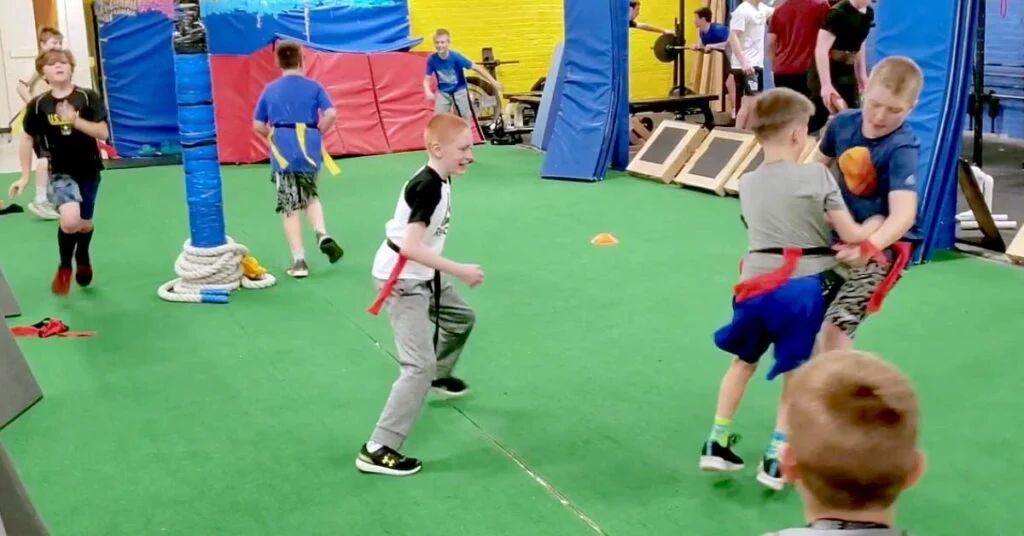
It is no secret that children love to play. Give kids a patch of open space and a few minutes of unstructured time, and you will inevitably witness them chasing one another, wrestling until they tumble to the turf, or inventing elaborate rules for impromptu games. For youth coaches, however, play is far more than a simple pastime—it is a powerful, underutilized vehicle for athletic development. By strategically modifying the rules, environment, and participants of a game, coaches can unlock specific physiological and cognitive outcomes. Strength and conditioning specialist Jeremy Frisch has long championed this philosophy, using dynamic play to build foundational athleticism in young athletes without the burnout often associated with early sports specialization.
From a child’s perspective, games are the most natural, recognizable, and inherently enjoyable activity imaginable. They require little introduction and offer immediate motivation. From a coaching standpoint, games provide an adaptable canvas. In a standard game of tag, for instance, a coach can subtly alter the size of the playing area. Enlarging the space forces players to cover greater distances, thereby increasing the cardiovascular conditioning effect. Conversely, shrinking the perimeter forces rapid decision-making and sharp changes of direction. By tweaking these variables, coaches can dictate the exact motor skills and physical adaptations they wish to foster.

Why Play Outperforms Rigid Youth Sports Structures
Ultimately, games serve as a medium for children to practice and expand their general motor skill repertoire. Long before the era of elite travel teams, specialized training facilities, and packed weekend schedules, children spent their afternoons playing self-directed games in backyards, neighborhood streets, and makeshift fields. These unstructured activities—loosely based on organized sports but governed by fluid, peer-invented rules—provided an optimal ecosystem for young bodies to test and refine a vast spectrum of physical capabilities.
Because these games lacked adult intervention, children enjoyed complete autonomy. There were no coaches barking instructions on proper mechanical execution; instead, youngsters naturally experimented with diverse movement patterns to solve practical challenges. This self-discovery fostered elite problem-solving abilities in chaotic environments, laying a robust foundation that athletes later applied to more complex, organized sports.
In his facility, Frisch emphasizes fundamental movement patterns such as sprinting, jumping, catching, and throwing. These core mechanics form the baseline of virtually all athletic endeavors, making it crucial for young participants to grasp them organically. Rather than demanding absolute technical perfection from children, the focus rests on building basic competence. Coaches introduce these fundamental movements during warm-ups and skill-development periods, then transition them into open, chaotic environments where games cement the learning process.
Frisch utilizes a wide array of dynamic games designed to target specific athletic objectives while keeping engagement sky-high. These activities range from deceptively simple tag variations to complex, high-energy challenges that test every facet of physical literacy.

Flag Tag and Team Relay Tag
At its core, traditional tag may be the simplest yet most athletically beneficial game in existence. It requires no formal instruction, triggers an innate thrill of simulated danger, and demands nothing more than an open space. Tag builds decision-making, tracking, evasion, tactics, strategy, acceleration, deceleration, change of direction, and body positioning, all while delivering profound cardiovascular benefits.
The flag tag variation introduces football flags to the equation, transforming the dynamic so that every participant is simultaneously a hunter and the hunted. Players compete in a free-for-all environment, attempting to snatch opponent flags while protecting their own until only one remains. Beyond the cardiovascular workout, flag tag introduces a vital biomechanical cue: opponents must target the hips to pull a flag. For football coaches, this establishes instinctive habits for defensive pursuit angles, as defenders naturally gravitate toward an offensive ball carrier’s hips.

Team relay tag introduces a time-based competitive element. Pitting a chasing team against a running team inside a confined grid, coaches time how long it takes the hunters to tag every member of the opposing squad. Tagged runners remain active in the game until all hunters have completed their turns, after which roles reverse. This setup forces rapid directional changes, efficient movement in tight quarters, and the rapid processing of visual information under the pressure of a running clock.
Power Ball, Move the Mountain, and Runners and Gunners
Drawing inspiration from classic television gladiatorial challenges, Power Ball pits offensive players against defenders in a frantic race to deposit balls into storage buckets within a strict thirty-second window. Crucially, the system features one more scoring bucket than there are defenders, forcing defensive units to communicate, hustle, and rotate rapidly while attackers exploit openings. This builds evasion, invasion tactics, lateral movement, and perceptual decision-making.

Move the Mountain re-imagines the traditional relay race by incorporating loaded carries, running, and obstacle negotiation. By balancing team rosters thoughtfully—pairing faster athletes with slower ones and introducing weighted objects—coaches transform a basic sprint into a multi-dimensional test of strength, pacing, and cooperative teamwork.
Runners and Gunners, frequently recognized by the classic playground moniker "Pickle," serves as a cornerstone conditioning tool in Frisch’s programming. Utilizing soft foam balls, modern iterations place large groups of runners in a central zone where they can be eliminated by tags or direct hits. Because athletes can never outrun a thrown ball, the game naturally trains explosive acceleration, deceleration, evasion, and reaction time. Athletes routinely log hundreds of yards of high-intensity sprinting without realizing they are conditioning, purely driven by the competitive immersion of the game.

Kings and Pawns, Boulder Ball, and Uphill Sprints
Kings and Pawns blends elements of wrestling and football within a compressed, chaotic space. Teams feature a designated "king" standing behind kneeling "pawns," whose job is to block opposing pawns and clear a path for their own king. For youngsters aspiring to play contact sports, this physical environment normalizes bodily contact, teaching them how to maintain balance, exert force, and react dynamically within another person’s personal space.
Boulder Ball utilizes stability balls rolled gently by coaches to challenge young athletes. One version focuses on evasion, requiring participants to duck, dive, and leap to avoid the oncoming "rock," with airborne catches offering teammates a chance to re-enter the game. The second version serves as an acceleration race, pitting athletes against a rolling stability ball in a dash toward a landing mat, evoking cinematic tropes that immediately captivate children.

Uphill sprints, while demanding, are structured as head-to-head races to maximize effort. Frisch notes that running uphill naturally enforces a forward lean characteristic of optimal sprint acceleration while providing cardiovascular and strength benefits for untrained youths. By framing hill work as a competitive race with adequate rest intervals, coaches train speed rather than pure fatigue, ensuring young athletes push their limits willingly.
Tug-of-War and the Foundation for Future Sport Success
When introducing fundamental strength concepts to children, traditional tug-of-war remains irreplaceable. Pulling against resistance demands maximal, whole-body output, placing quasi-isometric tension on the hands, arms, shoulders, back, and legs. Whether utilizing heavy ropes, medicine balls, or partner grips, tug-of-war builds functional strength across virtually every muscle group while keeping competitive enthusiasm at a peak.

Exposing young athletes to diverse movements and unpredictable environments through play prepares them for the realities of competitive sports. While pre-programmed, mechanical drills have their place in later stages of athletic refinement, early development thrives on open-ended problem-solving. Play ensures that movement remains engaging, reducing the burnout rates plaguing modern youth athletics and fostering a lifelong affinity for physical activity.