



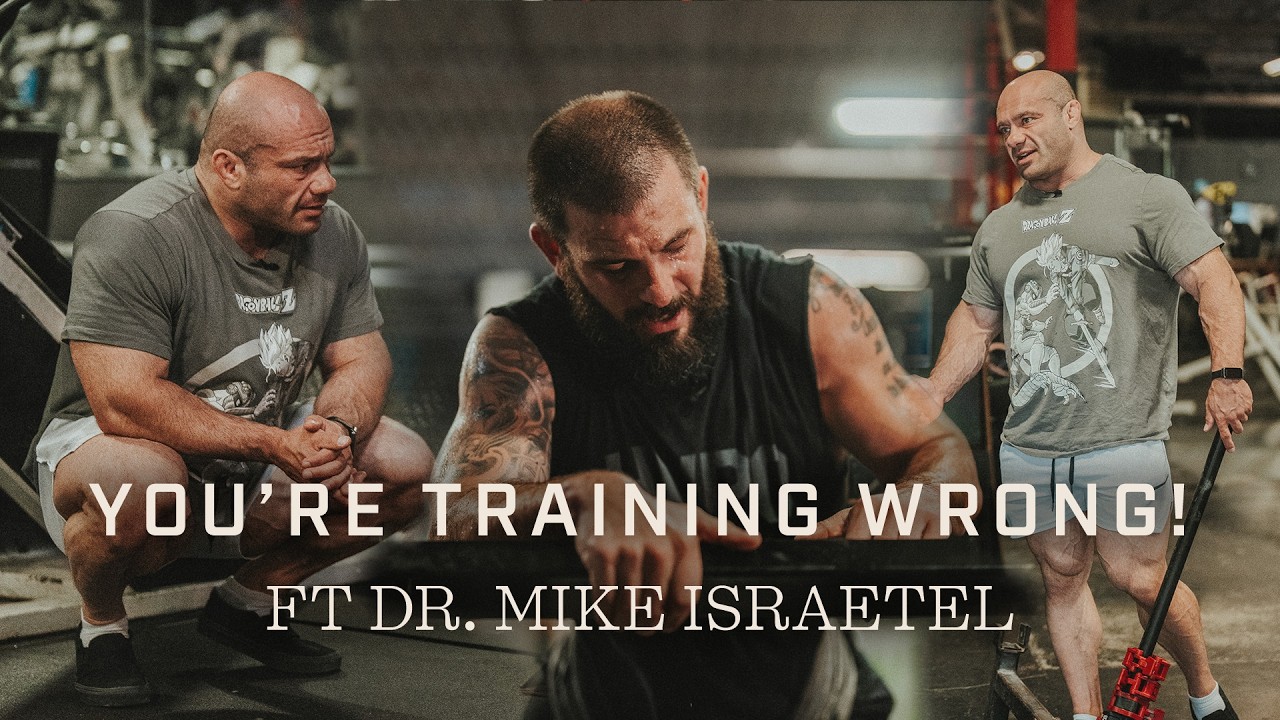
In a recent YouTube video that has quickly captured the attention of the fitness and CrossFit communities, five-time Fittest Man on Earth Mat Fraser sat down with exercise scientist Dr. Mike Israetel for a back-and-biceps training session. What began as a standard workout video quickly evolved into a masterclass on smarter training, longevity in sport, and the hidden psychological and physiological traps that derail even the most dedicated athletes.
Throughout their conversation, the two fitness icons dissected why piling on endless volume so often backfires, how to identify the subtle warning signs of overreaching, and why champions swear by counterintuitive off-season strategies. By bridging the gap between elite CrossFit conditioning and evidence-based hypertrophy science, Fraser and Israetel provided a rare blueprint for how athletes at any level can unlock years of sustained growth without burning out.
The Core Lesson: More Is Not Better
The conversation kicked off with a hard look at the biggest mistake both men witness in modern training environments, particularly within the sport of CrossFit. Fraser pointed out that athletes frequently fall into the trap of watching winners, assuming that whatever the champion is doing must be copied verbatim, and simply piling on more volume.
Fraser admitted that he fell headfirst into that exact trap himself around 2014 and 2015. His verdict on that period of his career was blunt: it went atrociously. He emphasized that every single workout needs to have a defined purpose, a clear goal, and a specific target.
To illustrate this philosophy, Fraser shared a concept he borrowed from his track coach, a mentor named Henshaw, who famously labeled purposeless, mindless exercise as "fluff training." According to Fraser and Henshaw, every session must target a weakness or serve a specific physiological adaptation, rather than just serving as a way to sweat or pass the time.
Why Your Body Has a Ceiling
Expanding on Fraser’s thoughts, Dr. Mike Israetel compared the human body to a mechanical hydraulic press. While the body is remarkably strong, adaptable, and resilient, it is ultimately a physical system bound by strict limits. Cross the threshold known as maximum recoverable volume, or MRV, and physiological trouble inevitably follows.
Israetel noted that MRV is a practical coaching framework derived from his own training models rather than a fixed, universally absolute physiological number. An individual’s personal ceiling fluctuates daily depending on variables such as sleep quality, life stress, baseline nutrition, and cumulative training history. Consequently, any specific set count or volume prescription should be treated as a starting estimate rather than gospel.
The underlying trick to long-term athletic development, Israetel explained, is to give the body enough of a challenge to stimulate growth and adaptation, while maintaining enough recovery bandwidth on top of that stress to actually heal, adapt, and supercompensate.
Copy Elements, Not Entire Programs
The discussion naturally drifted toward the broader phenomenon of program copying. Israetel observed a nearly identical pattern in the world of bodybuilding, where amateur lifters frequently clone the routines of professional champions word-for-word, set-for-set. Israetel’s perspective on the matter remains nuanced.
He acknowledged that the best athletes in the world possess an unbelievable amount of wisdom, making the adoption of specific elements, techniques, or training methods into one’s own program a fantastic idea. However, wholesale program theft from a genetic elite to a novice or intermediate lifter is usually a recipe for disaster.
This impatience trap frequently manifests outside the gym as well. Israetel recalled a message from a frustrated lifter who complained about failing to gain weight despite eating enormous amounts of food. Upon closer questioning, it turned out the athlete was steadily gaining about half a pound per week—a textbook, highly successful rate of growth. The lifter’s complaint ultimately boiled down to a desperate desire for immediate success rather than sustainable progress.
Fraser connected this impatience to Olympic weightlifting, where elite competitors might spend an entire year training twice a day just in the hope of adding a mere 2.5 kilograms to their total lift. As athletes transition from year one to year two and beyond, progress naturally flattens dramatically. As Israetel summarized, the line still goes up, but it goes up remarkably slowly.
Rushing the process can also manifest in the use of performance-enhancing drugs. Israetel issued a stern warning that jumping straight to professional-level dosing schedules invites severe, long-term cardiovascular consequences. His blunt summary was clear: shortcuts always exist, but athletes invariably pay for them dearly down the road.
Four Signs You Are Overreaching
Describing the grim reality of true overtraining, Fraser vividly recalled the aftermath of the 2015 CrossFit Games. Extreme heat during the competition left a massive portion of the field suffering from heat stroke, and Fraser and his fellow competitors reported feeling entirely off for months afterward. Describing that profound state of systemic fatigue, Fraser noted that he literally felt like a shell of himself.
To help everyday athletes avoid falling into that dark place, both men shared personal early-warning checks. While these indicators are experience-based gut checks rather than clinically validated medical tests, they offer free, daily feedback that costs nothing to track over time. Monitoring persistent mood changes, unexpected drops in performance, lingering joint soreness, and general lethargy can alert an athlete to systemic overreaching before it boils over into full-blown overtraining syndrome.
Training Versus Practice
To further clarify how elite athletes structure their time, Israetel drew a sharp philosophical line between training and practice. Practice rehearses the actual competition event, incorporating exact pacing, strategic transitions, and the necessary mental fortitude. Training, by contrast, builds the underlying physiological systems that make those performances possible in the first place.
Bodybuilders practice their mandatory posing routines, but they train with brutal hack squats. Weightlifters practice executing high-speed snatches, yet they train their raw strength with front squats and heavy push presses.
Fraser noted there is an inherent brutality to training because it is rarely the glamorous aspect of the sport that athletes want to be doing, but it is precisely what makes the glorious moments possible on the competition floor. Fraser applied this direct logic to his gymnastics work, specifically pull-ups. In training, he focused heavily on strict pull-ups to build raw capacity and joint resilience. In competition, however, butterfly kipping served as a necessary mechanical evil deployed strictly for speed and efficiency.
The Power of Strategic Time Off
Perhaps one of the most counterintuitive topics covered in the video was the necessity of strategic time away from the gym. Israetel candidly admitted that he personally hates this advice. After taking even a week and a half away from training, he experiences an existential crisis.
Yet, Israetel conceded that after two full weeks completely away from the gym, he returns feeling like he has an entirely new body, complete with happier joints and a surging, undeniable drive to train. His firm recommendation for dedicated lifters is to take at least two weeks fully off once or twice a year, with one of those breaks potentially stretching out to a full month.
Fraser revealed that he built this exact protocol into his championship years. Immediately after winning a CrossFit Games title, he would take a full month completely off, eating whatever he wanted and staying up late. He never committed to the next season until that month of mental and physical decompression had run its course. Knowing that a substantial rest period was always waiting at the end of a grueling season gave him the psychological freedom to push harder during the intense weeks of preparation.
Win the Hours Outside the Gym
Reflecting on his competitive dominance, Fraser recalled a conversation with a coach who bluntly reminded him that he was not special simply because he performed heavy squats and grueling rowing intervals. The true competitive edge always lives outside the gym in the unglamorous domains of sleep, nutrition, and daily recovery.
Fraser took that reality so seriously that he famously shipped a vacuum-sealed mattress to his hotel room during every Games week. His rationale was simple: why alter or compromise the single most important recovery variable during the most critical week of the entire year?
Israetel reinforced this sentiment by introducing a practical sleep-debt rule. He explained that heavy training volume is entirely acceptable if an athlete eats, rests, and sleeps exceptionally well that same night. Conversely, combining hard training on poor sleep with subsequent nights of inadequate rest creates a devastating physical blender effect that rapidly breaks the body down.
The Specialization Plan for Stalled Gains
For athletes currently experiencing stalled gains and frustration, Israetel offered a concrete multi-step solution. The first recommendation is to take two full weeks completely off from structured training, followed by a gradual rebuild starting from a lower volume baseline.
The second recommendation is to stop trying to push every single muscle group across the entire physique simultaneously. Instead, athletes should temporarily prioritize specific muscle groups while allowing others to coast on maintenance volume. For example, an athlete can place their legs, chest, and triceps on maintenance volume—which typically amounts to roughly one-third of their usual workload—while ramping up volume for the back, biceps, and other targeted lagging areas for a period of 12 to 16 weeks before eventually swapping roles after a designated deload period.
The physiological logic behind this approach is that a single muscle group’s maximum recoverable volume far exceeds what it receives when every muscle in the body is being smashed simultaneously. While biceps might easily thrive on 25 to 35 weekly sets, no balanced full-body routine physically has the systemic room to accommodate that kind of localized volume across every muscle group. Israetel emphasized that these high set ranges stem from his extensive coaching experience and must be adjusted to individual recovery capacities, noting that true maintenance volume successfully preserves existing muscle mass rather than causing regression.