
Throughout human history, certain words have served as anchors for the human spirit. A mantra—derived from the ancient Sanskrit roots man, meaning "mind," and tra, meaning "tool" or "instrument"—is fundamentally an instrument of thought. It is a sacred word, sound, or phrase repeated aloud or silently to steady, anchor, and focus the mind amidst the turbulence of life. While these linguistic anchors trace their origins deep into ancient Vedic, Hindu, and Buddhist traditions, their application has evolved significantly. Today, mantras are utilized across both spiritual practices and secular psychology to anchor focus during meditation, calm an overactive nervous system, and facilitate cognitive reframing.
For Army veteran Denny Giamazzo, a specific mantra has not merely been a tool for meditation; it has been a literal lifeline, carrying him through some of the darkest and most challenging trials a person can face. To this day, he lives by a powerful internal declaration: "Someone else out there has had it worse. They have come back stronger, and they are doing more with less. I am not allowed to feel sorry for myself."
That uncompromising mindset was not born in a vacuum; it was forged through a childhood defined by instability, hardship, and a staggering degree of early adversity.
Challenges From Childhood
When Giamazzo speaks about facing lifelong adversity, he means it in the most literal sense possible. Born two months premature in Worcester, Massachusetts, his life began under fragile circumstances. He never knew his biological father, and his early days were spent in the care of a mother who struggled profoundly with her own life. Giamazzo recalls numerous instances during his early childhood when his mother would vanish for hours or even days at a time, leaving him entirely alone without a word of explanation or a hint of where she had gone. In those moments of isolation, an upstairs neighbor would occasionally step in to watch over the young boy if they realized he was home by himself.
The instability of his earliest years came to a devastating head when Giamazzo was just five years old. His mother passed away from AIDS, plunging the young child into the foster care system. Eventually, he was taken in by his aunt, finding a relative to anchor him, but the transition was far from a storybook rescue.
Even amidst the trauma of losing his mother and navigating the foster care system, Giamazzo managed to extract a vital, enduring silver reflecting from the wreckage of his youth. Looking back on those formative years, he notes that the chaotic environment instilled in him an extraordinary capacity to endure. "I think what I took from that was just an insane amount of resiliency," he says.
That burgeoning resiliency became his primary psychological armor as he grew older. While living with his aunt, Giamazzo would often stay with his grandfather while his aunt worked. However, an uncle also lived in the household, and he subjected Giamazzo to physical abuse that persisted deep into the boy’s teenage years. Confrontations were frequent and intense. "We got into it a lot," Giamazzo recalls of those volatile domestic encounters.
Fortunately, salvation arrived in the physical, structured realm of sports and fitness. Long before reaching high school, Giamazzo gravitated toward organized baseball, eventually expanding his athletic repertoire to include basketball and football during his high school years. The grueling physical challenges, the discipline required, and the tangible sense of bodily improvement served as powerful driving forces for a young man searching for control in a world that often felt entirely chaotic. "At a young age, I just loved putting my body through things and seeing what I was capable of," he reflects.
From School to Service
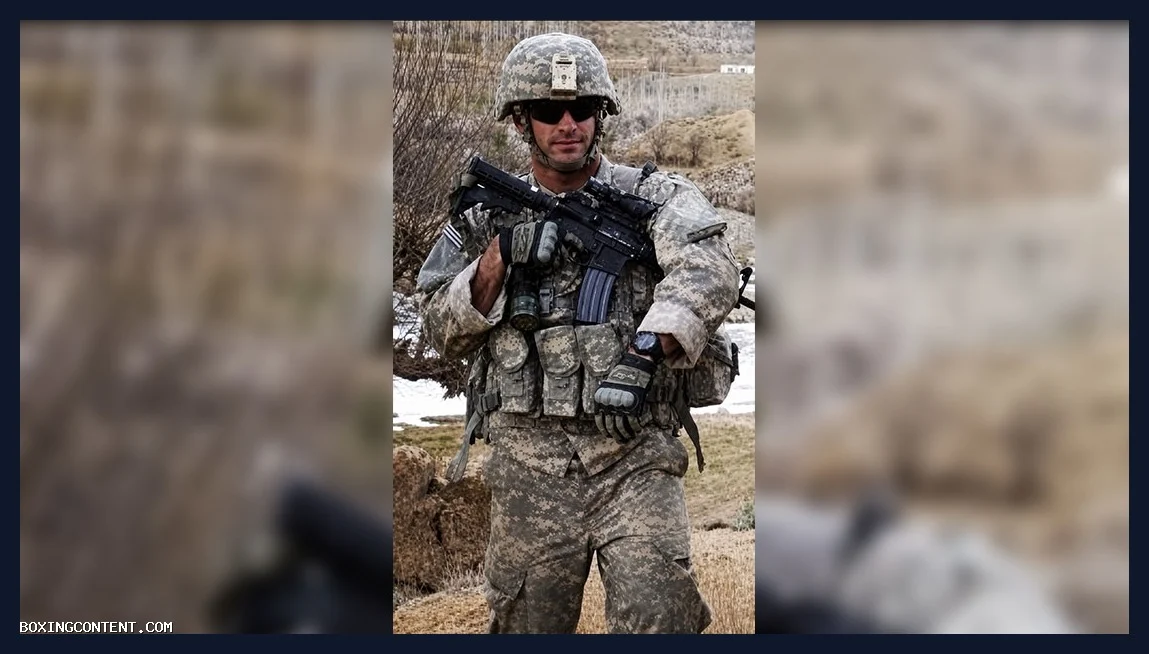
Seeking direction and a sense of purpose after completing his schooling, Giamazzo enlisted in the United States Army in 2006, embarking on a nearly seven-year military career that would ultimately take him halfway around the world. As an infantry team leader, he deployed to Afghanistan from 2010 to 2011, stepping directly into the harrowing realities of combat operations.
Characteristically candid about his initial motivations, Giamazzo admits that patriotism was not his primary driving force when he signed the dotted line. "I really didn’t join with this burning desire to go serve my country or anything like that," he shares. "That’s what it turned into after really getting embedded in that lifestyle and working with the guys I got to work with every day."
That brotherhood, however, came at a cost. Giamazzo did not return from Afghanistan unscathed. The physical toll manifested in two major surgeries on his right shoulder, while the psychological toll manifested in the silent, grinding battle with Post-Traumatic Stress Disorder (PTSD) that so many combat veterans face upon returning home. Faced with these new and formidable demons, Giamazzo did what he had always done: he reached back into the deep well of resilience he had forged as a child in Worcester.
"That inner strength and those lessons of resiliency that I learned early on as a kid have kind of been a barometer for me my entire life," he explains. "It led me through just about any pain, adversity, or objective that I’ve hit and then had to overcome throughout my entire life."
Crucially, Giamazzo also returned to the regimen that had sustained him in his youth: physical training. Working out five days a week, he alternates between heavy weightlifting and high-intensity interval training (HIIT). Among his preferred conditioning challenges is the grueling CrossFit benchmark workout known as "Cindy."
This reliance on rigorous physical exertion is strongly backed by modern science. A comprehensive 2023 review conducted by researchers at Duke University and Mount Sinai concluded that regular, structured exercise can be just as effective as pharmaceutical intervention in easing symptoms of depression. For Giamazzo, maintaining a positive, aggressive, and entirely self-contained physical outlet was an indispensable tool during his recovery—one that he continues to rely on today. "It really has been probably the most integral part of addressing my PTSD," he notes.
Wired for Action
Having transformed countless negative experiences into fuel for personal growth, Giamazzo has dedicated a significant portion of his post-military life to sharing those hard-won lessons with others. Recognizing that his unique trajectory and the insights gathered along the way could not be fully contained within the scope of a single conversation, he authored his autobiography and self-improvement guide, Wired for Action. The book serves simultaneously as a personal memoir and a practical blueprint for individuals struggling to navigate their own dark periods. "It’s easy sometimes to feel like we’re on an island by ourselves," Giamazzo observes. "That’s just not the case."
Expanding his reach further into the mental health and leadership spaces, Giamazzo co-hosts the Be the Standard Podcast alongside Mike Barnes. Together, they explore a wide array of critical subjects, including men’s mental health, combat trauma, PTSD, personal identity, individual responsibility, discipline, faith, and leadership. As a public speaker and leadership consultant, Giamazzo works directly with individuals striving to dismantle self-destructive habits and unlock their true potential despite past traumas.
"I would say that for each individual, it’s on them," he emphasizes, highlighting the importance of radical personal accountability. "It comes down to: ‘What type of person do I want to be? What action do I need to take to reach those objectives?’ If you know what you want out of life, you know exactly the type of person you want to be, and you’re willing to put the work in, I think that’s going to give you a substantial amount of purpose."
For those seeking a concise encapsulation of his philosophy—a modern mantra to carry into an uncertain future—Giamazzo distills his entire worldview down to five direct words: "Take action. Keep moving."
Readers interested in exploring his methodology can find Wired for Action available on Amazon, and can follow his ongoing advocacy and fitness journey on Instagram at @dennygiamazzo.