



In the modern fitness landscape, social media feeds are flooded with advice urging trainees to push closer to failure to maximize muscle hypertrophy and strength gains. Whether scrolling through Instagram or watching in-depth breakdowns on YouTube, gym-goers and calisthenics athletes are constantly reminded that the secret to growth lies in squeezing out those final, agonizing repetitions. Yet, according to a recent video published by the physiotherapist and calisthenics coach behind the popular online platform Fitness FAQs, a stark reality often goes unnoticed: most lifters quit their sets long before their muscles actually give out.
The primary culprit behind this premature cessation is not a lack of physical capability or a genuine breakdown of muscle tissue. Instead, it is psychological and sensory discomfort. When the familiar metabolic burn sets in and the central nervous system registers high levels of perceived exertion, the brain immediately signals that it is time to rack the weight or drop from the bar. According to the coach, who brings seventeen years of dedicated experience in bodyweight training and physical therapy, this phenomenon leaves massive amounts of growth potential completely untouched. Sets that look exceptionally difficult on paper—characterized by heavy breathing and facial grimaces—frequently harbor a deceptive number of repetitions in reserve.
To combat this widespread tendency, the Fitness FAQs coach advocates for a straightforward yet psychologically demanding experiment designed to recalibrate how trainees perceive true exertion. Rather than relying on subjective sensations like the skin-stretching pump or localized fatigue, athletes need a concrete, objective gauge to measure whether their training intensity is genuinely honest. According to his analysis, that vital clue is found in the final handful of repetitions of a given set, specifically observing how the movement speed changes under load.
Why Calisthenics Athletes Stop Too Soon
The temptation to cut a set short is particularly acute in bodyweight and calisthenics training, where the resistance cannot be adjusted mid-set with a flick of a wrist or the removal of a plate. As a set progresses, the accumulation of metabolic byproducts triggers a sharp, burning sensation in the target muscles. For many practitioners, this discomfort is mentally equated with muscular failure. The brain interprets the distress as an imminent emergency, prompting the individual to step away from the equipment and call it a day, even though the muscular fibers themselves are far from exhausted.
This psychological barrier leads to a chronic underestimation of one’s true capacity. Trainees routinely walk away from exercises believing they have pushed themselves to the limit, while in reality, they have left several repetitions on the table. Over time, this conservative approach becomes the baseline. Workouts feel intense because the individual is unaccustomed to pushing past the initial wave of discomfort, but the actual physiological stimulus remains insufficient to spark optimal adaptation.
The Problem With Training Close to Failure
The directive to train close to failure is a cornerstone of modern resistance training programming. Fitness literature and online coaching consensus generally dictate that sets should terminate within zero to three repetitions shy of absolute failure. While this principle is sound in theory, its practical execution is fraught with self-deception. Without periodic, direct encounters with actual failure, an individual’s internal barometer for intensity gradually drifts.
When a person has not pushed an exercise to its absolute limit in months or even years, sets that feel like maximal efforts are often occurring far too early in the timeline of muscular fatigue. The brain adjusts its threshold of what constitutes hard work downward. Consequently, a set that might feel like a severe challenge is actually insulated by a comfortable buffer of untapped physical potential. Without resetting that internal gauge, the quality of every subsequent workout is compromised by a skewed perception of effort.
The Honest Intensity Gauge: Rep Speed
To strip away the self-deception caused by the burning sensation of a pump or general fatigue, the Fitness FAQs coach points to a single, undeniable metric: rep speed on the final few repetitions of a set. When an athlete is genuinely approaching true muscular exhaustion, the velocity of the movement must noticeably decrease.
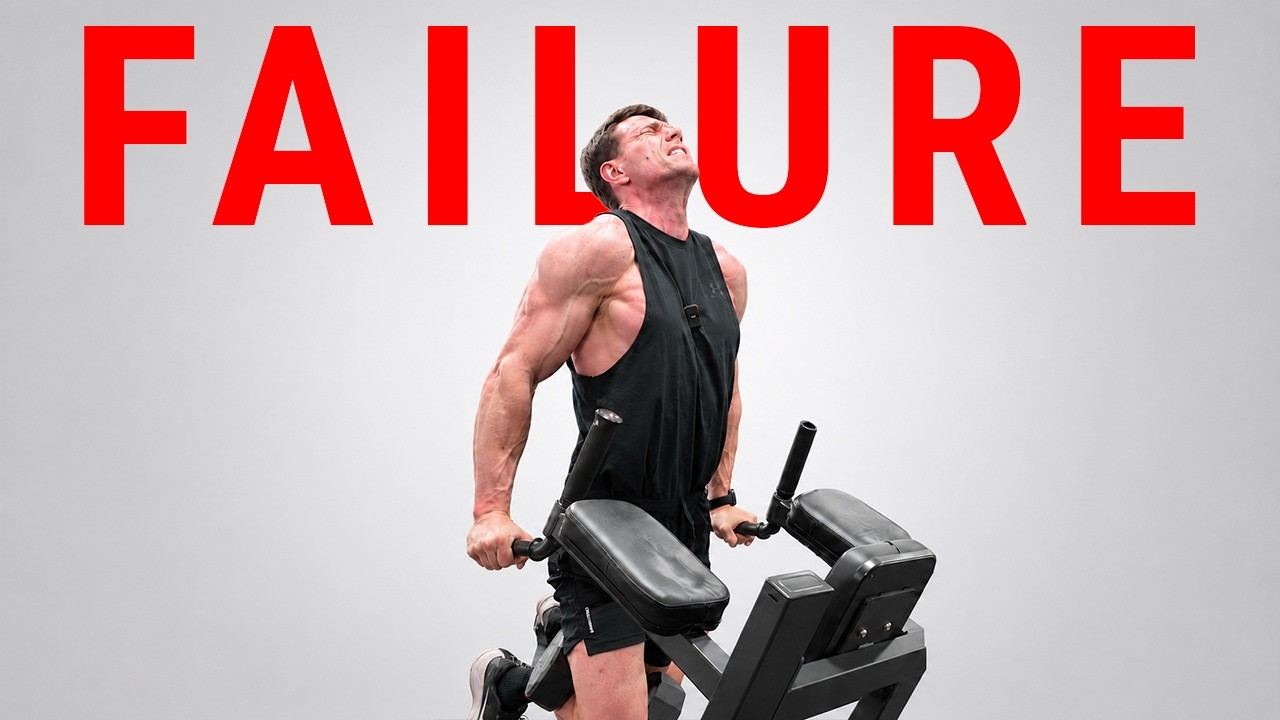
Crucially, this deceleration must be entirely involuntary. It is not a matter of intentionally slowing down the tempo of a repetition to increase time under tension. Rather, it is the undeniable phenomenon of a muscle struggling against heavy resistance, resulting in a crawl despite maximum effort. When a trainee is pushing as hard as possible and the concentric phase of the movement slows to a snail’s pace, that is the most reliable indicator of high training intensity. Without this observable deceleration, the claim of training hard remains dubious.
Two Flavors of Failure, Using Dips
To clearly illustrate the distinction between different thresholds of exhaustion, the coach utilizes the dip—a fundamental upper body calisthenics movement that targets the chest, triceps, and anterior deltoids—as a prime testing ground. Dips provide a clear visual framework for understanding the graduation from technical execution to absolute muscular breakdown.
The first threshold is technical failure, which occurs at the point of the last clean repetition. During a set of dips, an individual pushes through the movement until they complete a final repetition with a full range of motion and a locked-out finish. Attempting another repetition immediately following this point reveals that the full range of motion is no longer achievable; the body simply lacks the capacity to complete the entire path of travel cleanly.
Beyond technical failure lies muscular failure. At this stage, the standard lockout completely disappears, yet the trainee continues to fight through partial repetitions, squeezing out every remaining ounce of force the muscle fibers can muster. Reaching the point where the body literally cannot move upward anymore represents the absolute maximum exhaustion of the target musculature. According to the coach, achieving this level of total depletion on a staple exercise like dips provides an undeniable education on what the chest and triceps are truly capable of enduring.
Does Every Set Need to Hit Failure?
Despite advocating for these intense reality checks, the Fitness FAQs coach is careful to clarify that pushing every single set to absolute failure is neither necessary nor practical for long-term progress. Chronic exposure to maximal failure can quickly lead to systemic burnout, excessive joint stress, and compromised recovery capabilities, making sustainable programming nearly impossible.
Instead, pushing to failure should be viewed as a periodic recalibration tool rather than a daily requirement. It is an exceptionally useful strategy when workouts begin to feel stale, when training enters a monotonous autopilot mode, or when physical results have plateaued. By occasionally venturing into the territory of absolute failure, a trainee is forcefully reminded of their actual physical boundaries. That renewed perspective then transcends the specific exercise, elevating the intensity and focus of every subsequent training session that follows.
Running Your Own Failure Test and Maintaining Intensity
Executing a purposeful failure test requires careful judgment and a strict adherence to safety protocols. Trainees are advised to select a reliable foundational exercise and commit to pushing it until complete muscular breakdown occurs, while remaining vigilant about form integrity. If movement mechanics begin to degrade dramatically or if any sharp, atypical pain arises, the set must be terminated immediately. Pushing through high-intensity discomfort is a requirement for growth, but pushing through injury pathways is entirely counterproductive.
Furthermore, a single all-out effort does not permanently inoculate an athlete against intensity drift. The internal gauge that misjudges comfort for limitation will inevitably creep back over time as workouts normalize. Maintaining an honest training standard requires a continuous, ongoing battle of discipline and self-awareness. By periodically embracing these rigorous testing phases, fitness enthusiasts can preserve an accurate barometer of their capabilities, ensuring their long-term training remains genuinely effective.