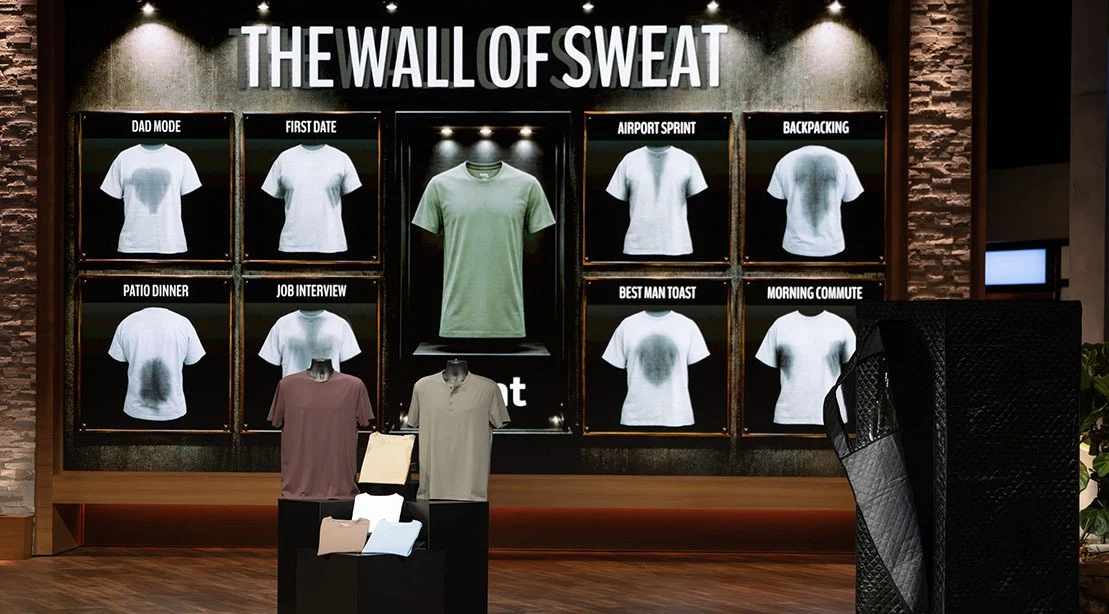
After taking Neat Apparel to the high-stakes Shark Tank stage, entrepreneur Jim Huffman is betting heavily on performance-driven apparel, smarter marketing systems, and the power of consistency. Yet, beneath the ambition of scaling a major consumer brand, his deepest motivation reaches far beyond corporate metrics and financial milestones.
Sweat is practically a badge of honor within fitness culture. It represents the final grueling rep, the last exhausting sprint, the extra mile run in the dark, and the quiet work that happens long before anyone sees the results. For dedicated athletes and everyday gym-goers, perspiration is simply part of the process. As legendary soccer star Mia Hamm once articulated, “The vision of a champion is bent over, drenched in sweat, at the point of exhaustion, when nobody else is looking.”
However, while sweat may be a welcome sign of relentless hard work inside a training facility, it is rarely something people want visibly showing through their clothes during everyday life. For Huffman, that universal everyday frustration presented a golden opportunity to rethink an overlooked wardrobe staple. That realization eventually culminated in Neat Apparel, a performance-driven clothing company built around specialized technology designed to actively prevent sweat from showing through fabric. Now, following a high-profile appearance on ABC’s Shark Tank, Huffman is looking to propel the brand into an entirely new tier of consumer awareness.
The concept was not necessarily born from a lifelong childhood ambition to build a traditional apparel company. Instead, it came down to recognizing a familiar consumer pain point, understanding the unique potential of a differentiated product, and spotting an opportune moment to apply his extensive professional background in business growth to a venture of his own.
Beyond Neat, Huffman is the founder of GrowthHit, a growth marketing agency specializing in helping various companies scale their operations. After spending years developing sophisticated strategies and building customer acquisition systems for other businesses, he began actively searching for an opportunity to deploy those exact same principles toward building a proprietary business. Neat presented an exceptionally interesting proposition: a product with a clear, defensible point of differentiation, a problem that consumers could immediately recognize without a lengthy explanation, and technology capable of demonstrating its value visually. For an experienced marketer, that combination made undeniable sense.
Yet, while the commercial opportunity remains compelling, Huffman’s perspective on sweat extends far beyond the physical merchandise. In a culture that loudly celebrates visible effort and exertion, Neat is intentionally built around a different side of the human experience: helping people feel comfortable, poised, and confident whether they are training hard, working long hours, traveling across the country, or simply navigating the unpredictability of daily life. For Huffman, the ongoing challenge is successfully transforming a product built around a relatable problem into a sustainable brand capable of capturing a much larger market share. Ultimately, the connection between entrepreneurship and fitness becomes remarkably apparent—both demand unwavering consistency, a willingness to embrace difficult challenges, and the resilience to keep showing up even when the results are not immediately visible. If sweat is proof that you have put in the work, it should not dictate how confident you feel walking out of the gym.
The Sweat Problem That Became a Business Opportunity
The origin story of Neat’s core technology traces back to specialized research within the performance apparel sector, where applications were initially being explored for competitive sports and demanding military uniforms. Huffman’s business partner, Tyler, maintained close connections to the performance apparel industry, placing the team directly in contact with emerging fabric technologies. Through that exploration, they encountered valuable intellectual property that would eventually serve as the foundational bedrock for Neat.
The primary hurdle, however, was discovering the right consumer application for the technology. As Huffman explained, the material had initially been considered for soccer applications, but the team quickly realized that professional athletes competing on a pitch were rarely concerned about visible sweat during a match. The real commercial opportunity lay in bringing that advanced technology to everyday consumers who wanted to stay comfortable, dry, and presentable throughout the grueling hours of a normal workday.
Huffman naturally familiarized himself with the product through his collaborative work with the apparel team. Having grown up in Oklahoma and spent considerable time living in Texas, he intimately understood the daily frustration of trying to maintain a professional appearance in punishingly hot weather. Recalling those uncomfortable moments, he noted, “I used to have, like, go in the bathroom and, like, pat my shirt off to look somewhat presentable.” When he finally received an early product sample, his personal reaction was immediate and enthusiastic: “Oh my gosh, this is amazing!”
Rather than rushing headlong into a premature launch, Huffman adopted a much more calculated, data-driven approach. He personally interviewed approximately 20 existing customers to gauge whether true, organic demand existed for the shirts. The responses he received were overwhelmingly encouraging. Customers were not just offering polite compliments; they were actively asking the company not to go out of business, begging for additional colorways, and clamoring for a broader product catalog. For an entrepreneur entirely focused on scalable growth, that kind of grassroots feedback was paramount. It signaled clearly that Neat was not merely a clever invention searching for an audience, but rather a brand addressing an audience that was already actively searching for a solution.
Why Demonstrating the Product Matters More Than Selling It
One of Neat’s greatest strategic advantages lies in the fact that its underlying technology can be demonstrated visually in a matter of seconds. In an increasingly crowded and noisy apparel market, simply telling consumers that a specific T-shirt is different is rarely enough to drive conversion. Huffman understood that the company needed to actively show people why the fabric behaved differently than standard textiles.
The brand’s creative marketing approach relies heavily on live demonstrations that make the product’s core utility instantly recognizable, often utilizing dynamic videos featuring water balloons and rigorous fabric saturation tests. “We wanted to hit on not just the benefit but, like, the use case,” Huffman explained. That mindset directly inspired one of the company’s most memorable marketing installations: a physical wall constructed from sweat-soaked shirts, displayed almost like a treasured sports memorabilia exhibit. Rather than depending on traditional, sterile product photography, the campaign allowed prospective buyers to immediately visualize the exact problem Neat was attempting to solve.
Importantly, Neat is not asking consumers to completely abandon their favorite athletic brands or wardrobe favorites. Instead, it is asking them to consider an additional, highly practical factor when choosing what to wear: how their clothing actually performs when ambient temperatures rise and daily stress accumulates.
The Shark Tank Effect: Scaling Beyond the Shirt
Appearing on the national stage of Shark Tank undoubtedly introduced Neat to a vastly expanded audience, but Huffman remains acutely aware that television exposure alone does not constitute a sustainable, long-term business model. The company’s subsequent hurdle involves successfully converting that transient wave of attention into permanent, compounding growth.
Huffman has witnessed firsthand how tactical marketing decisions can dramatically dictate a company’s ability to scale. Through his work leading GrowthHit, he has advised businesses across various stages of maturity, and those cumulative experiences have profoundly shaped his stewardship of Neat. One of the most critical lessons he has internalized is the vital importance of proper market selection before committing heavy capital to growth initiatives.
“Honestly, it’s market selection,” he noted, reflecting on common entrepreneurial missteps. “I think people real quick like, ‘Oh, this thing’s cool. Let me see if I can sell it.’ And they’re not intentional of, like, is this a market that in five to 10 years is going up and to the right?” He firmly believes that even an exceptional product will struggle to survive if it is forcefully introduced to a market demographic that lacks the willingness or financial capacity to pay for it.
The second major consideration centers on the business’s underlying financial architecture. When Huffman and his core team initially became involved with Neat, the shirts were retailed at approximately $38 apiece. However, that existing pricing structure made it mathematically difficult to profitably support the high customer acquisition and advertising costs required to aggressively scale the enterprise. Consequently, the team pivoted their commercial strategy toward curated product bundles and targeted discounts designed to intentionally increase the average order value, while simultaneously adjusting baseline pricing.
The ultimate objective was never merely to push higher volumes of individual shirts out the door. Rather, it was to successfully establish Neat as an indispensable wardrobe staple that loyal consumers would purchase and re-purchase over time. “We’re trying to villainize the cotton T-shirt,” Huffman joked. He quickly clarified that the company does not harbor an irrational animosity toward cotton; instead, they are focused on educating the modern consumer about the stark functional differences between a basic everyday cotton shirt and a high-performance alternative engineered to maintain comfort throughout the day.
Why Authentic Content Is Winning the Marketing Game
Huffman’s marketing philosophy also reflects a broader, industry-wide shift in how modern fitness and lifestyle brands forge connections with digital consumers. While traditional advertising certainly retains its place in the media mix, highly polished, expensive production values do not automatically translate into superior performance metrics.
Neat discovered this reality the hard time after investing roughly $30,000 into a sleek, high-production commercial video that ultimately failed to perform up to expectations. Meanwhile, much simpler, unpolished creator-produced videos featuring the product in natural settings generated significantly stronger engagement and conversion rates.
“Our best performing ads are not the fancy overproduced ads,” Huffman said. “We spent $30,000 on a high production video, did not perform as well as I liked, and then we’ll, like, throw a T-shirt at some 20-something, and they make an ad that really scales for us.”
That illuminating experience decisively steered the company toward prioritizing user-generated content, collaborative partnerships with digital influencers, and everyday creators who could authentically showcase the product in unscripted environments. The strategy is a natural fit for Neat because the garment is inherently visual; consumers genuinely want to see physical proof of how it functions, how it fits on various body types, and how it holds up during real-world stress tests.
Furthermore, Huffman recognizes that different social media ecosystems demand distinct distribution strategies. While fast-moving TikTok audiences may respond immediately to quick, punchy demonstrations and impulse-driven shopping behaviors, Meta platforms can support a more comprehensive consumer journey. The overarching takeaway is clear: successful marketing in the digital age is rarely about funding the most expensive production; it is about deeply understanding your audience and communicating core utility in a language that resonates.
The Bigger Mission Behind the Renegade Fund
While Neat’s rapid growth and subsequent Shark Tank appearance have brought Huffman plenty of professional validation, his overarching definition of personal success has shifted profoundly over the past year due to life-altering circumstances. During his discussions, Huffman shared the deeply personal ordeal that led him and his family to establish the Renegade Fund, an initiative dedicated to actively supporting pediatric cancer research.
In May of last year, his youngest daughter, Wren, began experiencing physical discomfort that initially appeared to be normal growing pains. Knowing instinctively that she was a resilient child who rarely complained about minor aches, the family decided to take her in for a thorough medical evaluation. The following day, they received devastating news: Wren was diagnosed with a rare, aggressive form of bone cancer. Comprehensive medical treatments began mere days later.
The catastrophic diagnosis arrived during an exceptionally demanding professional window. Huffman had recently committed deeply to Neat, the fledgling business had absorbed significant financial obligations, and the brand was desperately preparing for a major production order. Suddenly, the professional priorities that had previously dominated his daily attention were forced into a starkly different perspective.
“You’re just like, how am I going to do all of this, right?” he recalled. “And so that’s where you really figure out real quick what you need to focus on and not what really matters.”
Wren subsequently underwent 23 grueling rounds of chemotherapy alongside a radical, life-changing amputation surgery known as rotationplasty. Today, Huffman proudly describes her as stronger and more resilient than ever.
Her courageous battle inspired the family to transform an unimaginably difficult chapter into an enduring opportunity to support other children facing similarly terrifying diagnoses. Through GrowthHit, the leadership team initiated a firm commitment to donating one percent of all company profits directly to pediatric cancer research. They also established the Renegade Fund to expand those philanthropic efforts into a permanent core mission.
In September, the family organized a community fundraising event aptly titled “Pie Hard,” successfully raising $60,000. Under the rules of the event, for every $1,000 raised in donations, Wren earned the joyful opportunity to smash a cream pie directly into a willing participant’s face. The lighthearted event injected a vital dose of humor into a serious mission rooted in compassion.
Huffman also shared how the family’s radical transparency regarding Wren’s medical journey unexpectedly connected them with countless other families navigating similar health crises across the country. One particularly poignant connection involved a young girl living in Montana who had been following Wren’s story online. Facing her own terrifying decision regarding pediatric surgery, the young girl learned about the rotationplasty procedure through Wren’s lived experience. The families ultimately connected, and the girl was able to successfully pursue the same life-altering medical path.
For Huffman, moments like those serve as an enduring reminder of how much positive impact a family’s willingness to share their vulnerable story can have on total strangers. “If there’s, like, an exit with this, it’s like pouring that money into pediatric cancer research,” he noted regarding his long-term business ambitions. It is a profound mission that infuses the daily grind of corporate growth with a much deeper sense of purpose.
Fitness, Family, and the Discipline to Keep Showing Up
For an ambitious entrepreneur balancing a demanding marketing agency, a scaling apparel brand, and an active family life, maintaining rigorous personal consistency is non-negotiable. However, Huffman’s personal approach to fitness is less about chasing aesthetic perfection or an intimidating physique and more about preserving the essential mental clarity required to lead effectively.
He currently maintains a reliable routine of completing three to four 30-minute high-intensity interval training (HIIT) sessions each week, typically kicking off his mornings at 6:15 a.m. The timing of the workout is entirely intentional. “If I do it any time afternoon, I’m too tired and lazy and I won’t do it,” he admitted candidly. Getting the physical exertion out of the way early helps establish psychological momentum before the relentless demands of the professional day take over.
More importantly, he notices an immediate, tangible difference in his daily mood and leadership capabilities when he successfully executes the routine. “I am in such a better mood and a better leader when I get that going,” he emphasized. “If I skip my workout, I’m probably a grump.”
It is a familiar operational challenge for anyone attempting to balance professional responsibilities, physical fitness, and personal relationships. Huffman’s practical solution is straightforward: he deliberately schedules his training sessions directly into his calendar and accepts the reality that some weeks will inevitably fall short of perfection. He also credits his wife, who maintains a demanding career at Amazon alongside her own dedicated fitness regimen, with helping cultivate healthy, structured habits at home.
“Partner selection is so crucial to this,” he explained. For Huffman, having a supportive life partner who equally prioritizes physical and mental well-being makes consistency significantly more achievable. He recognizes that safeguarding a healthy marital relationship is fundamentally essential to keeping his long-term focus locked on what truly matters. A high-pressure professional life can quickly turn corrosive when personal connections are neglected. Having a partner who understands the volatile highs and lows of entrepreneurship, embraces calculated risks, and provides a grounded perspective has proven invaluable.
Ultimately, his overarching philosophy toward personal fitness mirrors his disciplined approach to business: small, consistent actions compound over time into monumental outcomes. “We all know it’s like you need to be the 10-year overnight success where these small things compound,” he reflected. “That’s what works with fitness. That’s what works with diet. That’s what works with business.”
Building a Brand That Goes Beyond the Next Big Milestone
Huffman’s commercial ambitions for Neat Apparel remain substantial. He envisions building the enterprise into a widely recognized household brand, beginning intentionally with men’s daily wear before eventually branching out into adjacent markets and broader product categories.
That expansion roadmap could eventually encompass dedicated women’s apparel lines, strategic wholesale partnerships, and broader international distribution. The company is already actively exploring additional garment styles, including performance polos, henleys, long-sleeve variations, and potentially premium underwear.
For the present moment, however, Huffman is deliberately resisting the dangerous temptation to expand too rapidly. “Shiny object syndrome is something I suffer from, and that can hurt a lot of businesses,” he cautioned. His immediate, unyielding priority is meeting current consumer demand for the existing men’s collection, continuing to refine product quality, and solidifying a robust operational foundation before venturing into unproven categories.
When asked what essential advice he would offer to aspiring entrepreneurs entering the notoriously competitive apparel industry, he distilled his philosophy down to two core tenets: deeply understand your target customer and establish a genuine, defensible point of differentiation. “Don’t be afraid to go smaller rather than bigger. Niche down because I think that’s where the future is going,” he advised.
Furthermore, he believes modern brands require something far more substantial than a catchy brand name alone. For Neat, owning the underlying patent and proprietary fabric technology provides a formidable barrier to entry that clearly separates the brand from generic competitors.
Ultimately, Jim Huffman is not measuring his ultimate life success purely by revenue milestones, television exposure on major networks, or the corporate prestige of building a nine-figure enterprise. When reflecting on his greatest personal accomplishment, his answer steers completely clear of the boardroom.
“It’s just like having, like, a family that is, like, along for the ride and, like, loves being together with all of this,” he reflected. Having witnessed firsthand how unbridled professional success can sometimes inadvertently come at the expense of family bonds, he has no interest in making that trade-off. “It’s not a sexy answer, but it’s just like the biggest success is the little family we built.”
For an entrepreneur who has spent the majority of his professional career helping outside companies grow, that may well be the most valuable lesson of all: true success is never solely about how far you can push a corporation; it is about what you are quietly building along the way, who you are sharing the journey with, and what ultimate purpose that hard-earned success serves in the end.