

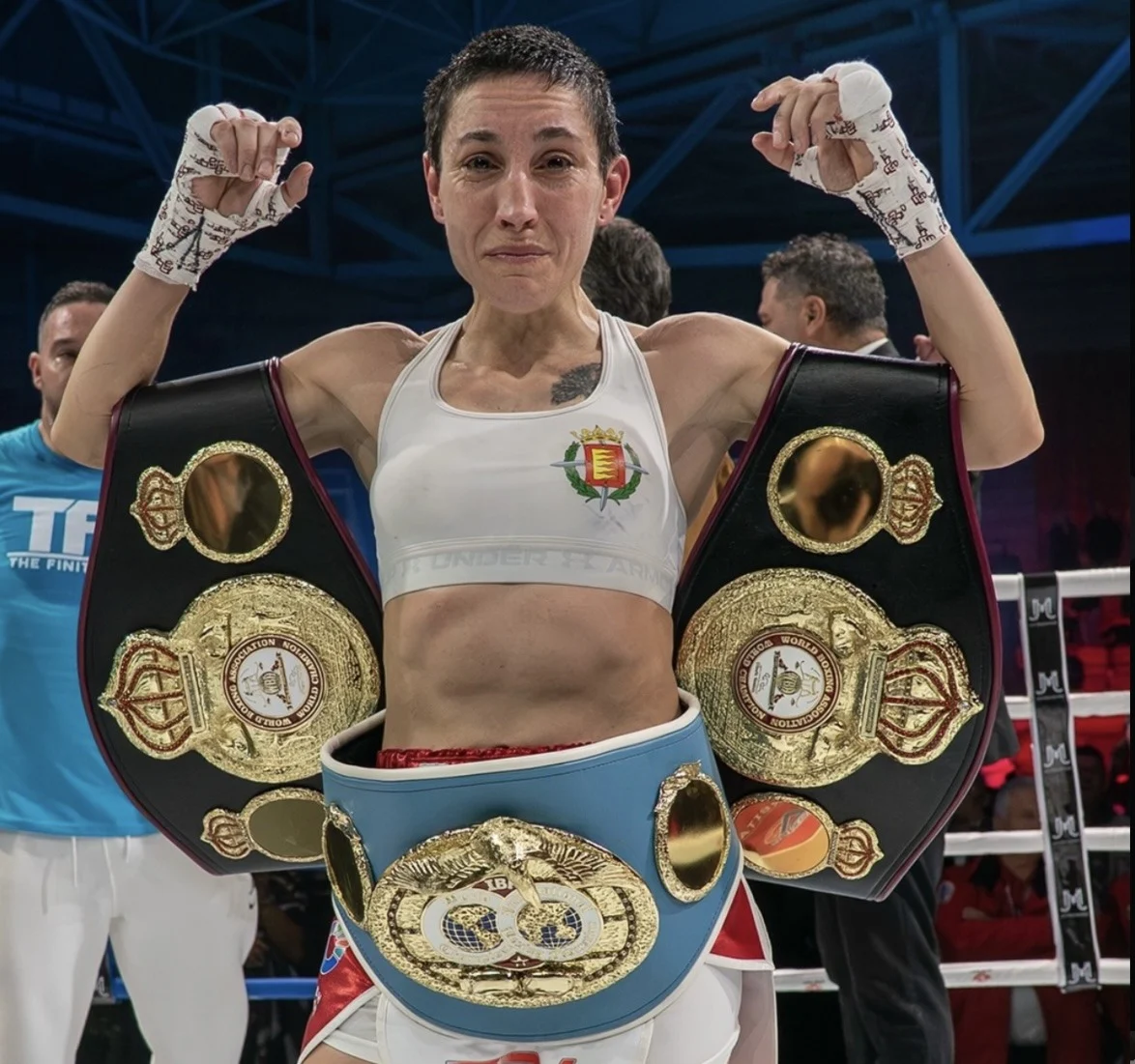
The El Escénico indoor bullring in Illescas, Toledo, served as the backdrop for a historic chapter in Spanish combat sports on Saturday, November 21, as defending World Boxing Association female light minimumweight world champion Isabel Rivero delivered a masterful performance to unify the 102-pound division. Performing in front of an enthusiastic domestic audience, the Valladolid native outpointed Japanese contender Sumire Yamanaka over ten hard-fought rounds, earning a unanimous decision victory that cemented her position at the top of the weight class and carved her name into the history books of Spanish athletics.
The championship fight represented a high-stakes meeting between two elite competitors operating at the pinnacle of the 102-pound weight class. Rivero entered the ring tasked not only with retaining her WBA championship belt but also with securing the unified crown against a determined international challenger known for her fast pace and offensive capabilities. By the end of the ten-round contest, Rivero had demonstrated the technical discipline, tactical adaptability, and composure required to overcome a dangerous opponent, ensuring that all three official scorecards tilted decisively in her favor.
From the opening bell, the contrast in approaches created an intense kinetic dynamic inside the ring at El Escénico. Yamanaka sought to establish control early by leveraging her swift footwork and initiating high-velocity offensive sequences. The Japanese fighter aimed to pressure the champion, using rapid combinations and early aggression to dictate the geography of the canvas. Recognizing the threat posed by Yamanaka’s initial surge, Rivero remained composed, avoiding the temptation to engage in reckless firefights during the opening exchanges where her opponent’s speed was most pronounced.
Instead, Rivero relied on sound defensive mechanics to blunt the initial attack. The Valladolid fighter systematically absorbed and deflected Yamanaka’s incoming charges through sharp upper-body movement, effective guard positioning, and precise spatial awareness. By managing the range between herself and her opponent, Rivero effectively neutralized the Japanese challenger’s primary weapon—her quick-burst entry attacks—forcing Yamanaka to fight at a tempo and distance more favorable to the defending champion.
As the bout progressed into the middle rounds, Rivero’s strategic game plan became increasingly dominant. Controlling the center of the ring, the Spanish champion established a calculated rhythm, using crisp jab work and disciplined movement to set the parameters of every engagement. Whenever Yamanaka attempted to breach the guard with aggressive rushes, Rivero answered with cleaner, more accurate counters. During the critical exchanges that defined the second half of the fight, it was Rivero who routinely landed the clearer, more impactful punches, cleanly catching her opponent while minimizing damage in return.
The energetic backing of the crowd inside the Illescas venue proved to be a constant source of momentum for Rivero. Though born in Valladolid, the champion found immediate kinship with the fans gathered at the converted indoor bullring in Toledo. The vocal support echoing throughout El Escénico provided an extra layer of energy as Rivero navigated the arduous physical demands of a ten-round world championship defense. Fueled by the home-canvas atmosphere, she maintained strict focus, refusing to let her concentration waver even as Yamanaka pushed to turn the tide in the late stages of the contest.
By the conclusion of the tenth and final round, the outcome rested in the hands of the three ringside judges. The official tallies reflected a clear but competitive contest, with all three officials scoring the bout in favor of the Spanish champion. Two judges submitted identical cards of 96-94, while the third judge scored the contest 97-93. The unanimous decision confirmed Rivero’s mastery over the ten-round distance, validating her tactical approach and acknowledging her ability to land the higher quality of scoring blows throughout the fight.
The scorecards of 96-94 and 97-93 highlight both the competitive nature of the bout and Rivero’s fundamental consistency. Winning six to seven rounds on the respective judges’ cards, Rivero demonstrated the necessary ring generalship to claim the majority of the three-minute intervals while preventing Yamanaka from putting together sustained winning stretches. Yamanaka’s performance earned respect for her unrelenting effort and early tactical pressure, but Rivero’s superior defense, cleaner counters, and pace control ensured that the championship remained on Spanish soil.
With this landmark victory, Isabel Rivero’s professional record expands to 14 victories, 3 losses, and 1 draw. Beyond enhancing her statistical record, the outcome carries immense historical significance for boxing in Spain. By securing both championships in the 102-pound division, Rivero became the first female boxer in the history of Spanish boxing to unify two world titles. Her achievement marks a historic threshold for women’s combat sports in the nation, setting a new benchmark of excellence for future generations of Spanish pugilists.
The light minimumweight division, governed at the 102-pound limit, represents one of the most fast-paced and technically demanding weight classes in professional boxing. Success at this level requires exceptional aerobic conditioning, laser-focused precision, and strict tactical discipline, as the minimal weight variance leaves virtually no room for error. Rivero’s ability to navigate these demands against a high-caliber foreign opponent like Yamanaka underlines her status as a premier practitioner of the sport.
The setting of the bout added to the distinct character of the occasion. El Escénico indoor bullring in Illescas has established itself as a versatile venue capable of hosting major sporting spectacles, providing an intimate yet grand arena for high-stakes athletic competition. Converted to accommodate a championship boxing event, the traditional architectural atmosphere combined with modern ring production created a memorable backdrop for a night defined by historical national achievement.
Rivero’s path to unifying the division reflects a career defined by perseverance and steady progression. Building a resume that now stands at 14-3-1, the native of Valladolid has navigated the inevitable trials of professional boxing, absorbing lessons from past setbacks to refine her skill set for the highest levels of international competition. Her performance on Saturday night demonstrated the maturity of a seasoned champion who understands how to manage high-pressure situations, adjust in real-time to dangerous opposition, and execute a tactical plan under the brightest lights.
For Sumire Yamanaka, the defeat represents a hard-fought effort on foreign territory. Traveling across the globe to challenge a reigning champion on her home soil presents immense logistical and psychological hurdles. Yamanaka’s aggressive style, rapid hand speed, and willingness to engage contributed significantly to making the ten-round contest an engaging showcase of high-level female professional boxing, even as she ultimately fell short on the scorecards against the relentless poise of the champion.
As the final decisions were announced inside El Escénico, the celebration in Rivero’s corner marked not just a successful title defense, but the culmination of an ambitious pursuit to bring unified championship status to Spanish boxing. By successfully combining her WBA female light minimumweight crown with the division’s additional championship title, Rivero has consolidated her power at 102 pounds and elevated her standing on the international boxing stage.
The successful event in Illescas reinforces the growing momentum of professional women’s boxing in Spain, proving that domestic venues can host major world championship unification bouts that capture national attention. Isabel Rivero’s historic victory over Sumire Yamanaka will be remembered as a defining highlight of her professional journey, securing her legacy as a pioneering figure who redefined the boundaries of achievement for Spanish fighters on the world stage.