

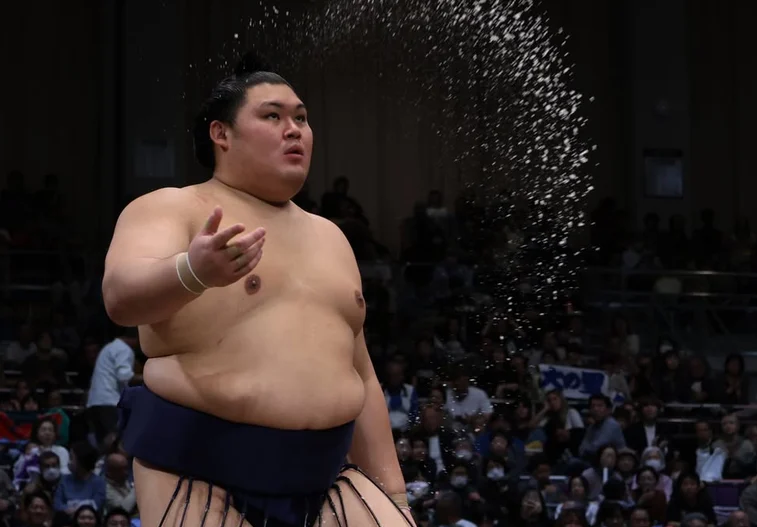
Grand Sumo’s 2026 Kyushu Grand Sumo Tournament has officially crossed its midway mark, setting the stage for what promises to be a dramatic sprint toward Sunday’s final day of competition. Following the conclusion of Day 9 bouts at the Fukuoka Kokusai Center, the top division presents an intensely competitive leaderboard. With only six days of action remaining in the final tournament of the calendar year, a tightly packed pack of championship hopefuls is locked in contention. The wrestler who finishes with the finest win-loss record on Sunday will claim the tournament title and become the final competitor to raise the prestigious Emperor’s Cup in 2026.
Beyond the battle for the championship, the tournament has produced major storylines across the ranks, including the resurgence of an elite champion, the struggles of an injured grand champion, and the sudden derailment of a historic promotion bid.
The Top-Division Landscape After Nine Days
The top division enters the home stretch with a four-way tie at the summit of the leaderboard, complemented by several closely positioned pursuers.
At the highest rank, East Yokozuna Onosato leads the way with an 8-1 record, while West Yokozuna Hoshoryu sits below the cut with a 4-5 tally. The ozeki rank reflects a sharp contrast in fortune: Kirishima stands among the tournament co-leaders at 8-1, while Aonishiki and Kotozakura both hold 5-4 tallies.
In the remainder of the titled san’yaku ranks, the sekiwake tier features West Sekiwake Atamifuji sharing the tournament lead at 8-1, while East Sekiwake Fujinokawa battles to keep his standing at 4-5. At komusubi, newly promoted Churanoumi has endured a bruising fortnight, slumping to 1-8, while Yoshinofuji remains on the winning side of the ledger at 5-4.
The upper ranks of the maegashira division feature intense parity. Both top maegashira wrestlers, Asanoyama and Fujiryoga, sit at 5-4. At Maegashira 2, Ura trails at 3-6 while Fujiseiun is 4-5. Maegashira 3 sees veteran Takayasu struggling at 2-7 opposite Hakunofuji’s 4-5. The fourth tier has been equally punishing, with former champions Takerufuji and Daieisho both languishing at 2-7. At Maegashira 5, Hiradoumi mirrors that 2-7 mark, while Gonoyama holds on at 4-5.
In the middle-to-lower maegashira ranks, several competitors have mounted unexpected runs. Maegashira 7 East Wakamotoharu matches the tournament leaders with an outstanding 8-1 mark, closely tracked by Maegashira 7 West Kinbozan at 7-2. Other lower-ranked contenders at 7-2 include Maegashira 11 West Asahakuryu and Maegashira 14 West Dewanoryu. Meanwhile, Maegashira 6 East Kotoshoho is 5-4, while his counterpart Kotoeiho sits at 1-2-6 following an injury-interrupted campaign. Maegashira 8 wrestlers Roga and Nishikifuji are both firmly in contention for strong finishes at 6-3.
At the bottom of the division, Maegashira 9 East Oshoma is 5-4 against Asakoryu’s 1-8, while Maegashira 10 East Shishi remains winless at 0-9 against Oho’s 5-4. Maegashira 11 East Takanosho and Maegashira 12 East Ichiyamamoto both hold 6-3 marks, with former sekiwake Abi trailing at 4-5. Maegashira 13 sees Toshinofuji at 4-5 and Asasuiryu at 3-6. Maegashira 14 East Tokihayate sits at 2-7. At Maegashira 15, the veteran Tamawashi holds a 6-3 record alongside Kitanowaka’s 5-4. Rounding out the division, Maegashira 16 wrestlers Arashifuji (6-3) and Kyokukaiyu (5-4) are posting positive results, while lone Maegashira 17 Daiseizan struggles at 2-7.
Onosato Among the Leaders
Yokozuna Onosato, who captured the autumn championship in Tokyo this past September, appears to be operating at peak form in Fukuoka. Throughout the first nine days of the basho, the towering grand champion has navigated his schedule with authority, deploying his rare combination of immense physical size, leverage, and athletic mobility to overwhelm his opposition.
His current dominance marks a dramatic contrast to his experience in Kyushu one year ago. In November 2025, Onosato suffered a severe shoulder injury on this very dohyo. The physical setback derailed much of his early 2026 campaign and forced the very first tournament absence of his professional career. Prior to that injury, Onosato’s meteoric rise through the ranks had sparked discussions that he might rewrite grand sumo records for rapid championship success. Following his commanding triumph in September and his blistering 8-1 start in Kyushu, those lofty expectations have returned to the forefront of the sport.
Onosato does not have a clear path to the title, however. Ozeki Kirishima and Sekiwake Atamifuji are matching him win for win, each carrying identical 8-1 records into the final third of the basho.
Atamifuji, who endured a disappointing September tournament, has rebounded by returning to his signature, immovable style. As the single heaviest competitor in the makuuchi division, Atamifuji has proven virtually impossible to dislodge or shift backwards when he secures his preferred center of gravity, neutralizing opponents’ attacks at the tachiai.
Kirishima is also enjoying a critical resurgence. A poor showing in September abruptly halted his momentum toward promotion as the sport’s potential 76th yokozuna. Nevertheless, his performance in Fukuoka has reminded onlookers of his status as arguably the most complete technician in grand sumo. When firing on all cylinders, Kirishima excels at inside belt control, ring-edge balance, and tactical adjustments, outthinking and outgrappling nearly every rival he has encountered over the past nine days.
Beyond this trio, Maegashira 7 Wakamotoharu has injected himself into the title conversation with his own 8-1 record. While the former sekiwake has spent recent years hovering in the mid-maegashira ranks, his veteran composure on the mawashi has revitalized his campaign. Just behind the leaders at 7-2 sits Kinbozan. The only Kazakh wrestler in the makuuchi division, Kinbozan previously demonstrated his title-challenging ceiling when he forced a championship playoff against Hoshoryu in 2025, and he is once again positioning himself as a formidable outsider down the stretch.
Hoshoryu Hobbling Through the Tournament
While the championship race gathers intensity, West Yokozuna Hoshoryu finds himself completely eliminated from contention. With a 4-5 record through nine days, the grand champion is enduring a grueling and painful fortnight.
Hoshoryu’s current predicament stems from major knee surgery that sidelined him for the entirety of the September tournament. Rather than taking extended rehabilitation time, the grand champion opted to return to competition in Fukuoka. It has become abundantly clear on the dohyo that he is nowhere near full fitness. His participation reflects the immense cultural and institutional pressure placed upon active yokozuna to perform and represent the sport, regardless of the severity of their physical limitations.
Although Hoshoryu has managed to scrap his way to four victories, his movements are noticeably restricted. He lacks the essential leg drive, balance, and stability needed to plant his knee and unleash his hallmark judo-based throws. Opponents have capitalized on his compromised mobility, leaving the grand champion in danger of finishing with a losing record if he cannot secure four wins over the final six days.
Aonishiki’s Yokozuna Run Is on Life Support
Entering the Kyushu basho, Ozeki Aonishiki was widely viewed as the primary favorite to seize both the Emperor’s Cup and grand sumo history. Having finished as the runner-up in September, a yusho in Fukuoka would have earned the Ukrainian star promotion to become grand sumo’s 76th yokozuna, as well as the very first European-born wrestler to achieve the pinnacle rank.
Instead, Aonishiki’s promotion bid is teetering on the brink of total collapse. Sitting at 5-4, his hopes of securing the championship have diminished drastically. The downturn has not necessarily been the product of careless errors; rather, Aonishiki has been systematically targeted by well-prepared opponents who have executed precise strategies to counter his aggressive driving style.
All four of Aonishiki’s defeats have come against formidable opponents: former ozeki Asanoyama, rising star Fujiryoga, tactical standout Fujiseiun, and dynamic sekiwake Fujinokawa. Both Fujiryoga and Fujinokawa, in particular, delivered performances that underscored their growing reputations as the sport’s next generation of elite talent.
While Aonishiki remains mathematically alive for the Emperor’s Cup and his promotion dream, the path forward is extraordinarily steep. The Ukrainian must win all six of his remaining bouts while relying on multiple leaders at the top of the banzuke to stumble repeatedly over the final week.
The Kyushu Curse
The 2026 tournament has reinforced a long-standing superstitious narrative within grand sumo: the so-called "Kyushu Curse," which posits that wrestlers hailing from southern Japan historically underperform at the year’s final basho in Fukuoka.
Through nine days, Komusubi Yoshinofuji of Kumamoto stands as the lone southern native in the top division possessing a winning record, sitting at 5-4. For the remainder of the region’s favorites, the tournament has been a succession of setbacks across the upper divisions.
The most notable casualty has been Churanoumi. Having made history on the November banzuke as the first wrestler from Okinawa ever to achieve promotion to the rank of komusubi, the veteran has found the elite san’yaku competition unforgiving. At 1-8, Churanoumi has already sealed a make-koshi (losing record), guaranteeing that his historic tenure at the rank will be short-lived.
Elsewhere, hometown favorite Hiradoumi is languishing at 2-7 in the upper maegashira ranks. Further down the hierarchy, the situation is even more precarious for established veterans Shodai and Sadanoumi. Both competitors have logged dismal records that put them at immediate risk of falling out of the salaried ranks altogether into the third-tier makushita division, a demotion that would strip them of their status, privileges, and official salaries.
Other Kyushu Basho News and Notes
East Sekiwake Fujinokawa has mounted an inspiring recovery after a dismal start to the tournament. Known for his explosive speed and relentless aggression despite an undersized frame, Fujinokawa scored consecutive upset victories over ozeki pair Aonishiki and Kotozakura. At 4-5, he has given himself a viable path toward securing a winning record and defending his sekiwake position.
In stark contrast, Ukrainian maegashira Shishi has experienced a devastating collapse. After emerging as a surprise championship contender during the Nagoya basho earlier in the year, Shishi sits winless at 0-9, representing the worst performance in the makuuchi division this November.
In the second-tier juryo division, the championship chase features compelling comeback stories. Former sekiwake Wakatakakage and rising challenger Tamashoho both remain undefeated at 9-0. Wakatakakage’s presence in juryo is the consequence of a life-threatening medical emergency; he was forced to sit out the September basho after developing severe compartment syndrome, an affliction that nearly resulted in the loss of his leg. Sharing the juryo lead with him is Tamashoho, who is putting together a career-best run. Lurking just one win behind the undefeated pair is blue-chip prospect Asahifuji, who remains firmly in pursuit of the second-division title.
Finally, veteran ironman Tamawashi continues to defy the aging process. Tamashoho’s brother-in-law recently celebrated his 41st birthday while competing in Fukuoka. As the oldest active wrestler in makuuchi, Tamawashi has maintained a 6-3 record through nine days, putting him in prime position to record yet another kachi-koshi (winning record) and extend his extraordinary career in sumo’s top flight.