

The Ultimate Fighting Championship’s latest visit to the historic Madison Square Garden in New York City was supposed to be a showcase of elite welterweight talent, but UFC 334 will instead be remembered for a whirlwind of mid-fight fouls, strategic controversy, and a major administrative blunder by the broadcast desk. Among the fallout from the event is a lingering dispute regarding the legality of the strikes that shaped the bout, specifically centering on welterweight contender Uros "The Doctor" Medic and his high-stakes encounter with veteran fan-favorite Kevin Holland.
Medic, who has found a renewed sense of momentum inside the Octagon, recently took to social media to publicly question the legitimacy of the first low blow called against him during the second round of their high-profile clash. While Medic has readily conceded that a subsequent infraction genuinely caught Holland below the belt—ultimately leading to a critical point deduction by the referee—he firmly maintains that Holland dramatically overstated the impact of the initial groin strike, accusing his opponent of exaggerating the referee’s pause to recover.
The bout itself, held on a brisk Saturday evening at the world-famous arena in midtown Manhattan, was turbulent from the opening bell. Both men entered the Octagon with contrasting career trajectories, carrying high expectations from the matchmakers and the partisan New York crowd. Medic, riding a wave of professional confidence, was looking to extend a stellar run of form that has seen him firmly establish his presence in the fiercely competitive welterweight division. On the other side of the canvas, Holland, known for his unorthodox striking and willingness to take on any challenger at a moment’s notice, was eager to reverse a troubling skid that had seen him drop ground in the divisional hierarchy over his previous outings.
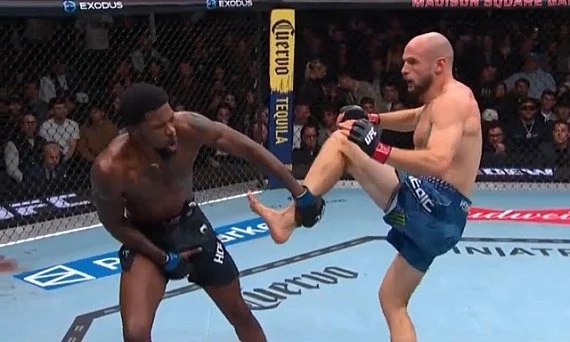
As the fight progressed into the second frame, the competitive momentum was disrupted by a series of pauses called by the officiating referee. The action was halted twice within the span of a single round due to strikes landing in the prohibited lower region of Holland’s body. While the second
infraction was clear-cut and universally acknowledged by both fighters and corner teams—prompting the referee to penalize Medic by deducting a point from his scorecard—it was the first stoppage that has sparked intense debate among fans, analysts, and now, the fighters themselves.
What Uros Medic said about Kevin Holland’s first low blow
The controversy deepened in the days following the event when slow-motion broadcast replays of the first disputed foul began circulating widely across digital platforms. Upon reviewing the footage, many observers noted that the strike appeared to land primarily on Holland’s inner thigh rather than directly into the groin area. Medic, watching the same angles, took to the social media platform X, formerly known as Twitter, to voice his grievances and challenge the narrative surrounding the fight’s turning points.
"Low? Second one for sure, but this? Kevin was faking it," Medic wrote in a direct post addressing the incident, accompanied by a laughing emoji to underscore his skepticism regarding his opponent’s reaction in the cage.
For "The Doctor," the distinction between the two fouls is crucial. Medic readily accepts accountability for the second sequence, acknowledging that fatigue and the chaotic nature of high-level mixed martial arts exchanges can lead to misdirected techniques. However, he draws a sharp line at what he perceives as theatrical gamesmanship during the first stoppage, suggesting that the referee was unduly influenced by Holland’s immediate and dramatic physical response to a legal or marginal strike.
The disagreement over the low blow was only one layer of a remarkably messy conclusion to the UFC 334 welterweight encounter. The mandatory point deduction administered by the referee following the second clear infraction played a decisive role in the final outcome, directly altering the mathematical reality of the judges’ scorecards. This penalty created profound confusion once the final horn sounded and the fighters awaited the official decision inside the center of the cage.
When veteran Octagon announcer Bruce Buffer took the microphone to read the judges’ verdicts, the procedural chaos reached its peak. Buffer initially announced a majority draw to the bewildered crowd and television audience, having mistakenly misread the mathematical totals compiled by the ringside judges. The confusion stemmed from scorecards that had initially been tallied or interpreted incorrectly as 30-27, 29-28, and 28-28.
Recognizing the error, athletic commission officials and promotion executives quickly moved to correct the record, clarifying that the official scorecards actually read 29-27 in favor of Medic on one card, alongside two matching 28-28 scorecards. Because of the point deduction assessed for the undisputed second low blow, the majority draw announcement was rendered erroneous, and the official result was corrected to reflect a majority decision in favor of Medic, or alternatively categorized according to the official commission adjustments resulting from the penalty.
The administrative mix-up added an extra layer of frustration to an already tense night of combat sports, leaving both competitors in a state of limbo while the statistics were frantically sorted out behind the scenes. For Holland, the controversial nature of the stoppage and the subsequent score adjustments offered little solace in a bout where he was seeking to alter his recent fortunes. Having secured only a single victory in his last four Octagon appearances, the veteran striker needed a definitive win to right the ship, making the contentious point deduction and the chaotic score readings a bitter pill to swallow.
Conversely, the outcome—however muddled in its delivery—extends a highly positive career trajectory for Uros Medic. With this latest result, Medic finds himself enjoying a strong career resurgence, remaining undefeated across his last five professional bouts. This streak has demonstrated his adaptability, durability, and evolution as a complete mixed martial artist capable of navigating the treacherous waters of the UFC welterweight landscape.
As the dust settles on UFC 334 at Madison Square Garden, the debate sparked by Medic’s public comments is likely to echo through the mixed martial arts community for weeks to come. The intersection of fighter safety, referee discretion, instant replay analysis, and judges’ scoring protocols continues to be a central talking point for the sport. Whether athletic commissions and the promotion will implement stricter reviews for disputed fouls remains to be seen, but for now, Medic stands firm in his defense, insisting that the New York crowd and the television audience witnessed an exaggerated reaction to a strike that was far cleaner than it appeared in real-time.