The historic rivalry between Brazilian jiu-jitsu and the grappling disciplines of Russian wrestling and sambo has long served as one of the most compelling narratives in modern combat sports. That storied cross-cultural antagonism took center stage once again in the combat sports capital of Rio de Janeiro, where the 23rd edition of ACBJJ brought together some of the finest grapplers from South America and Eastern Europe to square off under a diverse and demanding array of rulesets.
The event offered an ambitious and deeply competitive fight card, anchored by a series of head-to-head clashes designed to test the technical boundaries and physical limits of both styles. Of the event’s twenty matches, eleven featured direct confrontations between Brazilian and Russian competitors. Buoyed by the passionate and vocal support of a partisan hometown crowd inside the arena, the Brazilian contingent staged a dramatic late rally to edge out their international rivals, ultimately claiming a hard-fought 6-5 victory in the overall head-to-head competition.
In the marquee main event of the evening, the spotlight fell upon a high-stakes rematch a decade and a half in the making. Recreating the historic tactical battle of the 2011 ADCC final, grappling legend Andre Galvao stepped onto the mat to face off against Rousimar “Toquinho” Palhares. This time, however, the familiar adversaries met under the unique and unforgiving parameters of Battle Jiu-Jitsu rules, a framework that introduces distinct tactical challenges by permitting targeted strikes to the body and limbs while maintaining a heavy grappling focus. When the dust settled, Galvao once again emerged victorious, putting on a technical masterclass that showcased the breadth of his skill set against a notoriously dangerous opponent.
Galvao Dominates Palhares in Battle Jiu-Jitsu Rematch as Brazil Edges Russia 6-5
Rousimar Palhares entered the main event contest carrying the psychological advantage of greater experience in mixed martial arts competition, a factor that many observers felt would serve him well under a hybrid ruleset. True to expectations, "Toquinho" pressed forward aggressively from the opening bell. Looking to capitalize on his heavy-handed reputation, Palhares sought to establish a rhythm by throwing hard punches and kicks while Galvao carefully maneuvered and circled along the outer perimeter of the ring, absorbing information and measuring his opponent’s timing.
The dynamic of the fight shifted decisively midway through one of Palhares’ forward surges. Seizing a momentary opening, Galvao timed a crisp double-leg takedown that instantly changed the complexion of the bout. Once the action hit the canvas, the leader of Atos Jiu-Jitsu assumed complete control of the positional landscape. Displaying the fluid transitions that have defined his legendary career, Galvao systematically swept his opponent, passed the guard with precision, advanced to the dominant mount position, and ultimately transitioned to Palhares’ back.
Faced with mounting pressure, Palhares relied on his trademark leg-lock proficiency, attempting to latch onto a footlock from underneath. However, Galvao remained composed, expertly defended the submission attempt, and maintained his offensive momentum. Capitalizing on the specific allowances of the Battle Jiu-Jitsu rulebook, Galvao punctuated his positional dominance by landing a series of calculated punches to the body, wearing down his opponent’s energy reserves and nullifying any dangerous offensive bursts from the submission specialist.
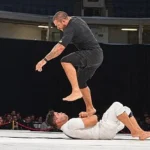
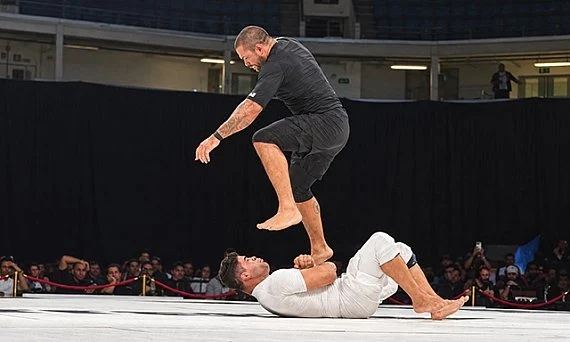
As the grueling nine-minute contest neared its conclusion, Galvao delivered the definitive exclamation point of the match. Leaping over Palhares’ guard, he landed cleanly with both feet squarely on his opponent’s abdomen in a dynamic display of athleticism. With Palhares visibly exhausted and unable to mount a meaningful defense against the onslaught, the referee stepped in to halt the contest, officially awarding Galvao a dominant victory and closing another chapter in his storied rivalry with Palhares.
The supporting card offered an equally thrilling array of high-level grappling encounters, featuring several recognizable names from the upper echelons of professional combat sports. In the co-main event, multiple-time world champion Rodolfo Vieira made exceptionally quick work of fellow elite grappler Andre “Sergipano” Muniz in a high-stakes no-gi matchup. Vieira wasted little time asserting his grappling pedigree, securing a swift takedown, advancing methodically to the mount, and bringing a rapid halt to the contest with a textbook kata-gatame, or arm-triangle choke, forcing the tap and electrifying the arena.
Another compelling Battle Jiu-Jitsu encounter pitted veteran Ultimate Fighting Championship alumni Gleison Tibau and Philip Rowe against one another. Tibau, a battle-tested Brazilian veteran known for his immense strength and suffocating wrestling base, controlled the majority of the contest from top position en route to a clear decision victory over the American. Securing an early takedown, Tibau maintained relentless top pressure for nearly the entire duration of the match. Taking full advantage of the rules permitting strikes below the head, he methodically punished Rowe with a steady stream of body punches that drained his opponent’s stamina and prevented any meaningful escape attempts.
The trend of dominant Brazilian performances continued as Herdeson Batista squared off against former UFC veteran and "The Ultimate Fighter" winner Kelvin Gastelum. In what proved to be a highly technical and physically demanding chess match, Batista successfully took Gastelum’s back twice over the course of the bout, repeatedly threatening with deep submission attempts. Though Gastelum demonstrated his veteran savvy by mounting a valiant comeback—highlighted by a sequence where he managed to reverse positions and take Batista’s back—the early deficits proved too steep to overcome, and Batista ultimately secured the victory on the judges’ scorecards.
One of the most memorable highlights of the evening belonged to two-time PFL champion Antonio Carlos Jr., who captured the imagination of the hometown crowd with a dazzling performance against Russian standout Ivan Shtyrkov. Demonstrating his trademark creativity, Carlos Jr. attempted an audacious flying triangle early in the match. Though the submission did not reach its final conclusion, the sequence allowed the Brazilian to seamlessly pass guard, take Shtyrkov’s back, and threaten a rear-naked choke. While Shtyrkov proved durable enough to survive the choke attempts, Carlos Jr.’s overwhelming control earned him a definitive points victory, along with the prestigious All-Stars no-gi belt.
In stark contrast to the submission-heavy grappling matches that populated much of the evening, a Battle Jiu-Jitsu contest featuring former UFC standouts Edson Barboza and Rashid Magomedov played out almost entirely on the feet. Eschewing traditional grappling exchanges, the two seasoned strikers engaged in a tactical, high-paced kickboxing bout within the grappling arena. Trading heavy punches and sharp kicks to the body throughout the duration of the match, both athletes showcased exceptional durability and technique. Ultimately, Magomedov found success by landing the heavier, more impactful strikes during the prolonged exchanges, doing enough to convince the judges and secure a points victory.
Despite the intense athletic competition and the traditional nationalist pride associated with the rivalry between Brazilian jiu-jitsu and Russian sambo, the atmosphere behind the scenes remained remarkably cordial. Athletes, coaches, and representatives from both nations interacted with a profound sense of mutual respect throughout the event, reflecting the deep camaraderie shared by elite martial artists regardless of their geographic origins or fighting styles.
The venue itself added an extra layer of historical significance to the proceedings. Hosted in Rio de Janeiro—a city universally recognized as the spiritual birthplace of the Gracie family’s jiu-jitsu legacy—the event drew an exceptionally impressive gathering of combat sports royalty and legendary figures who came out to witness the modern evolution of the sport.
The VIP section played host to an illustrious assembly of icons, including former UFC champion Jose Aldo, legendary middleweight Ronaldo “Jacare” Souza, grappling pioneer Fernando Augusto, Carlos Rosado—a respected black belt belonging to the first generation under Carlson Gracie—and Leonardo Castello Branco. The presence of such towering figures underscored the cultural importance of the event within the broader combat sports community.
Looking ahead, the success of the ACBJJ 23 card appears to have firmly established the promotion’s foothold in South America. According to former UFC fighter Davi Ramos, who played an instrumental role in promoting and organizing the event within Brazil, ACBJJ is already laying the groundwork for a triumphant return to Rio de Janeiro in early 2027, promising another chapter in the ongoing evolution of international grappling supremacy.