

The 2026 ATP Finals are set to bring the curtain down on a men’s professional tennis season defined by dramatic breakout campaigns for American players, substantial commercial growth, and the prolonged, conversation-starting absence of some of the sport’s biggest marquee names.
As the men’s tour converges on Italy for its traditional year-end showcase, the tournament arrives against a backdrop of both celebration and mounting industry tension. Carlos Alcaraz returns to competitive play from a lengthy injury layoff to pursue his first career ATP Finals title. However, the Spanish phenom will have to navigate the draw without his greatest contemporary rival, Jannik Sinner, who continues his careful recovery from a persistent knee problem.
With last year’s champion Sinner forced out of contention, Germany’s Alexander Zverev is guaranteed to finish the 2026 season as the undisputed world number one. Zverev’s stellar campaign, which included capturing his maiden major title at Roland-Garros before following up with a hard-fought triumph at the US Open in September, has put him mathematically out of reach at the summit of the rankings. Even if Alcaraz goes entirely unbeaten in Turin and collects the maximum 1,500 ranking points available, he remains too far adrift to catch the German powerhouse.
Still, there is plenty left to play for at the prestigious season finale, which will once again offer record-breaking prize money. This financial heft firmly underlines the tournament’s status as the most lucrative event in professional tennis outside of the four traditional Grand Slams.
The Host
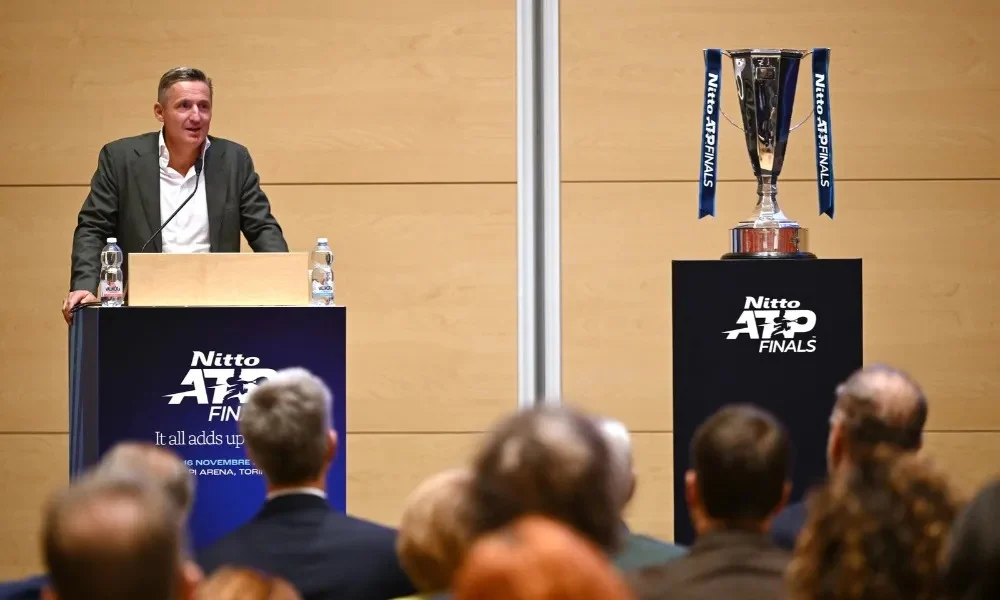
Since relocating in 2021, the ATP Finals have found a vibrant home at Turin’s Inalpi Arena, a venue originally constructed to stage ice hockey competitions during the 2006 Winter Olympics. The northern Italian city successfully fended off international competition from Manchester, Singapore, and Tokyo back in 2019 to secure an initial five-year contract through 2025. This move effectively took over hosting duties from London after a hugely successful and atmospheric 12-edition stint at the O2 Arena.
Early speculation that the event might be poached by Saudi Arabia was firmly quashed when an extension was signed in 2024, guaranteeing that the prestigious tournament will remain in Italy at least until 2030. Despite lingering whispers and suggestions that the Finals could potentially relocate within the country to Milan, the ATP has officially confirmed that Turin will continue to serve as the host city for the 2027 tournament.
Turin’s case for retention has undoubtedly been strengthened by a series of substantial infrastructure and fan-experience upgrades rolled out this year. These improvements include an expanded seating capacity, which has grown from 12,000 to 13,500 seats, newly redesigned hospitality suites, and an innovative open practice court integrated directly into the bustling fan village.
Organisers will be quietly hoping that the disappointing absence of local hero Sinner does not significantly dent ticket sales, particularly following a record-breaking 2025 edition that saw 229,879 spectators pass through the turnstiles—a nine per cent increase on the previous year. Regardless of individual star power for this specific iteration, the event has proven exceptionally prosperous for the host city. Regional economic studies indicate that the tournament generated an economic impact of nearly €600 million (US$663 million) in 2025 alone.
Italy is further cementing its association with the tour’s year-end championships by also returning as the host of the under-21 Next Gen ATP Finals. That junior showcase is scheduled to take place in Reggio Calabria from 9th to 13th December. This relocation, announced in September, successfully ended the ATP’s search for a new home after its previous contract with Jeddah—which was originally due to run until 2027—was terminated prematurely.
Prize Money
The total financial compensation pot for the 2026 ATP Finals reaches a record-breaking US$15.75 million, marking a solid increase of US$250,000 compared to the previous year. Under the tournament’s lucrative payout structure, an undefeated singles champion can take home a maximum of US$5.171 million, while an undefeated doubles team will earn US$959,300.
While the ATP Finals prize purse sat roughly on par with the WTA Finals as recently as last year, it now towers over the women’s equivalent by US$5.75 million. The women’s tour season finale saw its prize pot unexpectedly shrink to US$10 million after its lucrative hosting agreement with Saudi Arabia ended early, prompting a subsequent relocation to Indian Wells.
Historically, however, the ATP had frequently looked enviously at the WTA’s financial trajectories. This was particularly true when the women’s tour secured an eye-watering US$14 million pot as part of its ill-fated deal to take its season-ending competition to Shenzhen beginning in 2019. Indeed, the ATP’s own strategic migration from London to Turin was driven in large part by the pursuit of improved commercial revenues.
Thanks to the steadfast support of title sponsor Nitto and generous backing from the Italian government, the tournament’s prize fund has surged by an impressive 75 per cent from the US$9 million baseline established during its final years in London. This financial growth is projected to continue well into the future, underpinned by the Italian Ministry of Sport’s commitment of US$100 million to support the event through 2030.
Sponsorship Overview
Title sponsorship for the ATP Finals remains arguably the most coveted commercial inventory on the global tennis circuit.
When the ATP was first contemplating moving its season finale to London back in 2009, securing the backing of banking giant Barclays—which was actively seeking to diversify its sponsorship portfolio away from association football—proved vital. Even though that initial deal nearly collapsed amid the global financial crisis in 2008, the resulting eight-year partnership was ultimately renewed twice and proved to be an overwhelming commercial success.
Japanese industrial and electronics firm Nitto stepped in to replace Barclays as the title partner in 2016, subsequently locking in a five-year extension in 2020. Demonstrating absolute confidence in the property’s enduring value, Nitto renewed its title partnership agreement once more last year, securing rights through 2030.

Alongside the title partner, Emirates airline, coffee brand Lavazza, and automotive manufacturer Lexus serve as prominent platinum partners of the event. The commercial ecosystem is further rounded out by a deep portfolio of gold, silver, and bronze sponsors, alongside official suppliers such as TechnoGym and TicketOne. Notably, among the silver partners is yoghurt brand Fage, which has similarly expanded its footprint in tennis by recently becoming the title sponsor of the WTA Finals.
More broadly, the ATP revealed ahead of the Turin tournament that the tour’s central sponsorship revenue increased by a record-shattering 49 per cent this year, pushing past the symbolic US$100 million milestone for the first time in history. Leadership attributes this unprecedented growth to sustained, long-term investment from existing partners alongside fresh agreements with high-profile brands like EQT, K-Swiss, and Julius Baer, which came on board earlier in the week as the ATP’s inaugural official wealth management partner.
This commercial momentum aligns with broader executive ambitions. Following his re-election earlier this year for a third term running through the end of 2028, ATP chairman Andrea Gaudenzi has outlined sweeping plans to increase total player compensation across the tour to US$350 million beginning in 2028.
Broadcast Arrangements
The ATP Finals perennially rank among the most-watched sporting events of the tennis calendar, with the unique prospect of eight consecutive days featuring high-stakes clashes between the world’s elite players serving as an undeniable magnet for television audiences.
That drawing power was starkly illustrated last year, when more than 6.7 million viewers across Italy tuned in to watch Sinner edge out Alcaraz for the championship trophy. Broadcast across pay-TV network Sky and public service broadcaster Rai, that viewership milestone established the fixture as the most-watched tennis broadcast in Italian television history.
Replicating those astronomical figures will prove challenging in the absence of Sinner, though local interest could receive a welcome lift if Italian tournament debutant Flavio Cobolli manages to assemble an unexpected deep run. Still, the withdrawal of last year’s champion represents a commercial blow of sorts for Mediaset, which successfully prised the lucrative free-to-air broadcasting rights away from Rai in a new deal reportedly valued at €4 million per year.
Beyond the domestic Italian market, Sky maintains long-term agreements to broadcast the tournament across the UK and Germany. Spanish fans will have the opportunity to watch Rafael Jódar make his Finals debut via Movistar, while Eurosport currently holds the broadcast rights in France—though it has already been confirmed that BeIN Sports will take over French coverage starting in 2028. Further afield, TSN and Tennis Channel provide dedicated coverage for audiences in Canada and the United States respectively.
In addition to traditional linear and digital television broadcasts, the ATP is taking proactive steps to broaden the cultural reach of the Finals this year by bringing 11 digital content creators to Turin. These creators will cover the event extensively on the social media platform TikTok, which will also host a dedicated daily live show for the very first time. This initiative is a direct continuation of the ATP’s "On Tour With" creator programme, which originally launched at the 2025 edition of the Finals.
The Bigger Picture
The high-profile injuries suffered by two of the game’s transcendent young stars have inevitably cast a sharp spotlight back onto the grueling, relentless 11-month tennis schedule. Prominent players have grown increasingly vocal, arguing that the current calendar fails to afford adequate time for physical recovery and creates an unsustainable workload.
Carlos Alcaraz recently voiced his frustrations directly to the media, stating that it is "impossible" to compete in every tournament on offer. The Spanish star revealed plans to deliberately skip selected events moving forward, issuing a blunt warning that the sport will witness heightened rates of injuries and player fatigue if fundamental changes are not enacted to restructure the competitive calendar.
Addressing the schedule remains a paramount priority for ATP chairman Andrea Gaudenzi. In an open letter published in October, the Italian administrator attempted to ease growing industry concerns regarding player workloads by outlining strategic plans for a clearer season structure, featuring dedicated, uninterrupted weeks for each tournament category to help athletes better plan their annual campaigns.
Player compensation has already risen by US$100 million under Gaudenzi’s watch, and the ATP is now pushing to elevate its official bonus pool from US$21.5 million to US$50 million. This enhancement forms part of a broader financial package projected to lift overall player remuneration to the targeted US$350 million threshold by 2028.
While those financial upgrades will undoubtedly be welcomed within the locker room, other structural proposals have met with fierce resistance. Most notably, the ATP’s planned modifications to the doubles format have been met with immediate pushback; more than 150 professional players recently signed a joint letter urging the tour to rethink proposals that would reduce draw sizes and redistribute prize money away from doubles specialists to further bolster singles compensation.
This internal friction serves as a clear microcosm of a broader sport that frequently struggles to pull in a unified direction. Gaudenzi has long championed the absolute necessity of closer commercial and administrative alignment across professional tennis, noting earlier this year that the sport continues to miss out on billions of dollars in potential revenue by failing to pool its commercial rights and successfully reduce systemic fragmentation between competing events.
Despite optimistic noises earlier in the year—including ATP chief executive Eno Polo expressing firm confidence back in January that the men’s and women’s tours were "quite close" to a commercial merger—a long-discussed unification with the WTA does not appear to be any closer to fruition. Industry reports indicated that formal talks were placed on hold indefinitely after newly appointed WTA chair Valerie Camillo deemed the financial terms of the proposed revenue-sharing model unacceptable, resulting in the women’s tour stepping back from the negotiating table.