Back in September, Hyrox co-founder Moritz Fürste had a clear message for the company’s community of fitness racers: “You’re not getting rid of us anytime soon.”
Persistent reports that Swiss agency Infront Sports & Media planned to divest its majority holding in Hyrox had previously sparked widespread speculation that Fürste and his fellow co-founder, Christian Toetzke, might also be stepping away from the business. However, in an Instagram video fittingly recorded inside a gym, the pair appeared all smiles as they addressed the rumors directly, assuring their global community that they were staying put to guide the brand’s next chapter.
Instead of an exit, Fürste and Toetzke confirmed a major ownership shift, partnering with a consortium led by consumer-focused private equity firm L Catterton to buy back control of Hyrox. The high-profile transaction reportedly valued the nine-year-old fitness enterprise at €600 million, equivalent to approximately US$700 million.
Infront originally entered the picture in 2019 when it made a strategic investment in the rapidly growing fitness phenomenon, later stepping up to a majority shareholding in 2022. While that 2022 agreement stipulated that the core Hyrox team would retain substantial direction and operational oversight over commercial choices, Fürste describes regaining a controlling equity stake as a profoundly significant milestone for the founders.
Reflecting on the deal during an interview at the SportAccord Forum in Lausanne, Fürste explained how the opportunity materialized. "I think opportunities arise at times," he noted, "and there was the opportunity to get back into the majority shareholding of Hyrox, which we always wanted."
He acknowledged that stepping away from majority ownership in 2022 was not part of their original vision, driven instead by a distinct set of corporate circumstances at the time. "We did not necessarily want to sell in 2022. There were different circumstances that led to the fact that it happened. But we always said that we would like to regain majority."
While praising their relationship with Infront Sports & Media and noting that they were already "calling the shots to the most extent before," Fürste emphasized the psychological and operational weight of executive ownership. "Being in the driver’s seat officially is also an important aspect for founders."
‘We will see Hyrox on TVs everywhere’
Announcing the transaction when it was finalized, Fürste characterized the fresh injection of capital as a pivotal moment in the rapid evolution of the Hyrox success story.
Under the terms of the agreement, Hyrox stands to benefit immensely from the deep expertise of L Catterton—backed by luxury goods conglomerate LVMH—which boasts a proven track record of scaling high-growth consumer and fitness brands. The private equity firm’s portfolio includes high-profile names such as sandal maker Birkenstock, connected fitness pioneer Peloton, and French fashion label APC. Such associations strongly signal that investors view Hyrox not merely as a demanding competition format, but as a robust, culturally resonant lifestyle brand.
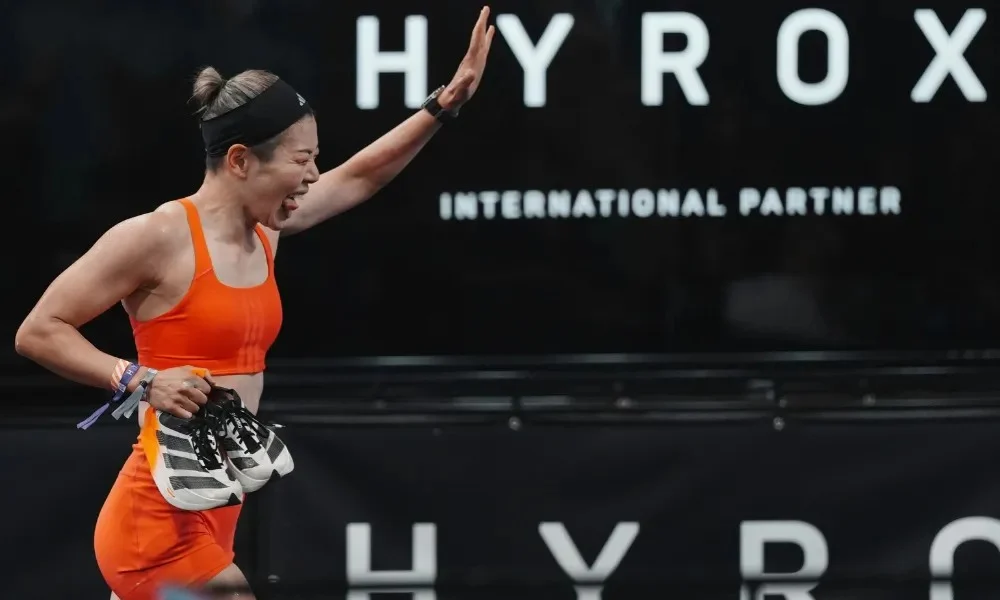
Since launching in 2017, Hyrox has earned a well-established reputation as one of the fastest-growing mass participation sports on the planet. It has cultivated a deeply loyal following of fitness fanatics who regularly travel internationally to test their physical limits. Typically staged inside expansive convention centers, exhibition halls, and indoor arenas, standard races challenge participants with a grueling sequence: eight alternating blocks of 1-kilometer running, each immediately followed by a functional movement station, ranging from heavy sled pulls and burpee broad jumps to sandbag lunges.
Designed specifically to give everyday gym-goers a concrete, structured goal to train for year-round, the organization’s scale has blown past initial projections. According to Fürste, Hyrox anticipates hosting approximately 2.5 million participants alongside 2.89 million spectators across roughly 135 individual events during the 2026/27 season alone.
Supported by a workforce of more than 600 employees distributed across corporate offices in Germany, the United Kingdom, and the United States, Hyrox has expanded globally into more than 35 countries. Its operational footprint is vast, frequently hosting simultaneous events across multiple continents on the exact same weekend in key international markets such as Australia, Brazil, China, France, India, and Japan.
This staggering trajectory explains why the brand continues to command intense interest from institutional investors. Yet, keeping pace with such breathless, explosive growth has proved challenging, occasionally pushing even the internal organization to its limits. Fürste readily admits that the journey has been "super intense," noting that the immediate priority moving forward is less about breaking into uncharted geographic territories and more about reinforcing the internal corporate structures necessary to sustain long-term expansion while guaranteeing uniform event quality across all global venues.
The incoming investor group brings strategic muscle that extends far beyond financial backing. Fürste explains that while the partnership will be strategic in nature, the founding team remains firmly at the helm. "We will keep driving the business and making decisions," he affirms.
Another critical component of the investor syndicate is WndrCo, the prominent investment firm co-founded by Jeffrey Katzenberg—former chairman of Walt Disney Studios and founder of DreamWorks—alongside former Dropbox chief financial officer Sujay Jaswa. When considering their potential impact on Hyrox’s ambitions to scale its global media footprint, Fürste remarked that he didn’t really have to explain the caliber of expertise they bring to the table.
Historically, traditional media rights have accounted for a remarkably small fraction of the company’s overall revenue stream. Roughly 60 percent of Hyrox’s income is generated through direct participation fees and spectator ticket sales. While marquee races are regularly streamed live via the official Hyrox YouTube channel, the company has also forged distribution alliances, such as a deal struck last year with Atmosphere TV to broadcast all Hyrox Majors and Regional Championships to more than 60,000 bars, restaurants, gyms, and retail venues around the world.
Traditional sports broadcasting agreements, however, have historically been sparse. While hyper-accelerated revenue growth from media rights has not been explicitly baked into the core financial model to date, Fürste acknowledges that broadcasting represents an essential pillar of the company’s next phase of maturity. He highlights the immediate priority as elevating the live production values of races and cultivating alternative entertainment formats.
Unlike open-air endurance spectacles like traditional marathons or triathlons, which span massive urban landscapes and present notorious broadcasting hurdles, Fürste argues that Hyrox is inherently built for visual media. Because the entire competition takes place within a condensed, enclosed arena, the primary challenge lies simply in "making it sexy so that people actually want to watch it."
Early proof of market demand is already materializing. In Germany, where the inaugural Hyrox event was staged back in 2017, the company subsequently secured a landmark broadcast partnership with Axel Springer-owned media outlet Bild. The agreement sees Bild air live coverage of the remainder of the Elite Series following the broadcast of the season-opener in Hamburg late last October.
If Fürste has his way, the Bild partnership is merely the opening salvo in a much broader global media strategy.
"That development will be immense and we will see great development on the live broadcasting of Hyrox races," he observes. "I think it’s super exciting to watch. Obviously I’ve watched quite a few, and the production level has gone up quite consistently, and hopefully also with our new investors, we will invest a lot more into that space as well. And I’m pretty sure we will see Hyrox races on TVs everywhere in the world over the next 18 months."
Wider, mainstream television coverage is also expected to significantly bolster the company’s sponsorship proposition. Even prior to securing major broadcast partnerships, Hyrox successfully landed lucrative global and regional sponsorship deals with heavyweights like Puma, Amazon, and Intersport.
"I think media is obviously a new anchor for that," Fürste notes, explaining the interconnected nature of modern sports commerce. "And the world still works like that—if you have the reach on those channels, it’s much easier to engage with partners, or at least get better contracts or upgrade those contracts. So that’s why media was always a super important point."
Nevertheless, Fürste maintains that the beating heart of the enterprise remains its grassroots community and the physical events themselves. "The core of it all is still our community and the events itself. You have direct touch points with four, five million people, including spectators on site, which is a super big value for a lot of partners. Because instead of sponsoring maybe one marathon in a city in a year, you can activate six times a year on six Hyrox events."
Pursuing ‘the ultimate goal’
While the precise contours of Hyrox’s future media distribution ecosystem continue to take shape, the organization’s long-term ambitions point firmly toward the Olympic and Paralympic Games. Hyrox has made no secret of its desire to achieve formal Olympic inclusion, but over the past year, those aspirations have translated into concrete institutional action. Most notably, the company announced a landmark strategic partnership with World Triathlon, establishing "Hybrid Racing" as an officially recognized discipline within the global governing body.
The international federation’s congress, held in Wollongong, officially approved the Hyrox competition structure, paving the way for the establishment of official world, continental, and national championships for hybrid racing.
Because international sporting recognition requires governance by a recognized international federation to qualify for consideration by the International Olympic Committee, partnering with World Triathlon offered a streamlined pathway to the Games. Creating an entirely independent global federation from scratch would have required a lengthy, bureaucratic process.
"We didn’t see any merit in creating our own federation at that point," Fürste explains, looking back at the strategic alignment. "We were looking around and triathlon in the end is a multi-sport federation. They also combine three sports that existed before and created a race out of that. We did kind of a similar thing, just with eight workouts and running, and also we had some connections to World Triathlon from our former lives. So it was the first federation we approached."
He adds that the cultural and structural similarities made the partnership a logical choice. "There were a lot of similarities where we aligned, and for me, it’s an important next step because if you want to create a real ecosystem that you call a sport, then you need that professional setup."
With the sports program for the upcoming LA28 Olympic Games already locked in, Brisbane 2032 stands as the earliest realistic window for hybrid racing to make its debut on the Olympic stage. The IOC intends to review and confirm the full sports program for the Brisbane Games during an upcoming IOC Session, while candidate disciplines learn whether they advance to the "combined comparison phase," where the merits of existing and proposed sports are rigorously evaluated.
Hyrox has certainly never lacked public attention or participant demand since bursting onto the global sports scene. However, as a three-time Olympic medalist who claimed field hockey gold for Germany at both the Beijing and London Games, Fürste understands intimately what the Olympic platform can achieve for an athlete and a sport’s global profile. Given the fierce competition among numerous international sports disciplines vying for a coveted spot on the program, he remains balanced and philosophical about the journey ahead.
"Any sport, that’s the ultimate goal: to be part of the Olympics," he concludes. "It’s the recognition, it’s the athletes that get the opportunity to experience the greatest event in the world. So all of that together is reason enough to have that as a goal."
For Fürste, the motivation is also deeply personal. "I would love for our athletes to have the chance to experience what I was able to experience. And of course, for me, it would be a full circle moment to create something that gets integrated after being part of that for such a long time."
"This is goal setting, and if in the end you don’t reach your goals, then you have to find a new one. We’re now pursuing this as much as we can. If it doesn’t work out, it doesn’t work out, and we need to do something else."