
The final mile of an Ironman triathlon is a uniquely unforgiving place to discover that your body has completely depleted its reserves. Long before reaching that stage, an athlete has already swum 2.4 miles through open ocean water, pushed a bicycle 112 miles across grueling terrain, and run far enough to complete a full, respectable marathon. By the time they enter the final stretch, all that remains is a narrow strip of asphalt and a finish line. Unfortunately, at that critical juncture, tired legs and depleted systems do not care about careful pacing strategies, lucrative sponsorships, or the millions of spectators watching from around the globe.
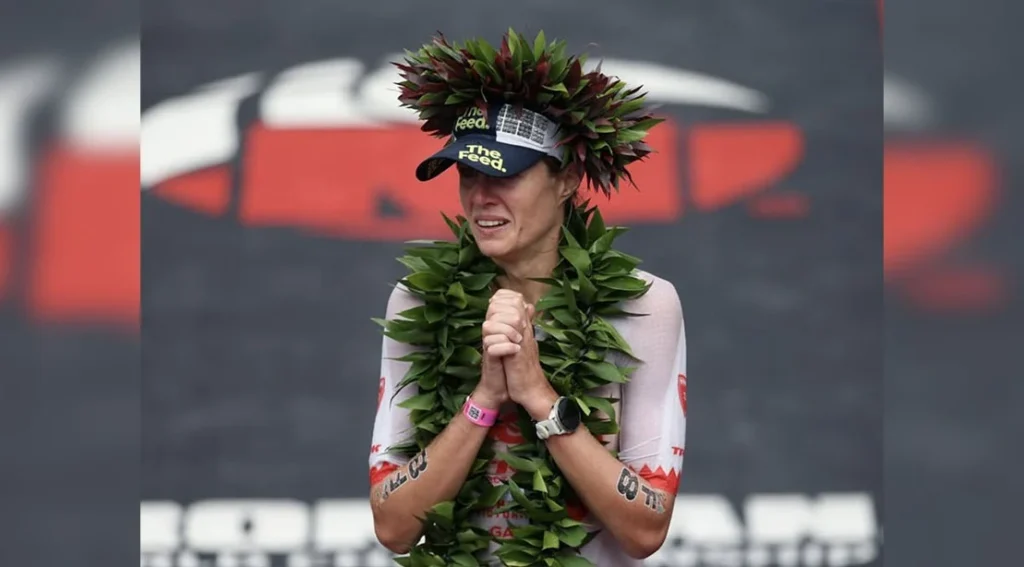
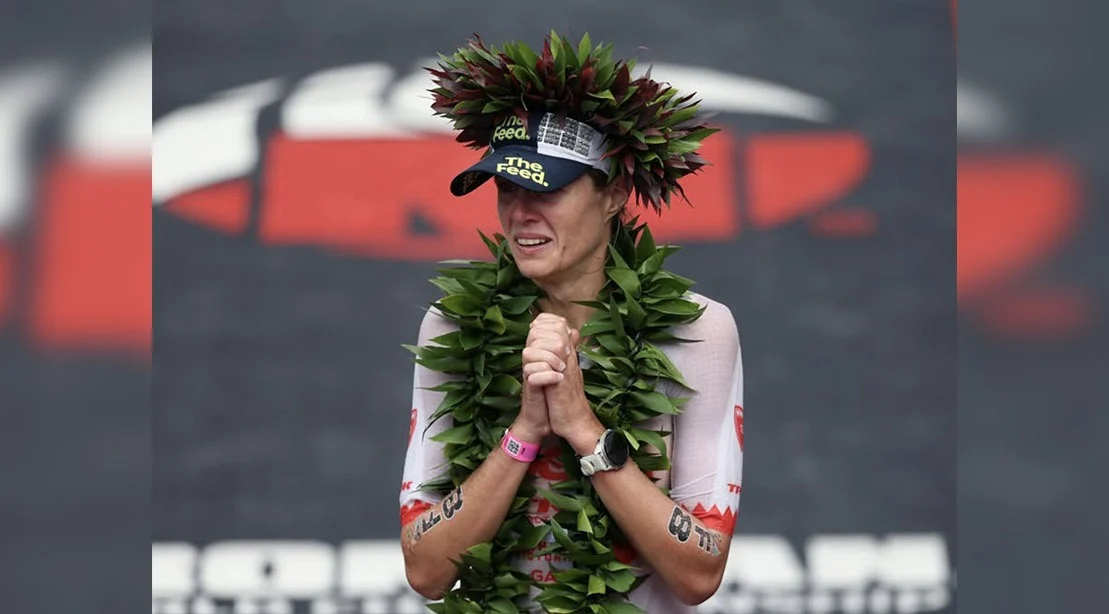
On October 10, the prestigious Ironman World Championship in Kona, Hawaii, delivered a masterclass in this brutal reality, producing a dramatic finish that made even the most ambitious Hollywood sports scripts look underwritten. American standout Taylor Knibb powered through the demanding conditions to capture the women’s world championship title in a remarkable time of 8 hours, 36 minutes, and 29 seconds. Yet, the victory was heavily overshadowed by the heartbreaking theater unfolding just moments before the finish line.
Defending champion Solveig Løvseth, who had seized the lead from Knibb with roughly five miles remaining in the marathon, began to visibly struggle in the final mile. Her stride faltered, her pace slowed to a staggering walk, and eventually, she collapsed onto the pavement. As Løvseth fought to gather herself, Knibb swept past to claim the crown. Showing immense grit, Løvseth eventually rose to her feet, pushed through the remaining distance, and crossed the finish line to secure a heroic eighth-place finish. Behind Knibb, Germany’s Laura Philipp claimed the second-step podium spot, while Switzerland’s Julie Derron took third.
One Year Later, the Heartbreak Changed Hands
What elevated the women’s race from a standard endurance event into an extraordinary piece of sports history was the eerie symmetry of the previous year. Just twelve months earlier, at the 2025 championship, these exact same two elite athletes found themselves in virtually identical, yet completely reversed, positions.
During that race, Knibb had held the lead late into the marathon before her body broke down under the oppressive Hawaiian heat and relentless exertion. Løvseth capitalized on that exact moment, passing Knibb to capture the championship while her American rival failed to finish.
To have the exact same protagonists return a year later, only for the roles of victor and vanquished by exhaustion to flip entirely, feels almost too cinematic to be real. If a screenwriter pitched that exact narrative arc to a film producer, they would likely be told that the coincidence was far too obvious and contrived for an audience to believe.
Yet, sports resist clean scripts. There is often a strong temptation among observers and commentators to distill moments of sudden athletic failure into cliché inspirational posters about perseverance and never giving up. In this case, however, that interpretation misses the mark entirely. Neither woman lacked determination, focus, or preparation. Knibb arrived in Kona having already secured a dominant victory at the 2026 Ironman 70.3 World Championship—a grueling half-ironman distance that demands hours of intense physical punishment in its own right. Løvseth, meanwhile, was the reigning champion defending the most prestigious title in the sport.
Both competitors were operating at the absolute peak of their capabilities and were thoroughly equipped to win. The deciding factor on the lava fields of Kona was not a matter of who wanted the victory more. Instead, it came down to a much more primal biological question: whose physical systems could continue to function after the clock had been running continuously for eight and a half hours.
In the immediate aftermath of the race, social media platforms and online forums quickly filled with armchair analysts diagnosing Løvseth’s sudden collapse. However, experts urge caution against such speculation. There has been no official, confirmed medical diagnosis released to the public establishing the precise physiological cause of her breakdown. While extreme heat, severe dehydration, depleted carbohydrate stores, and accumulated physical exhaustion are all logical factors to examine in an endurance event of this magnitude, watching an athlete wobble on a broadcast and diagnosing an electrolyte deficiency from a living room couch is not sports medicine.
Any sudden collapse during extreme physical exertion can signal a serious medical emergency and always warrants a thorough professional medical assessment. While an athlete’s fierce determination is universally admirable, turning a potentially dangerous medical incident into a casual motivational slogan overlooks the very real physical risks involved in extreme sports.
Vincent Luis Makes His Kona Debut a Winning One
While the women’s race provided staggering drama in the closing stages, the men’s division offered its own compelling narrative of tactical brilliance and unexpected triumphs. Vincent Luis of France, competing at 37 years of age and making his career debut at the Ironman World Championship in Kona, shocked the triathlon world by capturing the overall men’s title with a stellar finishing time of 7:47:27.
Luis was far from an anonymous newcomer stumbling out of a local cycling club. He entered the event with an illustrious pedigree, having previously competed at the Olympic level and secured world championship titles at shorter, explosive triathlon distances. Rumors had even swirled regarding his potential retirement from elite competition. Instead of stepping away, the seasoned French competitor chose to test his limits in Hawaii. During the marathon leg of the race, Luis steadily hunted down Denmark’s Magnus Ditlev, eventually making the decisive pass and holding off a hard-charging Gustav Iden—a former champion—to win the race by roughly a minute and a half. American competitor Matthew Marquardt rounded out the podium by taking third place.
The 2026 event marked a significant milestone for the sport, as the men’s and women’s professional championships were held together in Kona for the first time since 2019. The dual showcases demonstrated the unpredictable nature of Ironman racing, where both divisions featured dramatic late-race reversals. These shifts underscore the vast chasm that often exists between being the strongest athlete on paper and being the athlete who manages to survive until the finish line.
Athletes can train meticulously for the grueling distance, refine their nutritional intake down to the gram, dial in their equipment aerodynamics, and spend months preparing specifically for the stifling Kona heat. Indeed, professional competitors must do all of these things just to have a chance at competing on the global stage. However, as the events on the Big Island proved once again, there is no training program, coaching methodology, or technological advancement on earth that can completely guarantee a human body will fully cooperate over the course of 140.6 miles of continuous punishment.
An event of this scale is certainly not meant for everyone, and most people can easily envision countless more pleasant ways to spend a Saturday afternoon than swimming, biking, and running to the point of exhaustion. Yet, anyone who has ever trained seriously for an endurance challenge recognizes the deep, universal lesson embedded in the results.
A race is never truly over simply because an athlete is currently in the lead, nor is it lost solely because they find themselves trailing behind. Occasionally, the most profound victory is not crossing the finish line first, but rather possessing the self-awareness to recognize when the elements and the distance have taken everything a body has to give. The final mile of an Ironman has no respect for past reputations, world titles, or pre-race hype, and it certainly does not care who was winning at mile 139.