


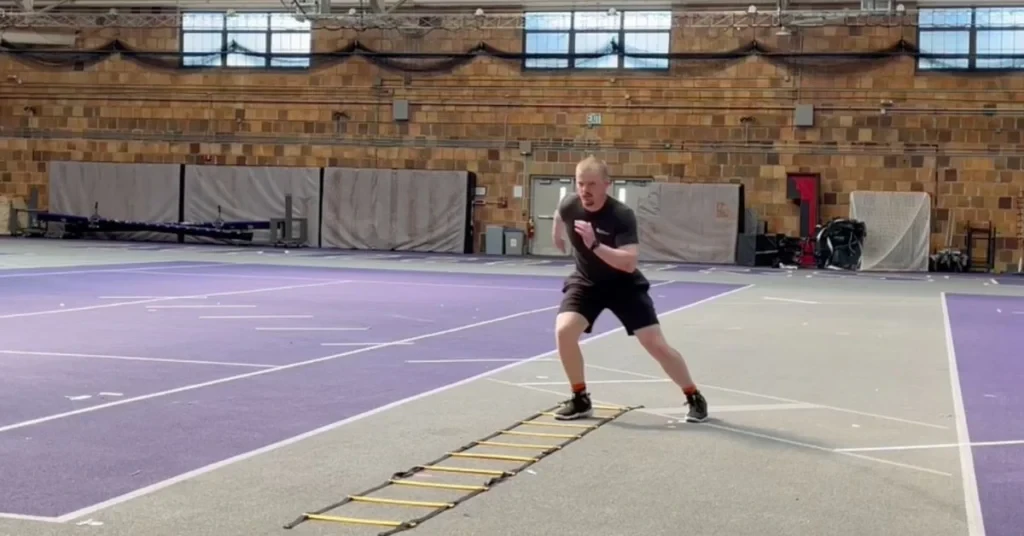
In the landscape of modern strength and conditioning, few training tools spark as much spirited debate as the flat-ribbed nylon contraption commonly known as the speed or agility ladder. On one side of the aisle, detractors dismiss them as little more than theatrical props—glorified footwork games that offer negligible transfer to actual athletic performance. On the other side, athletes and coaches revere them as staples of pre-practice preparation, drawn to the hypnotic rhythm and visual flair of high-speed footwork drills.
According to strength and conditioning coach TJ Cahill, both camps miss the nuanced reality of how these tools function within a comprehensive training program. Rather than viewing ladders as a magical shortcut to elite athleticism or dismissing them as absolute nonsense, Cahill suggests that coaches can leverage them effectively by understanding their true purpose. Far from replacing foundational sprinting or reactive agility training, agility ladders serve four distinct, practical functions: supercharging warm-ups, sharpening coordination, introducing extensive plyometric contacts, and driving athlete engagement.
To understand where the ladder fits, it is essential to first establish what it does not do. For decades, marketing claims have promised that ladder drills will instantly transform a plodding athlete into a lightning-fast speedster capable of cutting on a dime away from defenders. However, biomechanical reality paints a very different picture.
Speed training is a deeply specific endeavor, generally broken down into primary, secondary, and tertiary categories of acceleration, maximum velocity, and multidirectional movement. Primary speed exercises directly enhance velocity by training specific speeds and techniques, such as sprint starts executed from push-up positions. Secondary exercises contribute to speed development while slightly altering mechanics—like heavy sled pulls that challenge force production at the cost of strict sprinting form. Tertiary exercises, meanwhile, complement speed characteristics in a much broader sense, such as horizontal jumps that build explosive force without mimicking actual running mechanics.
While agility ladders demand that athletes move their feet at high frequencies, the movement patterns bear little resemblance to true sprinting mechanics. They do not replicate the neuromuscular and biomechanical demands of maximal velocity running, nor do they train the specific force vectors required to slash seconds off a 40-yard dash.

The same disconnect applies to the concept of agility. According to the National Strength and Conditioning Association, spearheaded by researchers like G.G. Haff and N.T. Triplett, agility is defined specifically as the physical and cognitive ability to change direction, velocity, or mode of locomotion in response to an external stimulus. Agility ladders, by their very nature, are entirely closed-skill exercises. The path is predetermined, the steps are memorized, and there is no reactive component. An athlete executing an intricate ladder routine is not processing visual or auditory cues to evade a tackler or intercept a ball. Therefore, running through a ladder does not foster the proper mechanics required for true, multi-directional open-field reactivity.
Yet, despite these glaring limitations, dismissing the ladder entirely means overlooking its practical utility in a well-rounded athletic development framework. When classified appropriately as tertiary training tools, ladders offer substantial value when integrated with clear intent.
The first major application lies in pre-training preparation. Elevating an athlete’s core body temperature, heart rate, and respiratory rate is a non-negotiable prerequisite for safe and effective performance. Following the RAMP protocol—which stands for Raise, Activate, Mobilize, and Potentiate—warm-ups should systematically prepare both the cardiovascular and nervous systems for the demands of the session ahead. Agility ladder drills, when executed correctly, can effortlessly accomplish this initial phase.
High-profile athletes frequently validate this approach. National Football League star Christian McCaffrey, recognized widely for his elite spatial awareness and on-field elusiveness, has openly discussed utilizing ladder drills at the onset of his training sessions. For McCaffrey and others, the ladder serves a dual purpose: warming up the feet, mobilizing the hips, and synchronizing the brain with the physical body. This neurological priming provides a stimulus comparable to traditional track drills like A-marches and A-skips, giving coaches another reliable weapon in their developmental arsenal.
Beyond simply raising body temperature, ladder work during warm-ups can significantly enhance coordination and timing, particularly for younger or less experienced athletes. While complex physiological reviews—such as those by R.M. Enoka and J. Duchateau examining rate coding and motor unit recruitment—clarify how the nervous system controls muscle force rather than guaranteeing direct speed transfer, the practical benefits of rhythm and neuromuscular control are undeniable. Patterns like the "Icky Shuffle," lateral step-ins, and snake drills challenge an athlete’s ability to sequence muscular contractions smoothly, fostering foundational body awareness that supports future athletic endeavors.

The third practical application involves accumulating extensive plyometric contacts. Extensive plyometrics may not pack the same high-velocity punch as intensive shock methods when it comes to maximizing the rate of force development, but they play a vital role in building tissue tolerance. During general physical preparation blocks, athletes need to condition their tendons, ligaments, and joints to handle the repetitive impacts of athletic competition. Incorporating ladder variations—such as scissor steps with opposing arm mechanics—allows coaches to safely increase submaximal plyometric volume. This capacity building is particularly crucial for endurance-heavy, multidirectional sports like soccer, where athletes must absorb and execute thousands of submaximal force applications over the course of a match. As weeks progress, these patterns can be chained together to build a robust physical foundation.
Finally, the psychological element of athlete buy-in cannot be overstated. Walk onto almost any youth, high school, or collegiate training facility, and you will hear coaches, parents, or athletes insisting on the necessity of agility ladder work. Ladders are visually compelling, especially when executed with the effortless fluidity of elite performers. Because athletes intrinsically want to master these flashy movements, the tool carries an immense motivational pull.
When leveraged correctly, this enthusiasm can spark a deeper commitment to the training process as a whole. However, as Cahill emphasizes, transparency is paramount. Coaches must clearly communicate the "why" behind every exercise, ensuring that athletes understand that the ladder is a tool for coordination, tissue prep, and neurological priming rather than a miraculous fix for linear speed. By framing ladder drills accurately—as engaging, tertiary components of a comprehensive program designed to enhance rhythm, warm up the body, and build foundational resilience—strength coaches can extract maximum value from a piece of equipment that continues to polarize the training world.