

In the modern landscape of professional and amateur boxing, the visual language of the sport is dominated by flash, distance, and athleticism. When fighters maneuver away from oncoming fire in highlight reels shared across social media, they almost universally default to slipping to the outside. It is a cinematic, clean, and highly visible movement—a fighter pulling their head across the trajectory of a punch, creating a wide berth before snapping back with a explosive counter. Yet, beneath the veneer of contemporary highlight-reel culture, a quieter, more economical defensive philosophy is steadily reclaiming its place in the squared circle.
Inside slipping, a foundational cornerstone of old-school pugilism, is experiencing a resurgence. Though frequently associated today with elite technicians like Vasyl Lomachenko or practitioners of the rigorous Cuban and Soviet amateur systems, the technique was once the universal standard of the sport. To watch archival footage of early boxing is to witness a masterclass in turning toward the interior of an opponent’s guard, diffusing power rather than fleeing from it.
The retreat of inside slipping from mainstream coaching curriculums is largely a tale of shifting eras and evolving media models. Over the past three decades, the tactical identity of boxing has been heavily influenced by generational icons who popularized outside movement. During the 1980s and 1990s, the emergence of Mike Tyson fundamentally altered public and gym-floor perception of elite defense. Tyson’s explosive, aggressive style relied heavily on slipping to the outside of punches to detonate devastating knockout counters from a distance. The boxing business model, built increasingly around pay-per-view television and audiences seeking immediate, visually dramatic finishes, naturally embraced a style that favored speed, clear separation, and highlight-reel knockouts.
Subsequent decades saw further evolution, most notably with the defensive mastery of Floyd Mayweather Jr., whose implementation of the shoulder roll and the Philly shell cemented a new baseline for modern defense. These dominant trends gradually pushed inside slipping into relative obscurity among recreational boxers and grassroots coaches, who naturally tailored their instruction to mirror the reigning champions of television. Consequently, generations of fighters came up learning that defense strictly meant blocking, parrying, or executing wide outside slips.
Yet, boxing history suggests that styles operate in cyclical waves, and the limitations of purely outside-based movement have opened the door for a return to interior tactics. Unlike the frenetic energy required to constantly run and manage distance on the outside—a strategy heavily favored in three-round amateur bouts—inside fighting offers a masterclass in energy efficiency. Historically, when fighters faced grueling fifteen-round championship bouts, mastering the inside was a matter of survival and stamina. Inside slipping allows a competitor to bypass the frantic footwork of the perimeter, immediately smothering an opponent’s punching space and neutralizing their leverage.
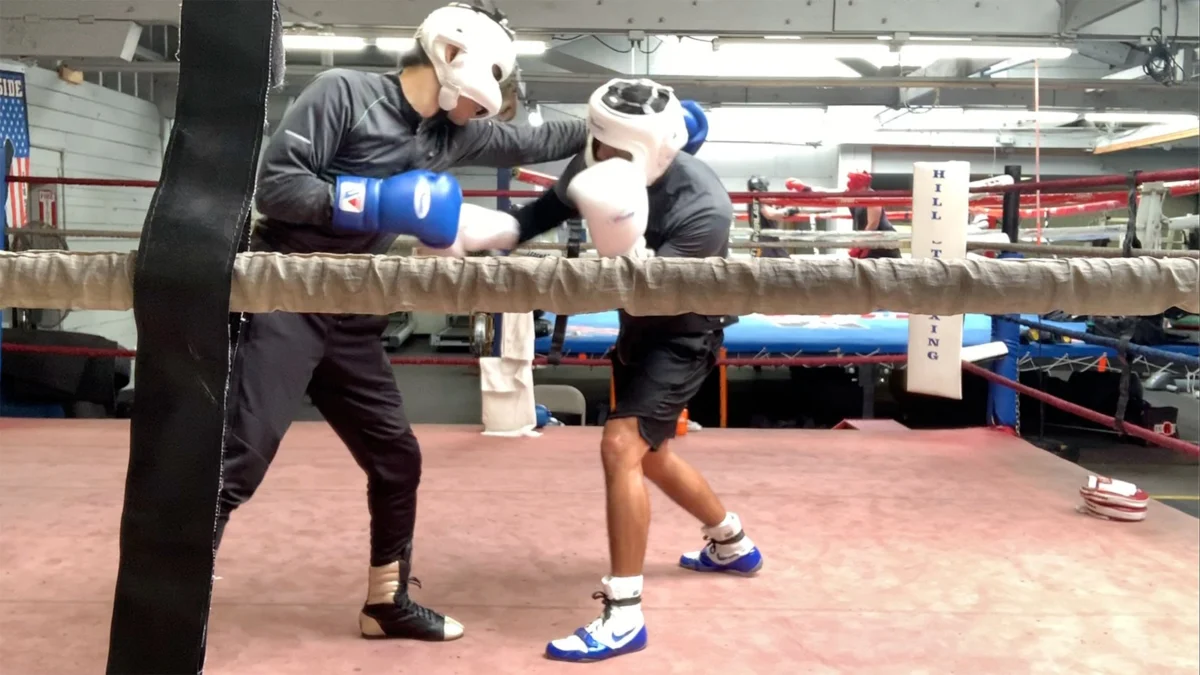
From a technical perspective, inside slipping offers distinct biomechanical advantages that many modern trainers are beginning to re-evaluate. While outside slipping demands exceptional spatial awareness, advanced reflexes, and a counter-intuitive motion that requires turning the torso toward an incoming strike, inside slipping aligns more naturally with human instinct. Initiating an inside slip involves turning the torso away from the incoming arm, a movement that feels structurally intuitive when facing a barrage.
Furthermore, the geometry of inside slipping fundamentally alters the dynamic of a bout. By mirroring an opponent’s body rather than crossing away from it, a fighter closing the distance prevents their adversary from easily sliding out of range. This approach creates a safer rhythmic exchange, as punches thrown on the inside roll with the flow of the opponent’s momentum rather than crashing against it. While getting caught while attempting an outside slip can dramatically amplify the impact of a punch by moving the head directly into its path, an inside slip or shoulder roll inherently dissipates force by moving away from the peak of the arc.
Despite its current reputation as a complex or hidden art, boxing historians and veteran trainers note that inside slipping never truly vanished. It remains embedded in the repertoires of elite fighters who understand the nuances of distance manipulation, body positioning, and timing over raw speed. Legends of the sport such as Roberto Duran, James Toney, and Bernard Hopkins utilized the interior landscape to neutralize taller opponents, demonstrating that mastery of the inside is often the great equalizer for stockier or pressure-oriented athletes. Modern standouts like heavyweight champion Tyson Fury and technical wizards such as Erislandy Lara and Guillermo Rigondeaux continue to showcase how subtle interior movements can dismantle an outside-fighting strategy.
As contemporary fighters and coaches continue to deconstruct the limitations of one-dimensional defensive styles, the traditional art of slipping inside is shedding its obscurity. What may look to the untrained eye like a messy clinch or a desperate lurch is, in reality, a continuation of a rich, energy-efficient lineage. For those willing to look past the superficial flash of modern highlight reels, the fundamentals of inside slipping remain a vital, highly effective dimension of the sweet science.