

In the sweet science of boxing, few tactical concepts are as widely misunderstood—and dangerously misapplied—as "fighting on the outside." For generations, casual observers and novice fighters alike have interpreted the phrase as a directive to fight from long range by creating maximal physical distance, often through a continuous retreat. According to conventional wisdom, when a fighter is overwhelmed, eating heavy shots, or struggling to track incoming punches, the instinctive reaction is to hit an imaginary "Get out of Jail Free" card: the straight backstep.
However, veteran boxing analysts and trainers argue that this approach is fundamentally flawed. In reality, there is no such thing as "fighting on the outside" when it is defined merely as moving backward away from an opponent. The moment a fighter relies on a straight retreat to escape pressure, they inevitably run out of room, trapping themselves against the canvas ropes and walking directly into danger.
The Illusion of Safety in the Backstep
The allure of the backstep in combat sports is undeniable. Statistically, stepping backward out of range can temporarily avoid almost any punch, offering a perceived layer of safety that is simpler and more immediate than executing complex defensive maneuvers like slipping, rolling, ducking, or blocking. When a competitor cannot see punches coming or feels overwhelmed by a relentless barrage, stepping out of harm’s way feels like the most logical solution.
The fatal flaw of the trusty backstep, however, is that it does not fundamentally alter the tactical scenario. At best, a backstep removes a fighter from the trajectory of one or two incoming punches. But once that initial distance is cleared, the adversary simply steps forward, restoring the original engagement range while leaving the retreating fighter with significantly less operating space.
This creates a compounding geometric crisis. Placed at the center of a standard boxing ring, a fighter attempting to rely on straight backward movement has a severely limited safety margin. The very first backstep draws them away from the center of the ring, and a second backstep places them squarely against the ropes. Even in an unusually large ring or against a slower opponent, the psychological burden of rapidly diminishing space alters a fighter’s mindset, inducing panic and forcing predictable, panicked jumps rather than controlled tactical retreats.
The Myth of Relying on Raw Footwork and Speed
Attempting to continuously outrun an aggressive opponent relies on an unsustainable set of assumptions. It requires superior athletic endurance, exceptional agility, and the explicit cooperation of an opponent who must somehow move clumsily and lose confidence upon seeing the target flee.
In reality, elite opponents often act like frenzied predators upon sensing hesitation or retreat. When a fighter attempts to constantly back away, they frequently exhaust their energy reserves while emboldening the aggressor. The visual narrative of a traditional mismatch often features one fighter landing a blow, sending their opponent off balance, followed by a mistimed counter into empty air. As the retreating fighter recovers, the aggressor closes the distance again, landing another blow until the referee is forced to intervene.
To understand true outside fighting, analysts point to legendary master technicians like Muhammad Ali and Sugar Ray Leonard. To the untrained eye, these champions appeared to be running backward away from pressure. A closer examination of archival footage, however, reveals a starkly different mechanical reality: they were rarely moving straight back. Instead, they were utilizing lateral movement and maintaining punching range, successfully evading danger while keeping their opponents constantly engaged and hesitant.
The Geometry of Lateral Movement
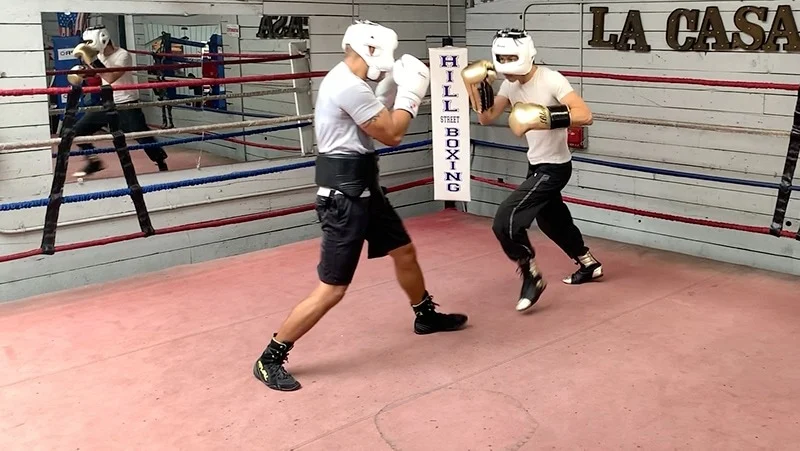
The cornerstone of effective outside fighting is circular, lateral movement. By circling around an opponent either clockwise toward their right hand or counter-clockwise toward their left hand, a fighter preserves their primary resource: space.
Lateral movement ensures that a competitor never truly runs out of room. While straight backward movement abruptly terminates at the ring ropes, circling preserves a continuous perimeter of motion, allowing for sustained repositioning and leaving the option of a backward step as a last resort rather than a primary reflex.
Furthermore, lateral movement keeps an opponent within active punching range. A fighter cannot launch effective counter-attacks if they continually jump themselves entirely out of range. More importantly, biomechanical studies of striking reveal that targets moving laterally are exponentially harder to hit. Throwing punches at diagonal and moving angles disrupts an opponent’s natural punching mechanics, forcing them to adjust awkwardly away from their standard forward-facing power lines.
Refining the Mechanics of Movement
Mastering lateral movement requires precise adjustments in both angling and body posture. Fighters can vary their circling trajectories by moving strictly sideways to create distance or stepping slightly forward to crowd an opponent’s rhythm and disrupt their offensive momentum.
While conventional defensive lateral movement often involves turning the body completely sideways and shuffling laterally, advanced practitioners incorporate more dynamic variations. Elite fighters frequently utilize a bouncing rhythm, skipping backward diagonally while circling sideways, effectively blending a lateral pivot with a controlled retreat. This hybrid motion allows a boxer to pepper an incoming opponent with a steady jab while remaining poised to land a heavy right hand should the pursuer overextend.
Maintaining proper posture is equally critical during lateral transitions. A common mistake among developing fighters is popping the torso straight up and exposing the chin in an unconscious effort to feel physically further away from the threat. Trainers emphasize the necessity of maintaining a slight torso hunch, keeping the head forward and low, which preserves defensive elusiveness and allows the fighter to duck cleanly beneath incoming combinations.
Additionally, advanced fighters rely on two-direction switching tactics to confuse aggressive opponents. By initiating a subtle head fake or a half-step in one direction to draw a reaction, a fighter can instantly redirect their movement to the opposite side, exploiting the opponent’s momentum. Alternatively, taking a committed initial step in one direction can initiate an escape route if the opponent fails to react, requiring only a secondary movement to complete the evasion.
Redefining the Outside Game
Ultimately, true outside fighting is not about standing still at a static, long-range distance or retreating in a straight line. It is defined by continuous, purposeful mobility. As long as a fighter keeps moving dynamically and finding new pathways of traversal, they remain effectively on the outside.
If forward movement represents the inside game and stopping altogether constitutes a tactical hazard, sustained lateral movement and circling represent the true essence of range control. By breaking the habit of the straight backstep in shadowboxing, bag work, and sparring—opting instead for diagonal angles and constant circular repositioning—fighters can maintain their defensive integrity. The next time a competitor seeks to control the outside, the path to success lies not in running away, but in going over, under, and around the opposition.