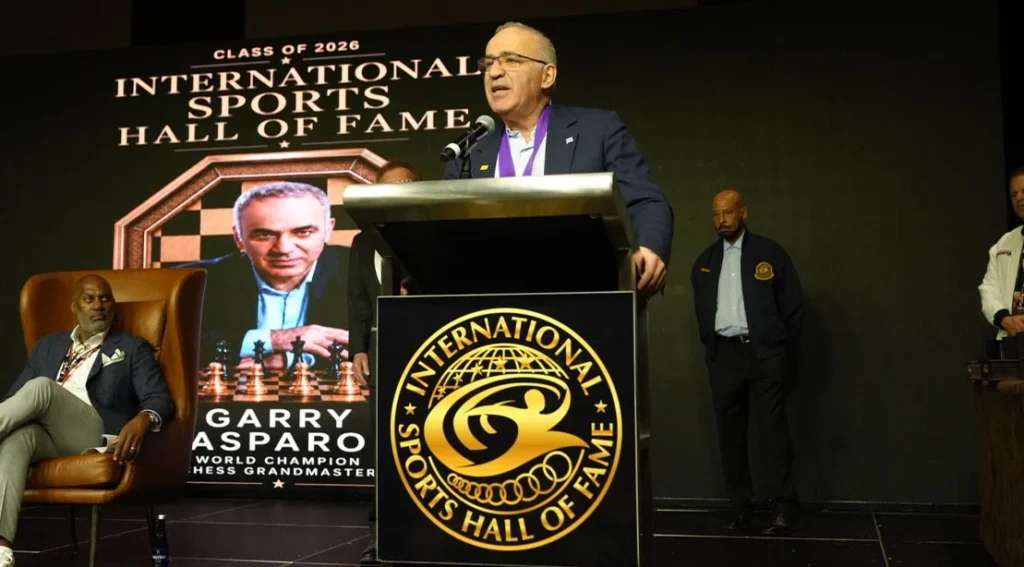


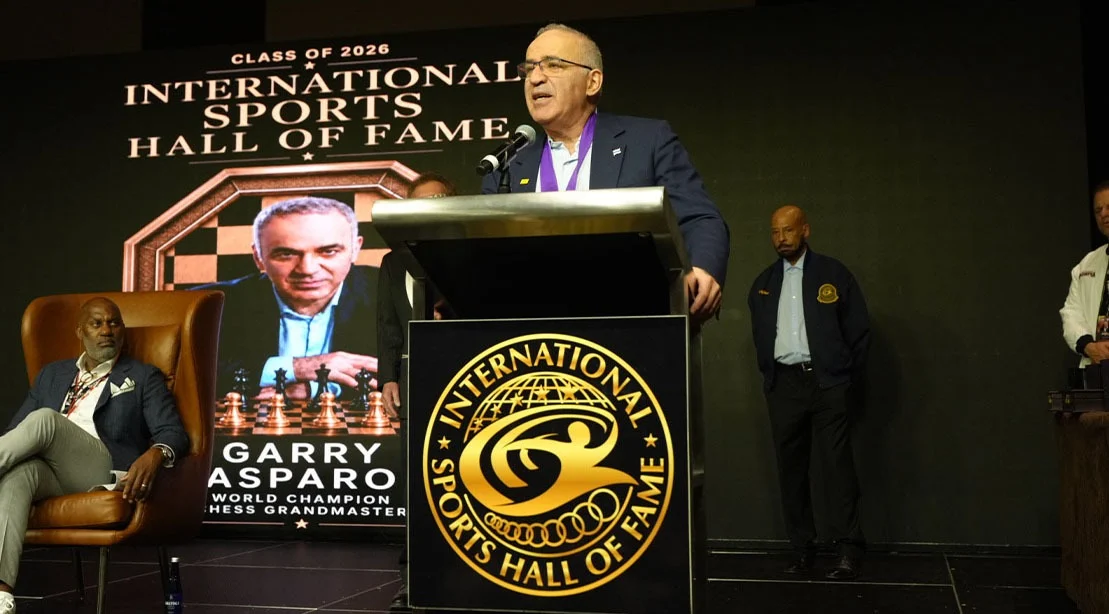
When the International Sports Hall of Fame welcomed its prestigious Class of 2026 on September 26th, the induction ceremony served as much more than a celebration of past athletic achievements and a fleeting moment at a microphone for chess legend Garry Kasparov. For the thirteenth World Chess Champion, the honor represented a definitive milestone in a decades-long cultural debate: officially cementing chess as a true sport.
Taking the podium alongside fellow 2026 inductees—including bodybuilding icon Dexter Jackson, mixed martial arts pioneer Forrest Griffin, martial artist Vitomir Maričić, and the legendary Harlem Globetrotters—Kasparov addressed the audience with characteristic eloquence, reflecting on the intersection of physical discipline and intellectual mastery.
"I also want to thank you for an important contribution that might help end this debate once and for all. Chess is, in fact, a sport," Kasparov declared during his acceptance speech, drawing appreciative applause from the crowd assembled in Las Vegas.
Jokingly acknowledging that his physical stature might not immediately bring to mind the chiseled physique of a Mr. Olympia winner like Dexter Jackson, Kasparov emphasized that true athletic competition extends far beyond raw physical exertion. He highlighted the intense mental components required in elite sports, competitions, and athletics, noting that when it comes to the ultimate mental game, chess stands unrivaled in its demands.
"Chess is in many ways the purest expression of the mental focus and fortitude necessary to achieve greatness in just about any other sport," Kasparov explained, bridging the gap between traditional athleticism and high-level cognitive competition.
Love and Dominance of the Game
The foundation of Kasparov’s historic career was laid during his early childhood in Baku, located in what was then the Soviet Union and is present-day Azerbaijan. Born in 1963 to parents who shared a deep appreciation for the game, young Garry was introduced to the rules of chess by his father. Tragically, his father passed away in a car accident when Garry was just seven years old. Despite the devastating loss, his mother remained fiercely dedicated to fostering his extraordinary potential, ultimately enrolling him in the renowned Baku Young Pioneer Palace chess circle.
By the age of ten, Kasparov’s prodigious talent caught the attention of the chess establishment, earning him admission into an elite, highly competitive chess school managed by former world champion Mikhail Botvinnik. Imbued with a phenomenal memory and a rare capacity to calculate deep, complex variations at astonishing speeds, Kasparov found an ideal mentor in Botvinnik. The legendary grandmaster helped guide the young prodigy along a trajectory that would soon alter the history of the game.
Just twelve years after entering Botvinnik’s academy, Kasparov reached the absolute summit of his profession. In 1985, at the remarkably young age of 22, he defeated reigning champion Anatoly Karpov to become the 13th Undisputed World Chess Champion.
"Karpov was still 34 at that time. So, I was quite young," Kasparov recalled during his ISHOF induction speech, reflecting on the monumental victory. "It convinced me that I could play a much bigger game."
Kasparov’s tenure at the top was characterized not merely by success, but by an unprecedented level of dominance. He held the official International Chess Federation (FIDE) World Championship title from 1985 to 1993, followed by the Classical World Championship title until 2000. Furthermore, he maintained the world No. 1 ranking uninterrupted from 1984 until his eventual retirement from professional competitive play in 2005. His peak FIDE rating of 2851, achieved in 1999, stood as the highest rating in chess history for more than a decade until Magnus Carlsen surpassed it in 2013.
Beyond his traditional dominance over human opponents, Kasparov proved to be a pioneer whose influence stretched far beyond the confines of the chessboard. Long before modern society began grappling with the sweeping ethical, professional, and cultural implications of artificial intelligence, Kasparov was on the front lines, testing the limits of human cognition against machine intelligence. His landmark matches against IBM’s supercomputer, Deep Blue, captivated the global imagination in the late 1990s. Kasparov won the initial six-game matchup in 1996 by a score of 4-2, before IBM returned with an upgraded machine that narrowly defeated him 3.5 to 2.5 in a highly publicized 1997 rematch.
While the matches generated intense media scrutiny and public debate, they served a broader purpose for Kasparov, sparking a deeper intellectual curiosity about computer science, technological advancement, and how human society could harness these emerging forces to make a lasting global impact.
His Noble Second Act
When Kasparov announced his retirement from competitive chess in 2005, he was still widely considered to be at the top of his game. However, he envisioned an even larger role for himself on the world stage, transitioning seamlessly from the chessboard to the complex and high-stakes arena of political activism. He quickly emerged as a vocal, uncompromising critic of Russian President Vladimir Putin and the shifting political landscape in his homeland. In 2008, Kasparov made a bold bid to run for President of Russia, an effort that was ultimately short-circuited when the government imposed restrictive measures, including denying him the ability to rent a hall large enough to assemble the legally required number of supporters for his nomination.
As one of Russia’s most prominent and visible dissidents, Kasparov faced severe repercussions for his outspoken opposition. He endured intense government surveillance, physical harassment, and multiple short-term detentions by Russian police during public street demonstrations. By 2013, facing the imminent threat of arrest within Russia, he made the difficult decision to leave his homeland. He relocated abroad, ultimately acquiring citizenship in Croatia—a move he described as becoming "a citizen of Europe."
"By 2015, my name had disappeared from Russian sport records," Kasparov noted, reflecting the extent to which the state sought to erase his legacy. Undeterred by the regime’s attempts to silence him, Kasparov expanded his international advocacy and eventually made his way to the United States. For him, the relocation represented much more than simply finding a new place to call home.
"So, I came to America and as millions and millions of people on the other side of the Iron Curtain, I viewed America as the beacon of hope," he explained.
Kasparov’s relentless criticism of the Kremlin continued unabated, leading the Russian government to officially designate him as a "foreign agent" in 2022. Despite the ongoing threats and official sanctions, his commitment to fostering democratic reform never wavered. From 2011 to 2024, he served as the Chairman of the Human Rights Foundation, an international nonprofit organization dedicated to defending human rights and supporting dissidents in authoritarian regimes across the globe.
In 2017, he further cemented his advocacy work by founding the Renew Democracy Initiative, an American nonprofit organization focused on strengthening and safeguarding liberal democratic institutions both within the United States and internationally. To this day, he remains actively involved in coordinating with the Russian anti-war opposition coalition in exile, fiercely opposing Putin’s regime and the ongoing invasion of Ukraine.
Giving Back to His Sport
Despite his heavy involvement in international politics and human rights advocacy, Kasparov has never severed his ties to the chess community that defined the first half of his public life. In recent years, his contributions to the sport have taken the form of tournament organization, youth mentorship, the promotion of chess variants, and participation in high-profile exhibition matches. He played an instrumental role in launching the Grand Chess Tour, an elite international circuit bringing together the world’s highest-ranking grandmasters. Furthermore, he remains an influential and outspoken commentator on modern world championship cycles and top-tier events, frequently offering sharp strategic analysis of contemporary players.
While he no longer participates in the grueling professional tournament circuit, Kasparov occasionally steps back into the competitive arena for specialized exhibition matches. Notable recent appearances include his 2025 clash with Viswanathan Anand and his 2026 match against his longtime rival Veselin Topalov. Through the Kasparov Chess Foundation, a nonprofit organization he established in 2002, he directs considerable energy toward chess education, grassroots youth programs, and the identification of elite young talent. The foundation hosts training camps, develops digital coaching platforms, and nurtures the next generation of international masters.
"Today, nearly every single American grandmaster, chess grandmaster under the age of 35 has come through the Foundation’s programs," Kasparov noted with pride.
During his induction speech at the International Sports Hall of Fame, Kasparov made a point to congratulate fellow Class of 2026 inductees Dexter Jackson, Forrest Griffin, Vitomir Maričić, and the Harlem Globetrotters. He concluded his remarks by expressing hope that the recognition he received in Las Vegas would resonate far beyond the walls of the ceremony, serving as another valuable platform in his ongoing mission to drive meaningful societal change.
"Thank you again for this honor, which will hopefully bring attention to our shared fight to renew and revitalize American democracy and ensure that it’s robust enough to meet the challenges of the new era," Kasparov concluded.
The full 2026 International Sports Hall of Fame Induction Ceremony is available to watch on YouTube, and further information regarding the organization and its annual inductees can be found at ishof.net.