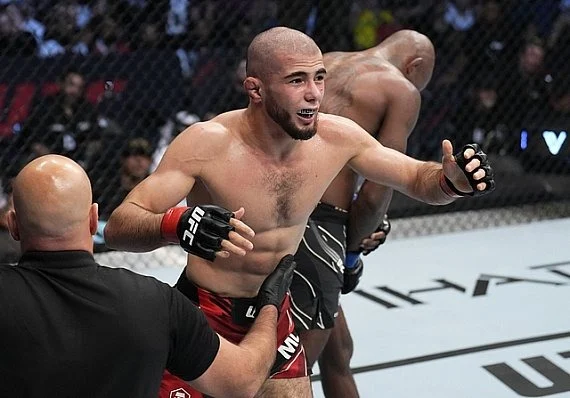
The Ultimate Fighting Championship (UFC) has increasingly found itself at the center of intense scrutiny from fans, media members, and fighters alike following a series of surprising roster decisions. In recent months, the world’s premier mixed martial arts organization has faced widespread criticism for declining to renew the contracts of high-profile athletes, particularly those currently riding impressive winning streaks. While many observers have naturally directed their frustrations toward UFC CEO Dana White, former promotional standout Muhammad Mokaev believes that the true decision-making power lies elsewhere, shifting the blame directly onto the organization’s corporate ownership and broadcast partners.
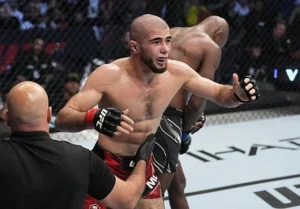
Mokaev, who famously exited the promotion under remarkably similar circumstances despite maintaining an unblemished record inside the Octagon, recently stepped into the public discourse to address the sudden departure of another undefeated fighter. According to the outspoken flyweight, the ongoing trend of letting go of elite talent is not merely a reflection of White’s personal preferences or traditional matchmaker grievances, but rather the result of overarching corporate directives stemming from TKO Group Holdings and media giant Paramount.
Muhammad Mokaev Rejects Dana White’s Explanation After Farid Basharat’s UFC Departure
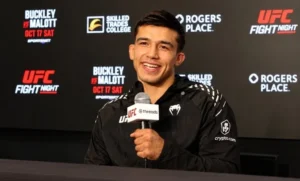
The debate over the UFC’s contract renewal policies reignited following the unexpected departure of bantamweight prospect Farid Basharat. Despite putting together a flawless 7-0 promotional record and establishing himself as one of the most promising talents in the 135-pound division, Basharat was quietly allowed to part ways with the organization after failing to secure a new deal. The situation closely mirrors the trajectory of veteran star Michael Page, who also found himself without a contract renewal despite carving out a strong 5-1 record inside the Octagon.
When questioned about Basharat’s departure during the post-fight news conference following UFC Edmonton, Dana White offered a measured explanation. Without explicitly referencing Basharat by name, the UFC CEO suggested that a variety of internal factors could lead to an unbeaten fighter not being re-signed. White pointed to potential logistical difficulties, complications working with the organization’s matchmakers, or instances where fighters had previously declined specific matchups as primary reasons why the promotion might choose to move on from a talent, regardless of their winning streak.
However, these explanations failed to satisfy Muhammad Mokaev, who immediately rejected White’s narrative and took to social media to voice his skepticism. Having experienced firsthand the abrupt end of a promising UFC career, Mokaev argued that the standard excuses provided by management do not accurately reflect the reality of how modern roster decisions are being handled behind closed doors. Instead of placing the responsibility on White, Mokaev asserted that the corporate entities pulling the strings are the ones driving elite fighters out of the promotion.
"They can’t give a reason. Only thing they gotta say is ‘the matchmakers can’t deal with him.’ Total bullsh*t answer. Still I don’t blame Dana, I blame Paramount and TKO," Mokaev wrote in a post shared on X, formerly known as Twitter.
The commentary highlights a growing friction between fighters and the corporate governance of modern mixed martial arts. Mokaev’s own departure from the UFC remains a prominent example of the complicated dynamics at play when high-level athletes reach the end of their introductory or exclusive contracts. Mokaev officially completed his previous UFC contract in July 2024, securing a hard-fought unanimous decision victory over elite flyweight contender Manel Kape at UFC 304 in Manchester.
That victory elevated Mokaev’s promotional record to a pristine 7-0, positioning him as a top-tier contender on the cusp of a world title opportunity in the 125-pound weight class. Yet, despite his undefeated status and clear athletic credentials, the promotion ultimately decided against offering him a contract extension. At the time of his departure, White hinted at behind-the-scenes issues that contributed to the decision not to re-sign the young contender, while Mokaev publicly revealed that company matchmakers had previously cautioned him about his grappling-heavy fighting style, which some executives and broadcast partners worry may not always translate into the kind of high-octane striking entertainment preferred for mainstream television broadcasts.
Mokaev’s decision to publicly absolve Dana White while holding TKO and Paramount accountable brings a unique perspective to the ongoing dialogue surrounding fighter contracts and television rights integration. As the sports landscape continues to evolve under major corporate conglomerates and multi-platform media broadcasting deals, fighters like Mokaev, Michael Page, and Farid Basharat find themselves navigating a complex business environment where athletic excellence inside the cage is no longer the sole guarantee of a continued career under the sport’s most visible banner.