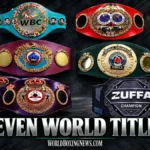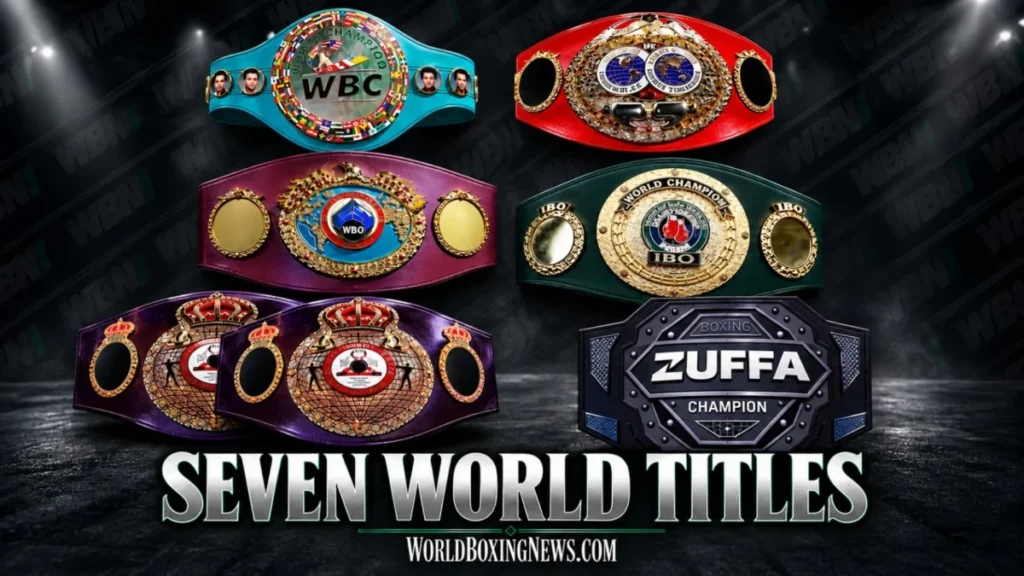


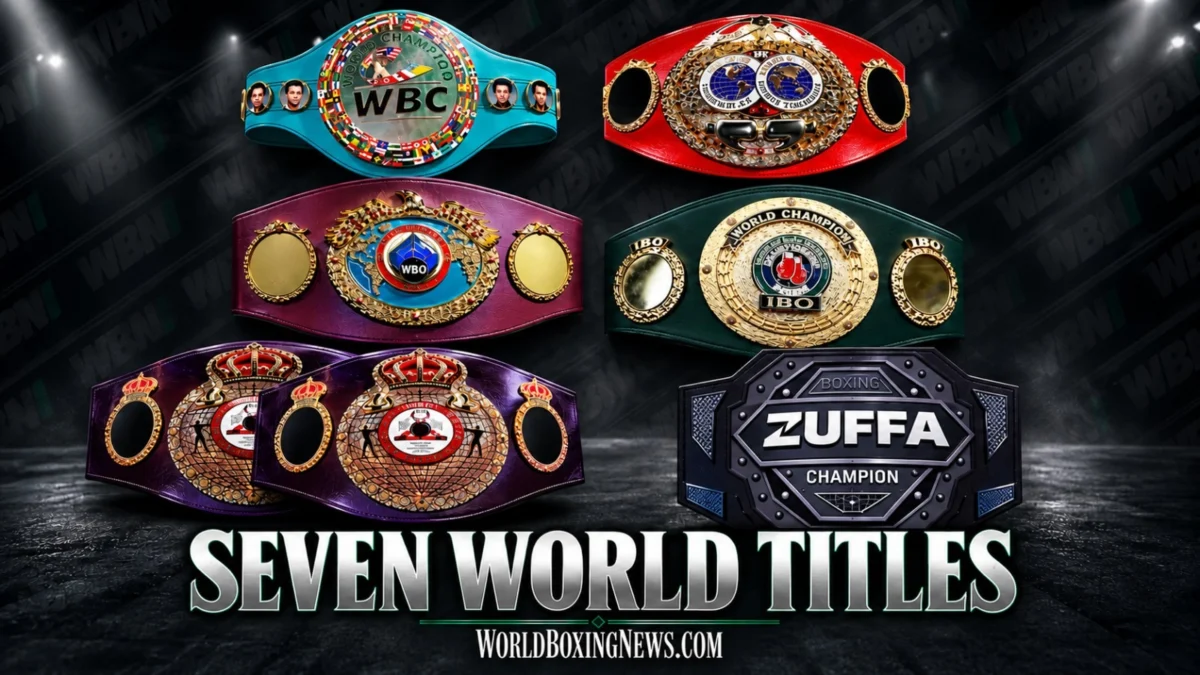
The landscape of professional boxing is once again facing familiar questions regarding promotional language and world championship integrity. Matchroom Boxing and Dana White’s Zuffa Boxing are slowly pushing the sport toward an era of seven distinct world championship titles, muddying the waters for fighters, media, and fans alike. This growing trend centers on the continued elevation of secondary and promotional belts to the status of recognized global championships, a practice that risks further diluting the prestige of the sport’s traditional crown jewels.
The latest flashpoint in this ongoing debate arrived on October 16, when Eddie Hearn’s Matchroom Boxing officially announced an upcoming bout between rising British star George Liddard and veteran Michel Soro. The pair are scheduled to square off for the IBO middleweight title in Monaco on December 12. From the outset, the promotional push framed the stakes in grand terms. The official press release boldly declared that the undefeated Liddard would be challenging for his "first World Title" on one of the most prestigious nights of the boxing calendar.
Furthermore, Soro was described in promotional materials as having reclaimed a world title earlier this year in June, while Liddard’s trajectory was characterized as being on the immediate brink of global honors. Notably, at no point throughout the announcement did Matchroom distinguish the International Boxing Organization (IBO) championship from the four major world titles traditionally recognized across the sport through the World Boxing Association (WBA), World Boxing Council (WBC), International Boxing Federation (IBF), and World Boxing Organization (WBO).
Matchroom’s Longstanding IBO Recognition
This is not a new battleground for boxing journalists or promoters. World Boxing News previously raised this exact promotional issue with Eddie Hearn five years ago during a similar wave of IBO-centric announcements. That particular debate followed Maxi Hughes capturing the IBO lightweight championship and subsequently signing a promotional pact with Matchroom. At the time, Hearn famously described the achievement simply as picking up "a piece of the 135lbs division," even as other champions within the weight class balked at the framing.
The confusion sparked public pushback from rival fighters who guarded the exclusivity of the traditional major titles. Former IBF champion Sunny Edwards famously took to public forums at the time to voice his bewilderment, pointedly asking what was driving the sudden obsession with IBO titles appearing consistently on Matchroom fight cards.
Five years later, however, Matchroom’s operational approach remains entirely unchanged. The IBO has undoubtedly operated as a legitimate sanctioning body for decades, and its champions consistently demonstrate elite skill, dedication, and sportsmanship inside the ring, deserving full credit for their hard-fought achievements. Yet, despite its longevity, the organization has never genuinely attained the historical standing, universal recognition, or institutional prestige commanded by the four established major sanctioning bodies.
Indeed, there was a time in the not-too-distant past when Anthony Joshua reigned supreme as a unified heavyweight ruler holding the WBO, WBA, IBF, and IBO belts, yet promotional press releases during his peak years occasionally glossed over the IBO entirely, referring to the core four as the definitive markers of undisputed supremacy.
Zuffa Enters the Fray and Makes It Seven
The modern championship puzzle has become significantly more complicated with the arrival of Dana White’s Zuffa Boxing. The entrance of the mixed martial arts giant into the sweet science brought an entirely new layer of promotional maneuvering to the table.
White introduced a proprietary championship system earlier this year, crowning Jai Opetaia as the promotion’s inaugural cruiserweight champion after he defeated Brandon Glanton in a high-stakes encounter in March. Zuffa’s newly minted belt operates entirely outside the traditional sanctioning structure governed by historical committees, yet the promotion continues to present it aggressively to the public and media as a bonafide world championship.
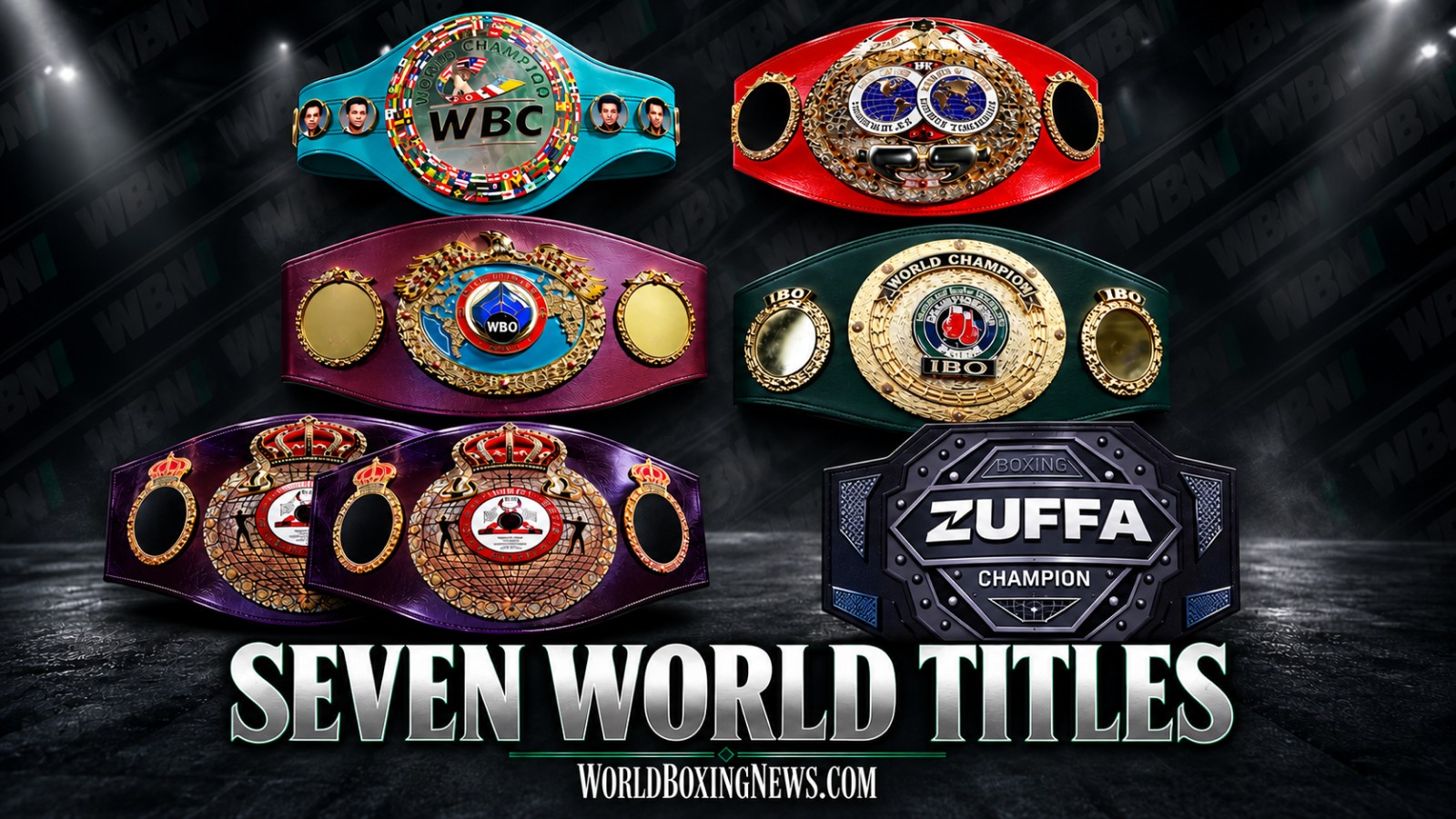
However, to his credit, White has since refrained from rapidly proliferating further Zuffa-branded belts across other weight classes and has even begun recognizing traditional sanctioning bodies in what represents a notable U-turn for the promotional newcomer. Past industry analysis from World Boxing News also highlighted unique anomalies like a special Promotional Board belt displayed during Sebastian Fundora’s high-profile fight week against Keith Thurman, though that particular piece of hardware ultimately appeared purely ceremonial and failed to blossom into a standalone recognized championship.
Meanwhile, The Ring magazine championship continues to function as an independent historical recognition system rather than operating as an active sanctioning body. This leaves the four established major organizations, the IBO, the WBA Regular tier, and Zuffa’s recent venture sitting squarely at the center of the current debate over how many true world titles actually exist in modern boxing.
The Complications of the WBA Regular World Title
The waters are further muddied by the existence of the WBA Regular world championship. Because this title originates from one of boxing’s four traditional major sanctioning bodies, it carries a unique institutional weight, yet it simultaneously creates internal division within the sport.
For years, the WBA has operated with multiple titleholders in single weight classes, creating a distinction between its primary Super champion and its secondary Regular champion. This administrative reality means the WBA can mathematically endorse two separate fighters holding belts explicitly described as world championships within the exact same weight division. Despite this marketing, the Regular title is rarely, if ever, treated as a mandatory requirement when determining an undisputed champion in an era where boxing purists demand all four major governing body belts for ultimate supremacy.
The IBO creates a structurally identical problem to the WBA Regular title. Fighters who capture either belt are enthusiastically presented to the public as world champions, even though neither championship carries the universal institutional recognition of the traditional major quartet.
This semantic nuance does nothing to diminish the athletic accomplishments of fighters like George Liddard. The unbeaten British middleweight has worked diligently to earn his upcoming opportunity against a seasoned test in Michel Soro, and capturing the IBO belt would undoubtedly mark another significant milestone in his professional development. However, acknowledging a fighter’s talent and hard work does not automatically elevate the promotional status of the championship on the line to the level of the four major governing bodies.
Five Years of Unresolved Title Confusion
The core architecture of professional boxing remains anchored by the four major organizations, which dictate the undisputed championship landscape and provide the historical lineage that defines legendary eras. That official structure has not expanded through formal consensus, yet Matchroom’s promotional language, the WBA’s persistent secondary titles, and Zuffa’s introduction of a corporate championship belt have quietly smuggled three additional world-title designations into everyday conversation.
Five years after industry watchdogs first challenged promoters over the blurred lines surrounding the IBO and WBA Regular titles, the exact same promotional playbook remains firmly in place. The crucial difference today is that boxing now has Zuffa adding a completely new belt to an administrative problem the sport had already failed to solve. If seasoned media professionals and ringside observers find it increasingly difficult to keep track of who holds what, it is little wonder that the viewing public is left struggling to navigate the modern alphabet soup of boxing championships.