

Three of my greatest joys in life are watching sport, going to the theatre, and playing the violin. Consequently, it felt almost embarrassing to discover a classic play that seamlessly combined all three, despite never having heard of it before. To be fair, Clifford Odets’s Golden Boy has not been performed in the United Kingdom in more than 40 years, and its curious premise may be one of the primary reasons for its long absence from British stages.
Written in 1937, the play centers on a gifted young violinist in Depression-era America who discovers he also possesses a natural talent for boxing. He is ultimately lured away from his music by the intoxicating pursuit of fame and money inside the squared circle. In the current London production, the protagonist is brought to life by Josh O’Connor, whom fans of the Knives Out franchise will recognize with his fists up as a boxer turned priest in Wake Up Dead Man.
O’Connor is no less convincing on stage than he is on film, attacking a heavy bag with the kind of raw power that genuinely makes an audience worry for his precious, musician’s hands. Nor is that impressive physical definition entirely the work of a theatrical makeup artist.
A drama concerning a fatal choice between a future as a struggling, impoverished musician or a stone-cold killer may seem unlikely, perhaps even pushing toward the point of absurdity. Yet, inside the theatre, it felt entirely grounded. For a start, playwright Clifford Odets, one of the foundational and most vital voices of American theatre, was directly reflecting a historical moment when New York life was desperately bleak. Opportunities were scarce, and boxing presented a shimmering mirage of escape from grinding poverty.
Equally, it was abundantly clear that the audience was watching a powerful allegory. As the hero finds his footing inside the ropes, he progressively loses his more tender self and forfeits the chance of achieving a quieter, more sustainable contentment.
Boxing has forever provided rich, fertile material for stories on both stage and screen. Indeed, there are more Hollywood movies dedicated to boxing than to any other single sport. Writers, directors, and performers are endlessly drawn to the discipline, despite the common thematic belief—as highlighted in Odets’s play—that an artistic nature stands in direct opposition to physical violence.

Perhaps part of the enduring appeal is the way a fighter inside the ring closely resembles the protagonist in a classic Greek tragedy. They are human figures stripped down to their absolute rawest state, forced to face their destiny while learning the strict limits of their own autonomy. Alternatively, the attraction may lie in the inherent performance potential of the choreographed ballet across the canvas, where human bodies duck, dodge, dance, and explosively collide in a brutal display of athleticism.
Whatever the underlying reason, it appears that a storyteller can load a boxing narrative with any conceivable amount and variety of subtext, psychodrama, or heavyweight themes. Thus, it is entirely possible to have an Odets play set in the grim, exploitative fight world of the 1930s that functions as an excoriating critique of capitalism and the dark dangers of the American Dream, while simultaneously producing works like Ron Howard’s Cinderella Man. The 2005 film, in which Russell Crowe portrays the real-life heavyweight champion James J. Braddock during his legendary title fight against Max Baer, manages to transform that exact same gritty environment into a feel-good fairytale of muscular Christianity.
What is it about the fight game’s complex, often deeply ambivalent ethics that keeps dramatists continually returning to the well? Alfred Hitchcock, that undisputed master not just of cinematic suspense but of profound moral ambiguity, loved boxing. His only self-penned film, The Ring, was released 99 years ago this month. It is a silent black-and-white picture from an era where women wore cloche hats and circular eyeliner, and actors’ limbs leap jankily about between frames.
Yet, the film remains remarkably notable for its realistic fight scenes—the lead actor, Carl Brisson, had previously been a Danish and European champion—and for the director’s pioneering use of point-of-view camerawork to visually demonstrate a fighter sliding into a dangerous concussion.
Hitchcock’s protagonist was a wannabe adulterer, but by the 1940s, a slew of gritty film noir features found the boxing world to be an ideal backdrop for dark tales of vice and viciousness, yielding classics such as Body and Soul, Champion, and The Set-Up. Stanley Kubrick’s second feature-length film, Killer’s Kiss, belongs squarely to the same tradition, and the tagline on its original promotional poster certainly pulled no punches: "Her Soft Mouth Was The Road to Sin-Smeared Violence!"
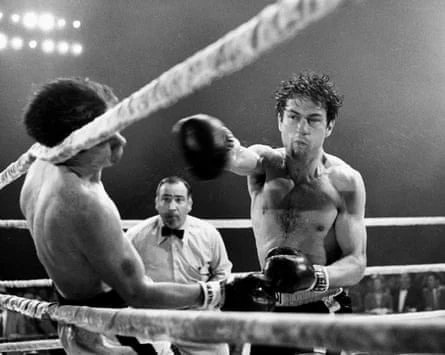
Then, of course, there is Martin Scorsese. His masterpiece Raging Bull, generally considered the absolute acme of boxing cinema, remains a brutal watch today. It portrays its real-life subject, Jake LaMotta, as an abusive, pathological antihero. Interestingly, Scorsese had initially been reluctant to make the film; it was his close friend Robert De Niro who was profoundly fascinated by LaMotta’s self-destructive story and the extreme physical transformation he would have to undergo to authentically tell it on screen.
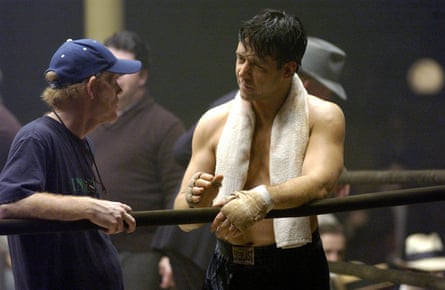
Within that artistic ambition lies a massive part of boxing’s longevity in drama: the ultimate challenge it presents to performers. It is nearly impossible to genuinely fake a professional boxer’s physique, especially under the unforgiving scrutiny of the cinema screen. Major stars like Daniel Day-Lewis, Jake Gyllenhaal, Will Smith, and Hilary Swank have all happily put themselves through grueling months of training hell and daily sparring to prove their absolute commitment to authenticity.
Mark Wahlberg, a noted boxing fanatic, even had a regulation ring built inside his own home and honed his pugilistic craft for five years before shooting The Fighter. One certainly has to feel a twinge of sympathy for Wahlberg that it was his co-star, Christian Bale, who ultimately walked away with the Academy Award.
Michael B. Jordan, the star of the lucrative Creed franchise, has described the process of making those films as akin to therapy, precisely because he gets to immerse himself so completely in the demanding role. "I like living like a fighter, training like a fighter," he has noted, detailing the physical toll of the work. "I’ve broken my hand a few times doing this movie. Hands swollen. Like, I wanna feel it. I want to go home and ache." Meanwhile, Sylvester Stallone’s massive contributions to the cinematic legacy of boxing have even earned him a permanent place in the International Boxing Hall of Fame.
If further proof were needed of just how circular the relationship has become between the sport and its fictional depictions, one need look no further than Stallone’s own trajectory. His 1976 script for Rocky was famously inspired by the gritty heavyweight bout between Chuck Wepner and Muhammad Ali the year prior. Decades later, in 2016, Liev Schreiber portrayed Wepner in the arthouse biopic The Bleeder.
The extraordinary truth remains that even as boxing’s direct cultural and commercial popularity has experienced a decline in the modern era, its emotional and dramatic appeal to audiences at one remove has never once wavered.